
My name is Caroline Mercer, and for a long time I believed I was a good neighbor.
I waved when I drove past Walt’s place. I brought banana bread twice in ten years. I called the sheriff once when something looked off. From a distance, I did just enough to feel like I cared.
Up close, I did nothing.
Walt lived three houses down, which in our part of the county meant nearly half a mile of fields and trees between us. He was ninety, a Korean War veteran, a widower for three decades, and a man who wore pride like a pressed shirt—quiet, firm, never wrinkled.
He never asked for help.
That made it easier to ignore that he needed it.
After his wife Eleanor died, the house started fading the way lonely places do. First the porch rail loosened. Then the paint peeled. The garden she had kept perfect for forty years turned into weeds. Every spring Walt bought seeds. Every summer he planted fewer. Every fall he apologized to flowers that never stood a chance.
We all noticed.
We just never showed up.
Then one afternoon, I saw him on a ladder.
Ninety years old, one bad hip, one hand gripping a failing rail, the other holding a paint scraper like it weighed ten pounds. His foot slipped for a second—just a second—but the way he froze afterward, pretending nothing happened, hit me harder than any fall would have.
That was the moment I stopped lying to myself.
I called my nephew Ryan.
He rode with a biker club called the Iron Table Riders.
“Do bikers paint houses?” I asked.
He laughed at first.
Then I told him about Walt.
The laughter stopped.
“Let me talk to Preacher,” he said.
Preacher showed up the next day. Alone. No noise, no show.
Just a man on a Harley who walked up Walt’s driveway like he belonged anywhere people needed something fixed.
Walt met him on the porch.
“I didn’t order anything,” Walt said.
Preacher nodded. “Yes, sir.”
“You selling something?”
“No, sir.”
“You lost?”
“Probably. Just not today.”
That almost earned a smile.
When Preacher mentioned painting the house, Walt shut down immediately.
“It’s my house.”
“Yes, sir.”
“I take care of my own.”
“I believe you.”
“Then why are you here?”
Preacher looked at him—not around him, not past him—at him.
“Because some jobs go faster with a crew.”
“I don’t take charity.”
“We don’t give charity,” Preacher said calmly. Then he tapped the veteran patch on his vest. “We call it maintenance.”
That word changed everything.
Not all at once.
But enough.
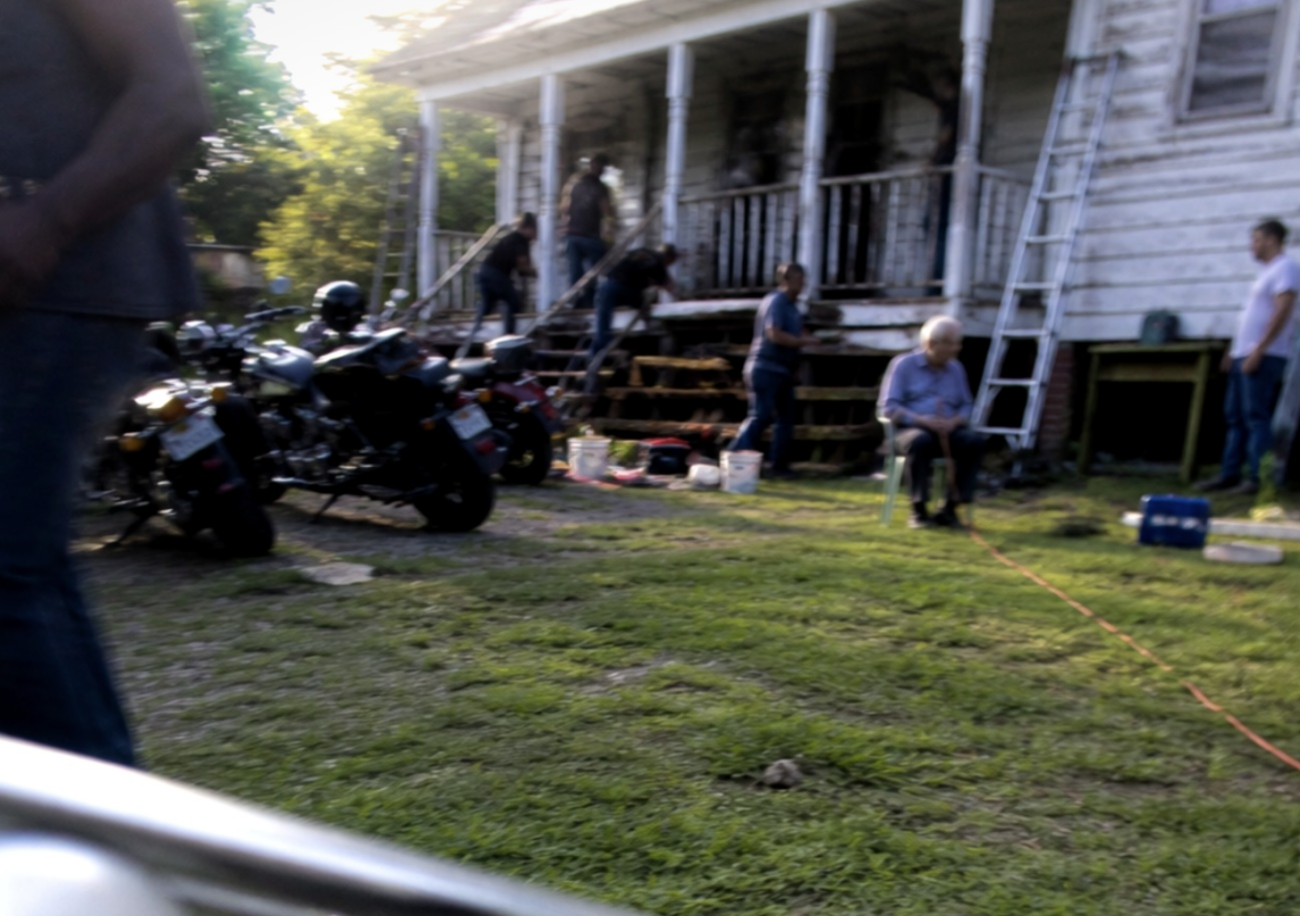
By Saturday morning, they came.
No roaring engines. No spectacle. Just work.
They scraped, sanded, repaired. Fixed what Walt couldn’t admit was broken. Protected what mattered—like the carved initials on the porch rail: E + W, 1954.
Walt tried to help.
Twice.
Preacher handed him a chair both times.
“I outrank you in stubborn,” he said.
“I was a corporal.”
“I was a medic. I outrank bleeding.”
Walt sat down.
By midday, the house looked worse—half-stripped, exposed, unfinished. Walt’s jaw tightened like maybe we’d made a mistake.
Then music started playing inside.
Old jazz. Soft. Familiar.
“Duke Ellington,” Walt called out, defensive.
“Yes, sir,” Preacher said.
“You boys know music?”
“I know Skynyrd!” someone yelled.
“That ain’t music,” Walt snapped. “That’s a truck accident with lyrics.”
And just like that—
he laughed.
Not much.
But enough.
By sunset, the house stood whole again.
Fresh paint. Strong steps. Clean lines. A place that looked like someone lived there.
Preacher knocked on the door.
“You want to see it?”
Walt stepped out.
He looked at everything.
And then he cried.
We thought it was about the house.
It wasn’t.
“It’s been thirty years,” he said quietly.
“Since what?” Preacher asked.
“Since anyone came… and stayed.”
That was the truth none of us wanted to face.
People hadn’t been cruel to Walt.
They had just been busy.
And busy can feel the same as abandoned when you’re alone long enough.
Then came the part none of us knew.
The room at the end of the hall.
Daniel’s room.
Walt’s son.
The name that used to be under his on the mailbox.
He died in 1989. Motorcycle accident. Twenty-six years old.
The last thing Walt ever said to him was angry.
The apology never came.
And for thirty-five years, that room stayed closed.
That day, it didn’t.
Preacher stepped inside like it was sacred ground.
“I’ve got a son who rides,” he said.
Walt nodded slowly.
“I hated motorcycles,” he admitted. “Every one of them.”
No one argued.
That’s why he kept talking.
Because no one tried to fix his grief.
They just stood there with him.
Outside, the work had ended.
But the real reason they came hadn’t.
They didn’t disappear after that day.
That’s what made it different.
They came back.
Not to fix anything.
Just to be there.
Coffee on Thursdays.
Lawn mowed.
Stories shared.
A radio replaced.
A mailbox repainted—with both names this time.
W. GRAYSON
D. GRAYSON
Walt complained the letters weren’t straight.
They were.
He just needed to say something.
The house changed.
Not because of paint.
Because it sounded alive again.
Boots on the porch.
Voices in the evening.
A screen door opening.
A screen door closing.
Then one night, Preacher brought something from the barn.
An old white motorcycle helmet.
Daniel’s.
Walt held it like it might break.
“I threw this away,” he whispered.
“No,” Preacher said. “You saved it.”
From then on, every Thursday, they sat together as the sun went down.
Sometimes talking.
Sometimes not.
Both counted.
That fall, the Iron Table Riders changed their annual memorial ride.
They started at Walt’s house.
Forty-two bikes.
Engines low. Respectful.
Not loud.
Not for show.
For memory.
Walt stood on the porch in his old cap, cane in hand.
Daniel’s helmet beside him.
“You ready, Corporal?” Preacher asked.
“I’m not riding,” Walt said.
Preacher smiled. “No, sir. We are.”
Walt understood.
As the bikes rolled past, one by one, he raised his hand.
Not quite a salute.
Not quite a wave.
Something deeper.
For the first time in decades, he wasn’t just remembering his son.
He was sending him off.
And behind him, the porch light was still on.
Even though the sun had already risen.
No one told him to turn it off.
Because some lights—
you don’t rush to shut down.