
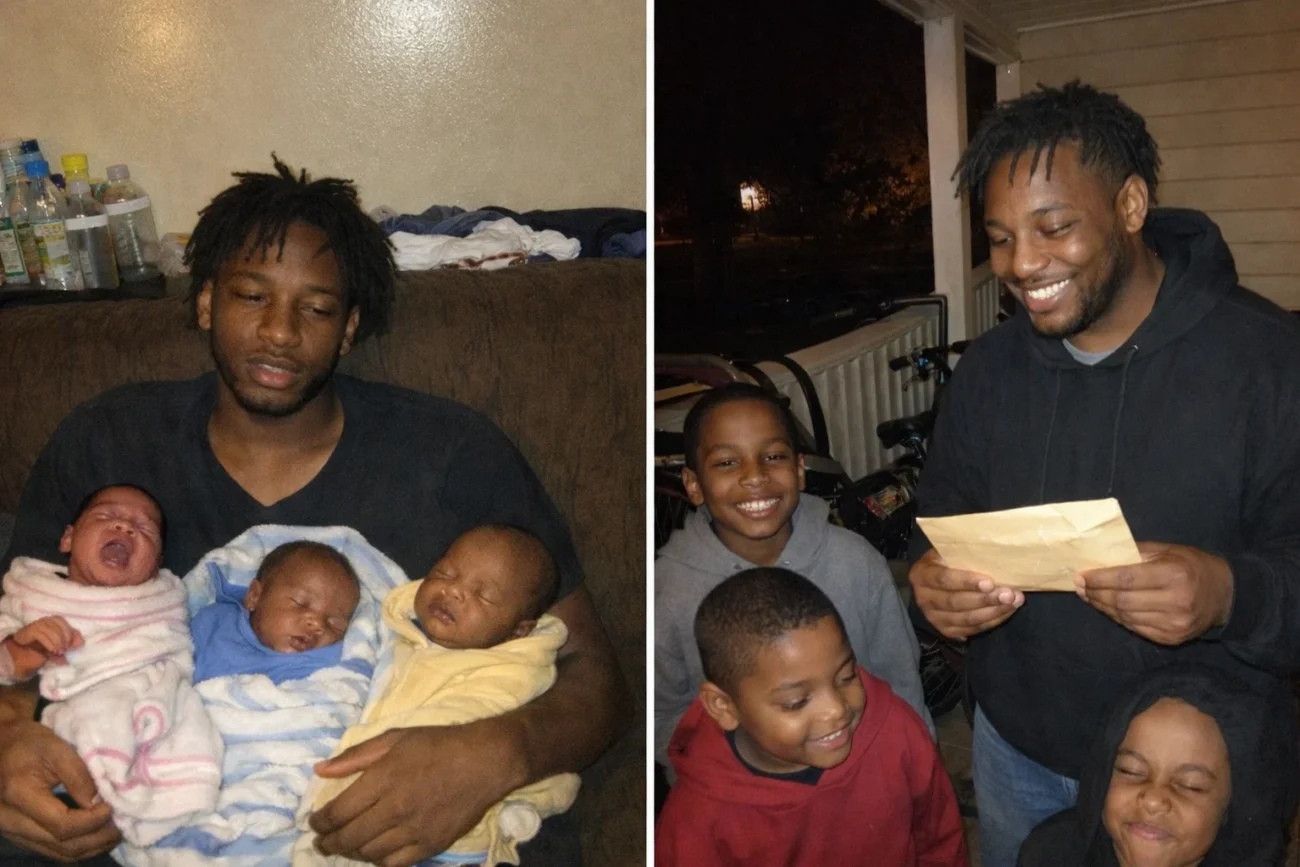
When Cade’s mother died, she left behind three newborn boys.
Triplets.
Three tiny lives that had barely learned how to breathe on their own. They still smelled like hospital blankets and antiseptic plastic bassinets.
And suddenly, they were his responsibility.
Cade was only eighteen.
Now he is twenty-nine, but the moment everything changed is still carved into his memory with brutal clarity.
Their father had always been around just long enough to cause damage.
Never long enough to be a father.
When Cade was a teenager, his father treated him like a joke in front of anyone who would listen. Cade dressed in black, listened to music his father didn’t understand, sometimes painted his nails.
That was enough to make him a target.
“What are you, a goth?” his father once shouted across the living room, pointing at Cade’s hoodie.
Cade stayed quiet.
“Not a son,” the man laughed, leaning back in his chair.
“A shadow.”
His mother always stepped in.
“That’s enough, James,” she would say sharply. “He is your son.”
His father would shrug and grin like it was all harmless teasing.
“I’m just messing with him. Relax.”
But Cade knew the pattern.
His father needed someone to tear down in order to feel bigger. And Cade had become the easiest target.
His mother, quietly and fiercely, had always been the one building the wall around him.
Then she got pregnant.
The day they learned it would be triplets, the doctor stared at the ultrasound longer than usual.
Finally he cleared his throat.
“Triplets.”
Cade remembered the way his mother’s eyes widened. The way the color drained from her face. The way she instinctively looked toward her husband.
But James had already turned and was walking toward the door.
That was the first time he disappeared.
At first, the excuses were simple.
Late nights at work. Errands. “Things to handle.”
Then the absences grew longer.
Cade helped his mother keep the house together. She tried not to show it, but the idea of raising triplets terrified her.
She was happy. But she was scared too.
Then she got sick.
At first the doctors called it exhaustion.
Then they started using the word complications.
Eventually the doctor closed the door to the exam room and sat down before speaking.
Cade remembered feeling like the floor had dropped out from under him.
His mother just listened quietly, nodding.
As if she already knew.
Not long after that appointment, their father disappeared for good.
No argument.
No explanation.
One day he simply never came home.
One evening, his mother called Cade into her bedroom.
Her voice was gentle but tired.
“Cade… he’s not coming back.”
Cade waited for anger to rise inside him. Or grief. Or something loud enough to match the moment.
But instead he felt… empty.
The triplets arrived early.
They were so small they looked unreal, lying inside incubators in the NICU. Wires everywhere. Machines breathing for them.
Their mother stood beside those incubators for hours every day.
Watching them.
Memorizing them.
Their father never visited the hospital.
He never called.
Never asked how they were doing.
A year later, Cade buried his mother.
The funeral was quiet. Smaller than it should have been.
Cade kept glancing at the back doors of the chapel, half expecting his father to appear at the last moment.
He never did.
That same week, social services came to the house.
“You’re not obligated to take care of them,” one of the workers told him carefully.
“You’re only eighteen. You still have your whole life ahead of you.”
Cade looked past them into the spare bedroom.
Three cribs stood in a row.
Three sleeping babies.
“But I can,” he said.
The workers exchanged a glance.
Finally one of them nodded.
“Okay. Then we’ll do this together.”
Cade grew up overnight.
Not in the heroic way movies like to portray.
There was no triumphant montage.
Just exhaustion.
Night feedings. Low-wage jobs during the day. Online classes on his phone while holding a bottle with one arm.
There was one night he still remembers clearly.
Three in the morning.
One of the babies screaming.
Cade sitting on the kitchen floor, too tired to remember if he had eaten that day.
He leaned down and whispered into the child’s tiny hair.
“I don’t know what I’m doing.”
The baby eventually fell asleep anyway.
The boys trusted him.
Even when he didn’t trust himself.
And every day, Cade chose them again.
Eleven years passed like that.
Soccer practices. Flu shots. School projects. Saving every dollar he could.
Then one evening, there was a knock at the door.
When Cade opened it, the man standing there looked like a ghost from another life.
Older. Worn down.
But unmistakably his father.
He said Cade’s name like he still had the right to.
“Cade… I’m their father. I want to explain. Your mom made me promise something.”
He held out an envelope.
It was thick.
Old.
Sealed with yellowed tape that had clearly been sitting somewhere for years.
Cade took it slowly.
His hands were shaking.
He didn’t want his father inside the house, but he also didn’t want the neighbors watching the scene unfold on the porch.
So he stepped aside.
The man walked in awkwardly, glancing around the living room.
Photos of the boys covered the walls.
“They look… good,” he muttered.
Cade didn’t respond.
“What’s in the envelope?”
“You should read it,” his father said.
Cade carefully peeled back the brittle tape.
Inside were legal documents and a letter.
He recognized his mother’s handwriting immediately.
The letter was addressed to James.
I’m sick, she had written.
And I don’t think I’m going to make it.
She explained that she had placed the inheritance from her grandmother into a trust for the triplets.
The money could only be used for their care and future.
And it could only be accessed by their legal guardian.
At the end of the letter, she wrote something that made Cade’s chest tighten.
You walked away from us, but these boys will need you after I’m gone.
Please take care of our children.
Cade folded the letter slowly.
“She knew the only way you might even consider taking them was if money was involved,” he said quietly.
“And even then… you still left.”
His father flinched.
“That’s not—”
“It is,” Cade snapped.
“She literally tried to bribe you to be a father.”
His father rubbed his face with both hands.
“I tried to do better, Cade. It just took me longer than it should have.”
“Eleven years?” Cade said.
“What made you come back now?”
His father gestured toward the envelope.
“The trust.”
“I wanted to make sure you knew about it.”
Cade stared at him.
“What do you really want?”
There it was.
That familiar look Cade remembered from childhood.
Calculation.
“I’m not asking for all of it,” the man said quietly.
“Just some. I’m sick, Cade. Really sick. Medical bills… I just thought maybe—”
Cade almost laughed.
“Even if I wanted to, I can’t give you a cent.”
His father blinked.
“But you’re their guardian.”
“The trust can only be used for them,” Cade replied.
“And I’m not giving their future to a man who abandoned them in diapers.”
The man took a step closer.
“Wouldn’t it actually be better for them if I was… handled?”
Cade felt something cold settle inside him.
“You’re asking me to pay you to stay away,” he said slowly.
His father nodded.
“When you put it like that… yes.”
For a moment, Cade just stared at him.
All those years he had spent wondering where his father was.
Why he left.
What kind of man he had become.
The answer was standing right in front of him.
He wasn’t a mystery.
He wasn’t even a monster.
Just a small, selfish man looking for an easy way out.
“You know what’s wild?” Cade said quietly.
“When you knocked on that door, I actually thought maybe you came back because you wanted to know how we were doing.”
His father opened his mouth to respond.
But Cade was already walking toward the door.
He opened it wide.
“You can’t have the money,” he said.
“And you don’t get to rewrite this story.”
“You left because you were selfish.”
“And you came back because you’re greedy.”
The man hesitated on the porch.
“So that’s it? You’re just kicking me out?”
Cade met his eyes.
“Because of everything.”
For a moment, his father looked back into the house.
The warm lights.
The photos of the boys.
Maybe he thought Cade would soften.
But the boy he used to bully was gone.
Cade wasn’t a shadow anymore.
He was the one holding the walls up.
Finally, the man turned and walked down the steps.
Cade watched him disappear into the darkness.
Then he closed the door.
And locked it.
Later that night, after making sure the boys were asleep, Cade brought the envelope into the kitchen.
He didn’t burn it.
He didn’t throw it away.
The trust papers might help the boys one day when they start thinking about college.
So he placed them carefully into a folder.
Then he walked over to the small metal lockbox where he keeps the important things.
Birth certificates.
School records.
The deed to the house.
He placed the envelope on top.
One more thing he would protect until the boys were old enough to understand the truth.
Because one day they deserved to know two things.
Who stayed when life got hard.
And who came back asking to be paid just to stay away.
Note: This story is presented as a narrative inspired by real-life experiences. Names and some details may have been changed for storytelling purposes.