When the judge signed the final adoption papers last month, the courtroom was packed with leather vests and tear-streaked faces.
Two construction workers in their fifties stood at the front, holding hands with four children who refused to stand apart from one another.
Eighteen months earlier, none of them had been a family.
The Call That Started It
Tommy remembers the phone ringing at the clubhouse late on a Sunday afternoon.
It wasn’t unusual for their veterans’ motorcycle club to get calls. They organized toy drives, helped struggling families, paid for funerals when needed. But this call was different.
A woman named Rosa explained that her sister, Maria, was dying from stage four cancer. She had four children under nine. Their father was serving time in prison. The state planned to place the children in separate foster homes.
Maria had one request before she died: keep her children together.
The shelter director had already warned them — two unmarried men with no parenting history wouldn’t qualify to adopt four traumatized kids. Policy was policy.
Still, Tommy and his riding brother made a decision within minutes.
They would drive the 1,200 miles and meet her anyway.
A Hallway at 11 PM
They arrived on a Tuesday night. Road dust still on their boots. Patches still sewn to their vests.
Maria was wheeled into the hallway wrapped in a blanket. She was thirty-two years old but looked decades older. The illness had taken almost everything physical from her.
What it hadn’t taken was her will.
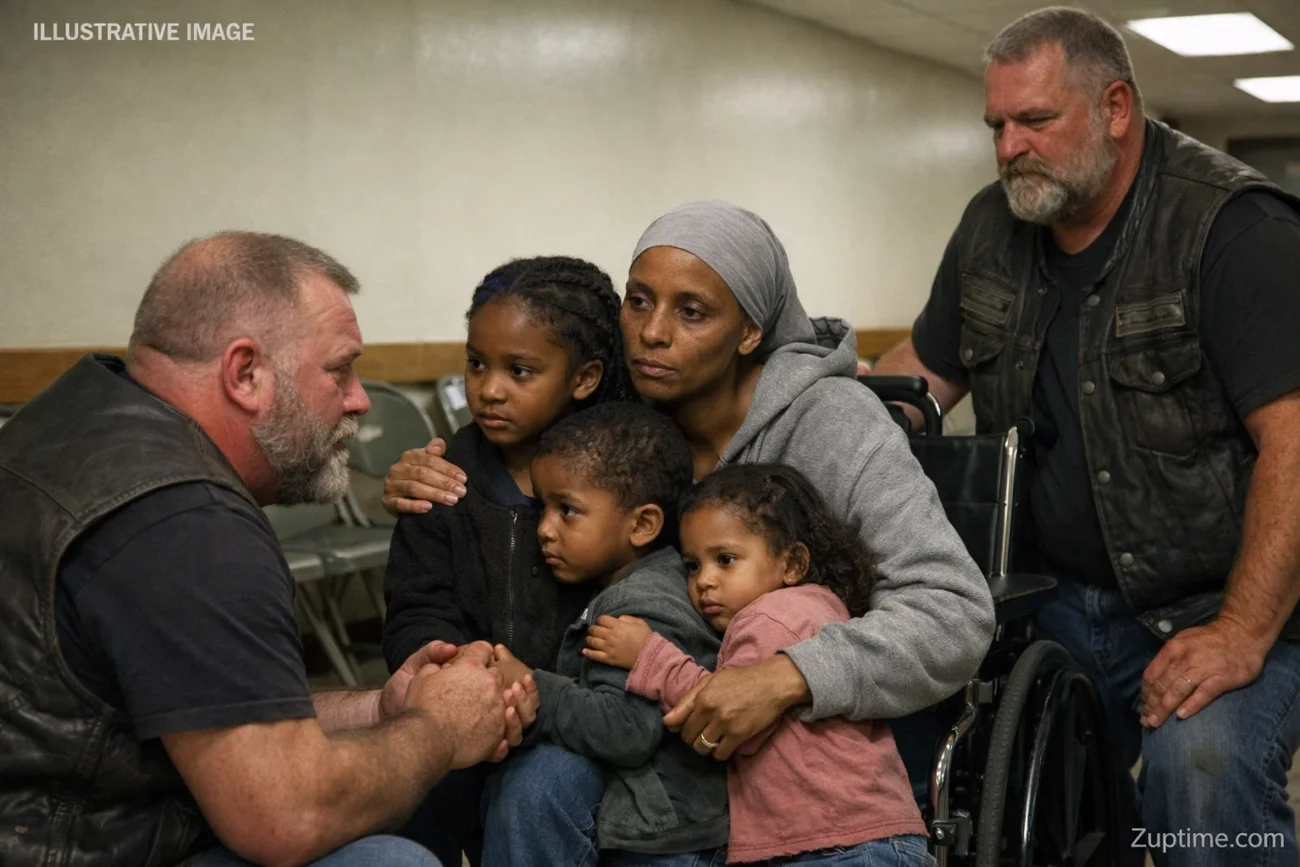
Behind her stood four children linked hand in hand, as if separation were something that might happen at any second.
The oldest girl, Camila, stood like a guard in front of her younger siblings. Diego watched silently. Sofia clung to her sister’s sleeve. The youngest, little Maria, barely understood why adults kept crying.
Maria explained the reality calmly. She had weeks left. The children would likely be split. She had grown up in the system herself and knew what that meant.
She didn’t ask for miracles. She asked for a fight.
When Policy Meets Brotherhood
The shelter director reiterated the obvious barriers: no parenting track record, no traditional family structure, no precedent for placing four children together under those circumstances.
But the two men weren’t alone.
Within 24 hours, their entire motorcycle club mobilized. Sixty veterans. Lawyers. Teachers. Nurses. Social workers. Grandmothers willing to help with bedtime routines and homework.
The clubhouse transformed into something closer to a command center than a hangout.
Paperwork was filed. Attorneys consulted. News outlets picked up the story. Donations poured in for legal fees and for Maria’s care. Pressure built.
What had begun as a dying woman’s desperate hope turned into a community effort.
A Promise Kept in Time
Three weeks later, emergency joint foster custody was granted.
Maria was still alive when the papers were signed.
She was too weak to sit up fully, but she understood. The children would stay together.
Two days later, she passed away.
The funeral drew hundreds of riders from multiple states. Engines idled quietly while four small children stood at the front, wrapped in more arms than they could count.
Camila spoke briefly. She didn’t cry. She simply said her mother had found the strongest protectors she could.
Eighteen Months Later
The house they bought together is loud.
Tommy handles school drop-offs. His brother — now nicknamed “Daddy Bear” — learned how to braid hair and pack lunches.
Camila excels in school. Diego joined karate and still talks about dinosaurs daily. Sofia sleeps peacefully under a ceiling covered in projected stars. Little Maria insists on bedtime stories twice.
They still pile into one room some nights.
The adoption became official last month.
Not Heroes. Just Present.
The men reject the word hero.
They describe themselves as two people who once lost families of their own and were given another chance.
The real courage, they say, belonged to a mother who refused to let her children disappear into statistics.
Every night before bed, they repeat the same sentence — the one Maria asked them to carry forward:
Your mama loved you more than anything. She fought for you until the end. And we will too.