By the time the sun started dropping behind the trees, fifteen motorcycles were lined up across my driveway like some kind of blockade. Chrome shining. Engines ticking as they cooled. My back door was splintered open.
Mrs. Harper from next door was standing in her yard when I pulled up.
“I already called the police twice,” she said. “They’ve been running power tools in there for an hour.”
Power tools.
Inside my house.
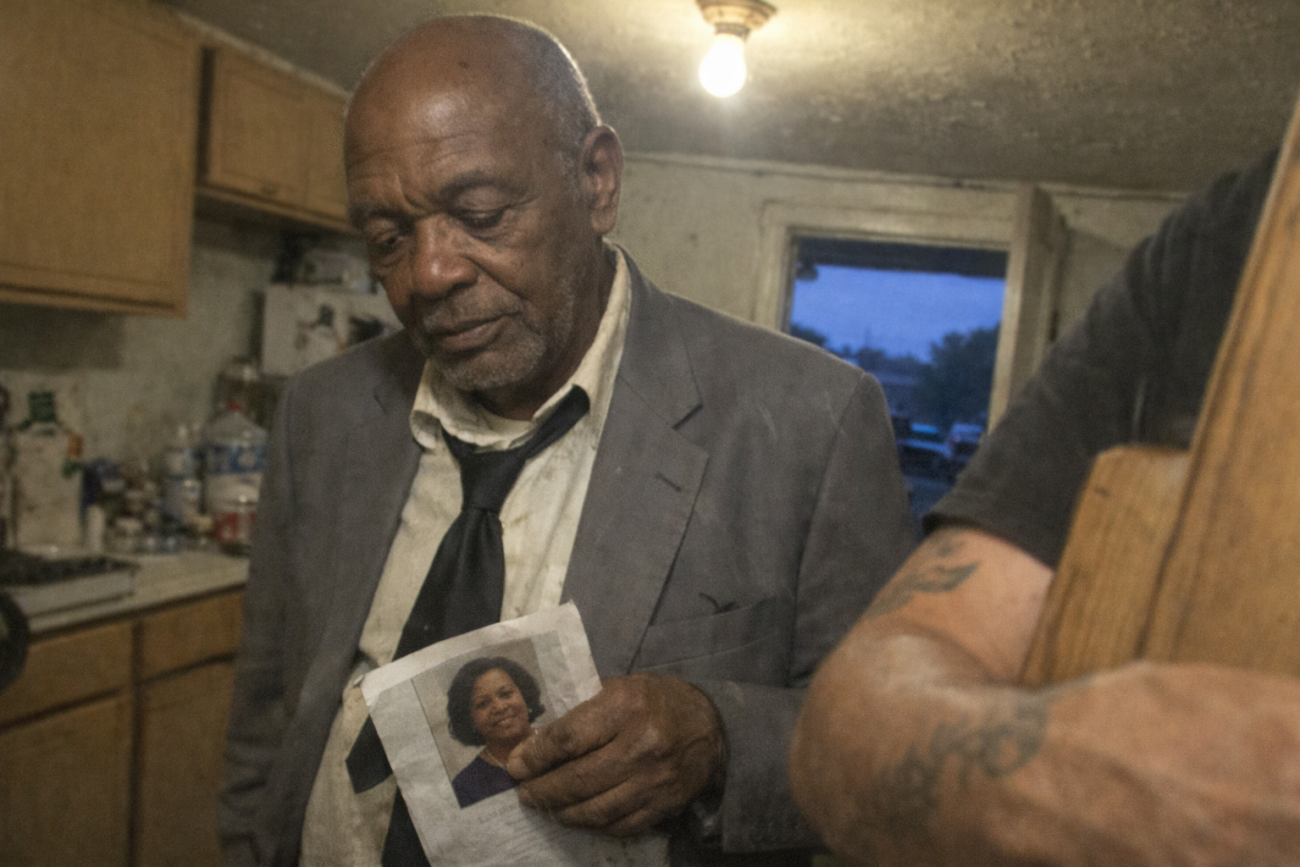
I was still wearing the same black suit I had stood in beside Sarah’s casket just hours earlier. The folded flag they handed me at the cemetery was still tucked under my arm.
Thirty-two years of marriage lowered into the ground.
And now strangers were dismantling what little I had left.
When Officer Daniels pulled in behind me, lights flashing softly, he stepped out slow.
“Sir, do you know the men inside your home?”
“No,” I said.
And I meant it.
I didn’t know who they were.
Didn’t know why they were there.
Didn’t know how much more I could lose in one day.
I walked through that broken doorway ready to fight. When you’ve just buried your whole world, fear stops meaning much. What else was there to take?
The sound hit me first.
Drills whining.
Wood cracking.
Hammers striking.
My kitchen cabinets were off the walls. The counters were gone. Sawdust covered the floor like snow.
Three men were measuring along the wall.
Two were carrying fresh boards inside.
Someone was painting the living room.
For a second I thought I was hallucinating from grief.
Then I saw him.
Sitting at my kitchen table, holding one of Sarah’s old photographs, shoulders shaking.
My son.
The son I hadn’t spoken to in eleven years.
He stood when he saw me.
He looked older. Thicker beard. Leather vest I didn’t recognize. Patches stitched across the back.
“Dad,” he said.
His voice broke in half.
“I’m sorry.”
I couldn’t even form a question.
“What is this?” was all I managed.
He took a breath like he’d rehearsed it a hundred times.
“Mom called me three months ago.”
Three months.
Sarah had been sick. Stage four. Fast. Brutal. Six months from diagnosis to goodbye.
“She made me promise something,” he said.
My wife had refused to let me call him when things got bad.
“He made his choice,” she always told me. “He walked away.”
Apparently she’d made a different choice when she realized time was running out.
“She told me you were going to fall apart when she was gone,” my son continued. “Said you wouldn’t eat. Wouldn’t sleep. Wouldn’t fix anything. That you’d just sit in this house and let it rot.”
I felt exposed. Like Sarah was standing there listing my weaknesses out loud.
“She said I didn’t have to fix the past,” he said. “But I had to show up for the future.”
He gestured around the room.
“These are my brothers. I asked my club to help.”
One of the bikers — gray beard, hands like bricks — stepped forward.
“Mr. Patterson, your wife was very organized.”
He handed me a folded piece of paper.
Sarah’s handwriting.
A list.
Kitchen cabinets — falling apart.
Living room paint — too dark, makes him sad.
Roof leak above hallway.
Porch boards unsafe.
Bathroom tile cracked.
At the bottom:
Make sure he has a reason to stay here. Make sure it feels like a home, not a grave.
My knees nearly gave out.
She had planned this.
She knew me that well.
“I told her I’d help,” my son said. “But I didn’t think I could face you alone.”
That hit harder than anything.
He hadn’t stayed away because he didn’t care.
He stayed away because we both had too much pride.
The fight eleven years ago had been about his decision to join a motorcycle club.
I told him he was throwing his life away.
Told him I didn’t raise him to be that kind of man.
The same words people once used against me when I rode.
Fear disguised as judgment.
And it cost me a decade with my child.
They worked for three straight days.
Not stealing.
Not vandalizing.
Building.
Installing cabinets.
Replacing rotten boards.
Patching the roof.
Painting over walls that had held too many quiet nights.
They brought groceries.
Paid the first few months of my utility bills from a fund Sarah had set up quietly before she passed.
“She didn’t want you worrying about money,” my son said.
On the second day, he asked softly, “Do you want to meet them?”
“Meet who?”
“My kids.”
I didn’t even know I had grandchildren.
An hour later, two small humans ran through my front door yelling “Grandpa!” like I had always been there.
My son had shown them photos. Told them stories. Kept me alive in their world even when I wasn’t in his.
We ate pizza on my repaired porch that night. Fifteen bikers sitting cross-legged like teenagers. Laughing. Passing soda cans around.
It didn’t look like a crime scene anymore.
It looked like family.
On the fourth day, when the last nail was hammered in and the last drop cloth folded, the house felt different.
Lighter.
Like it was breathing again.
Before they left, every single one of those men shook my hand.
Some hugged me.
One of them said, “Your son is our brother. That makes you family too.”
I stood in my driveway watching their motorcycles disappear down the road.
The same sound I once loved.
The same sound I once feared for my son.
Now it sounded like forgiveness.
Six months later, my grandkids spend every Saturday here.
My son calls every day.
Last week, he handed me a helmet.
“I’ve got an extra bike,” he said. “Thought maybe we could ride.”
We rode out to Sarah’s grave together.
Parked side by side.
“Thanks, Mom,” he said to the headstone.
I put my hand against the cold stone.
“Thank you,” I whispered. “For not letting us waste any more time.”
People see leather and patches and assume the worst.
Fifteen bikers broke into my house the day I buried my wife.
And instead of taking something from me…
They gave me my son back.
They gave my grandchildren a grandfather.
They gave a broken man a reason to keep living.
And I’ll never judge a brotherhood by the sound of its engines again.