A pediatric surgeon’s routine mission to save a young life turned into a lifelong commitment when his six-year-old patient was left behind in a recovery room. Owen, a young Black boy whose fragile heart had been mended by the finest medical skill, woke up to find his biological parents had vanished, leaving only a dinosaur toy and a trail of fake information. Twenty-five years later, a violent car accident brought the family back to the emergency room, forcing a confrontation with the very woman who had walked away decades earlier.
The Silence of Room 412 and a Vanishing Act
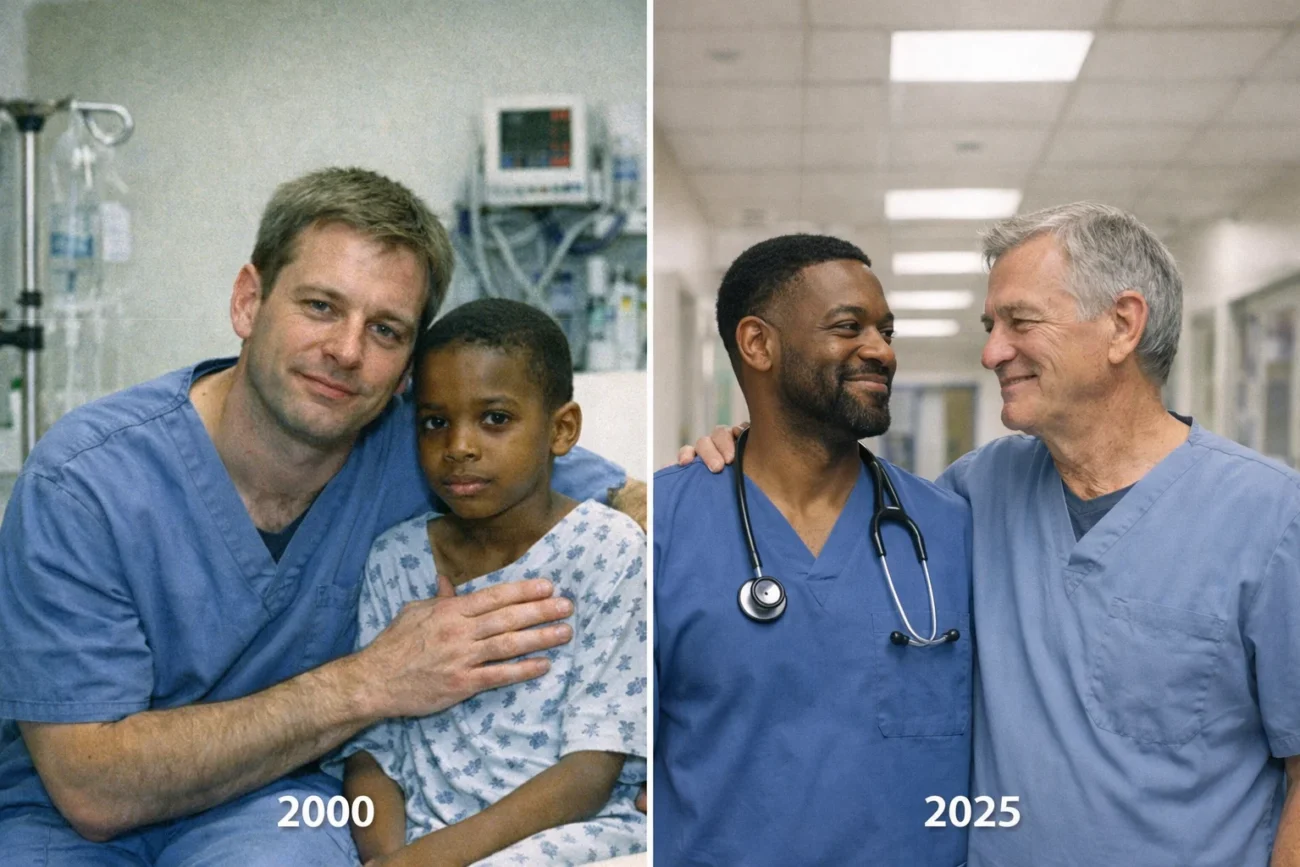
The medical chart for six-year-old Owen read like a desperate plea for help, detailing a congenital heart defect that had effectively sidelined his childhood. The surgery was high-stakes and exhausting, but as the lead surgeon, I felt a surge of triumph when his vitals finally stabilized. However, the professional victory was short-lived; the following morning, the emotional weight of the case shifted. Owen was alone in his hospital bed, his large, fearful eyes searching for a mother and father who were nowhere to be found.
Investigation by hospital staff revealed a heartbreaking reality. Owen’s parents had not simply stepped out for air; they had signed the discharge papers and disappeared. The address they provided was non-existent, and the phone number led to a dead end. Faced with the crushing costs of American healthcare and a father who had fled the responsibility, Owen’s mother had made the most desperate decision a parent can make. In that moment, the sterile environment of the hospital became the birthplace of a new, unplanned family.
Building a Home from the Fragments of Abandonment
The transition from doctor to father was not an overnight shift, but a gradual process of rebuilding trust. My wife, Nora, and I had struggled for years to conceive, and when I told her about the boy with the dinosaur toy, she saw a path where others saw a tragedy. We navigated the grueling legalities of the adoption process, but the real work happened at home. Owen initially slept on the floor, too terrified of the permanence of a bed, and it took months before he felt safe enough to trade formal titles for “Mom” and “Dad.”
As Owen grew, he became a young man of immense purpose, shaped by the thin white scar on his chest. He viewed his education not just as a career path, but as a way to honor the second chance he had been given. He chose the same field that had saved him—pediatrics—eventually returning to the very hospital where his life had been mended. We weren’t just father and son; we were colleagues, sharing coffee and surgical insights in the same hallways where he had once been a lost child.
A Collision of Past and Present in the Emergency Room
The stability of our lives was shattered on a Tuesday afternoon when an emergency notification flashed across our pagers. Nora had been involved in a serious car crash and was being rushed to the ER. Owen and I sprinted through the hospital, finding Nora bruised and shaken but alive. However, the focus quickly shifted to the woman standing beside her—a stranger in a worn coat with scraped hands, who had pulled Nora from the wreckage.
The atmosphere in the room changed instantly when Owen looked at the woman. The stranger’s eyes were fixed on the slight gap in Owen’s surgical scrubs, where the edge of his old heart surgery scar was visible. In a voice that trembled with twenty-five years of suppressed grief, she whispered his name. The savior who had pulled Nora from the car was Susan, the biological mother who had left Owen in that hospital bed a quarter-century ago.
The Confrontation of Two Mothers and One Son
The revelation brought the frantic energy of the ER to a standstill. Susan confessed the truth of her departure: Owen’s biological father had abandoned them the moment he heard the cost of the surgery. Alone, terrified, and drowning in debt, Susan believed that by leaving Owen at the hospital, he would be found by people with the resources she lacked. She had spent every day since then wondering if he was happy, or if he hated her for the choice she made.
Owen’s reaction was not one of cinematic joy, but of complex, raw human emotion. He stood between the woman who gave him life and the woman who had raised him, acknowledging that while he didn’t need a new mother, Susan’s heroic actions in saving Nora could not be ignored. It was a moment that transcended the black-and-white morality of abandonment, highlighting the desperate “dirty reality” of people broken by circumstance.
A Seat at the Table and the Power of Grace
The story did not end with a simple goodbye. Nora, ever the anchor of our family, insisted on helping Susan find stable housing and medical care after learning she had been living out of her car. By the time Thanksgiving arrived, we found ourselves setting an extra place at the table. Susan sat amongst us, a ghost from the past now rendered in flesh and blood, visibly moved as Owen placed his old stuffed dinosaur in front of her.
The healing that took place was not one of erasing the past, but of deciding that the future was more important. We realized that the most significant surgery any of us can perform is the one involving forgiveness. Owen’s journey from an abandoned patient to a successful surgeon came full circle, proving that while scars tell the story of where we’ve been, they do not have to dictate where we are going.