
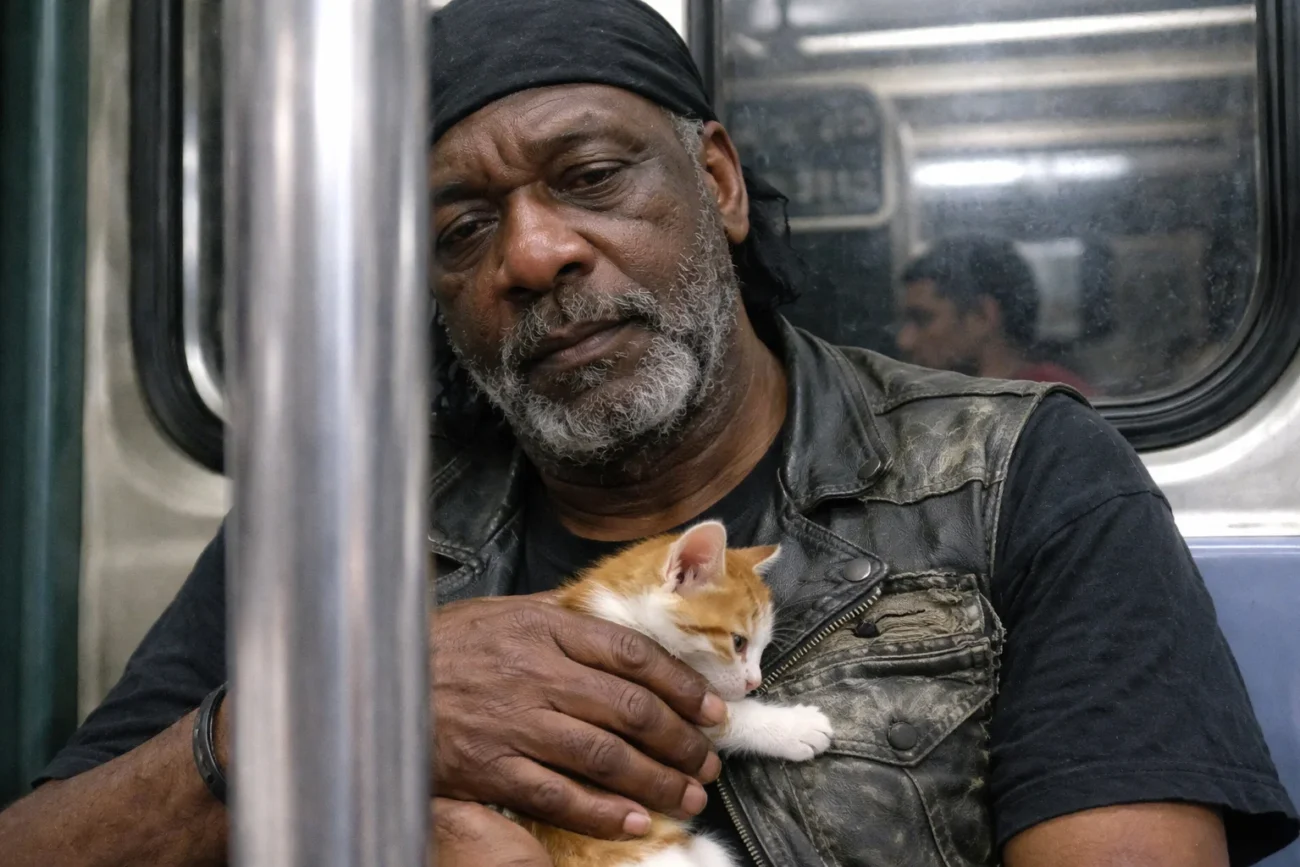
A routine commute turned into a profound display of raw human emotion when a man, whose appearance commanded a room, collapsed into uncontrollable tears. This wasn’t a typical city disturbance; it was the explosive conclusion of a silent drama that had been brewing for over four decades. Witnesses watched as the walls of urban indifference crumbled, proving that behind the most hardened exterior often lies a wound that has never been allowed to heal.
A Visual Contrast That Stopped the Train
The man sitting on the plastic subway seat looked like he belonged to a different era. He appeared to be over 65, with a thick grey beard and hands marked by years of heavy labor and old scars. His leather vest, adorned with patches, suggested a life spent on the open road, yet what he held against his chest contradicted his entire “tough guy” persona. In his massive arms, cradled with infinite delicacy, was a tiny orange-and-white kitten.
As the train rattled through the tunnel, the man sobbed openly, burying his face in the kitten’s fur. The reaction from fellow passengers was typical of a major metropolis: awkward silence and avoided gazes. One woman in a business suit, visibly annoyed by the biker’s emotional display, stood up and moved to the far end of the car, shaking her head in disgust.
The Confession That Silenced the Crowd
Sensing the silent judgment of those around him, the man looked up with tear-filled eyes and spoke words that froze the atmosphere. He apologized to no one in particular, explaining in a broken voice that he hadn’t held anything “this small and alive” in exactly forty-three years. This precise timing immediately shifted the energy in the car; he wasn’t just a stranger crying without cause—he was a man facing a soul-crushing memory.
One passenger moved to sit beside him, offering a moment of quiet support. In that small pocket of empathy, the biker began to share his story. He had found the kitten abandoned in a cardboard box near a hospital dumpster. Despite his own precarious situation—having lived on the streets for three years after medical issues ended his career—he couldn’t bear to leave the tiny creature to die.
A Wound Reopened in September 1980
The reason for his emotional collapse was tied to a specific date: September 14, 1980. That was the day his daughter was born, weighing just over five pounds with a tuft of orange hair exactly like the kitten’s fur. The biker recounted how he had only been allowed to hold her for seventeen minutes in the hospital. Because of the prejudices of the time, his former in-laws decided a young construction worker who rode a motorcycle was not fit to be a father.
Through an aggressive legal process, his rights were completely stripped away. Despite fighting for years in court and spending every dollar he had, he lost all trace of his child when she was just six months old. Later, he discovered she had been adopted by his ex-wife’s new husband, given a new name, and told her biological father was dead. For forty-three years, he had lived with the agony of being a “ghost” to his own child.
Spontaneous Solidarity Among Strangers
The kitten’s cries in the hospital parking lot had triggered a post-traumatic response, echoing the sound his daughter made during the only minutes they spent together. Despite having only fifteen dollars to his name, he was determined to save the animal. His act of compassion sparked a chain reaction of kindness among the passengers.
An elderly woman reached into her purse and handed him a twenty-dollar bill for kitten food, followed quickly by other commuters. Within minutes, the biker had nearly 200 dollars in his lap, given by people who had ignored him just moments before. Even the woman in the business suit who had initially walked away returned to offer her support and a business card.
A New Beginning Named Hope
As his stop approached, the man decided to name the kitten “Hope.” For him, saving this small life was not just a random act of kindness; it was a form of redemption and proof that he was still capable of caring for another, even after a lifetime of loss.
This incident highlights how prejudice can destroy lives, but also the extraordinary power of small gestures to heal old traumas. The man who boarded the train as a marginalized stranger left surrounded by people who finally recognized the heart of a father that had been there all along.
Narrative Fiction → This narrative is a work of creative fiction inspired by real-world social archetypes.