On the night Fatima Abdullahi became a wife, she stood barefoot on a cold concrete floor and tried to steady her breathing.
The house was quiet now. The drums had faded. The wedding guests had gone home satisfied, having witnessed what they believed was a small mercy: the orphan girl had finally been “placed.” No longer anyone’s responsibility. No longer a burden.
Inside the modest room, her husband lay on a thin mattress, turned toward the wall. His breathing was even. Controlled. Almost too controlled.
Samuel Okoye.
The quiet man.
The poor man.
The harmless man everyone pitied.
Fatima told herself to lie down. To accept what had been decided. To survive the way she always had.
But her eyes kept drifting toward the travel bag in the corner.
It didn’t fit the story.
The fabric was thick, expensive. The zipper heavy. Not something owned by a man mocked for empty pockets. It looked like it had traveled farther than any road she had ever seen.
Curiosity turned into instinct.
She opened it.
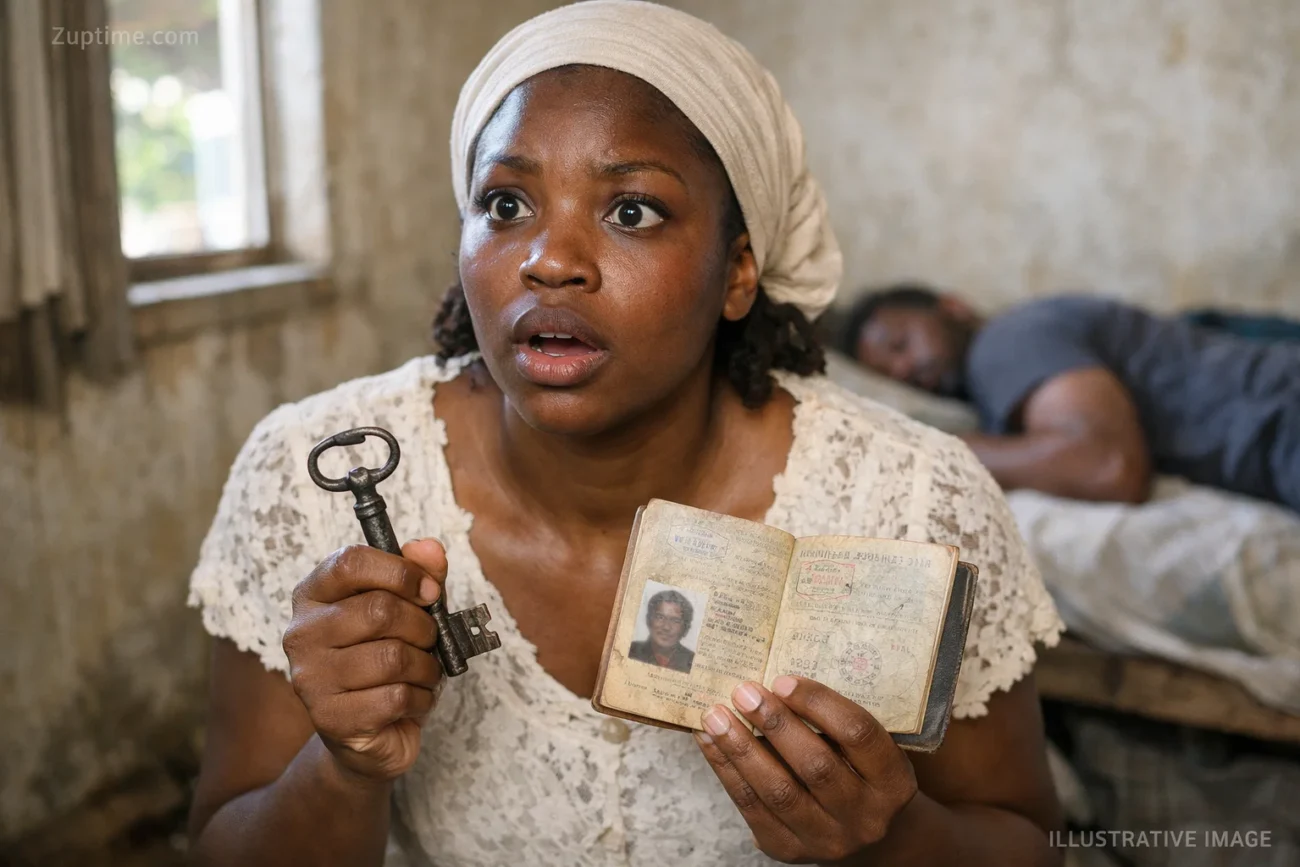
Clothes folded with precision. Documents tucked beneath fabric. A toiletry kit too refined for a village laborer. And then her fingers brushed something solid hidden along the inner seam.
A key.
Not a house key.
A vault key.
Her pulse roared in her ears.
She searched deeper. A passport. Multiple stamps. Multiple countries. The face inside belonged to Samuel — but the life printed across those pages did not belong to the man villagers laughed at.
Fatima sat down slowly, the key pressing into her palm like a sharp truth.
Marriage was supposed to rescue her.
Instead, she realized she had stepped into something much larger than survival.
The door creaked behind her.
⸻
Fatima had learned early that being invisible kept you alive.
Her mother’s death had been slow and quiet. Her father’s was sudden. By eleven, she had packed what little she owned and moved into her uncle Musa’s house — not as family, but as obligation.
Uncle Musa liked to be praised for his generosity.
Aunt Zenob made sure Fatima understood the cost of it.
She ate last.
She spoke softly.
She worked constantly.
School was occasional. Education, they said, was unnecessary for a girl with no dowry and no lineage strong enough to bargain with.
As she grew older, her uncle’s tone changed. Not affection. Not even resentment.
Calculation.
Debt followed him like a shadow. Men visited more often. Voices grew tense behind thin walls.
One night she heard it clearly:
“There is the girl.”
Her name was not spoken with tenderness. It was spoken like currency.
Marriage was arranged before she was asked.
Consent was never part of the discussion.
⸻
Samuel did not look like a savior.
He arrived quietly. Spoke little. Did not examine her like livestock, as other men had done. His eyes held no hunger. No triumph.
That unsettled her more than cruelty would have.
On their wedding day, guests laughed at him openly.
“Can he even afford a wife?”
Samuel absorbed the humiliation without reaction.
Fatima burned with secondhand shame.
But that night, when the door closed and they were alone, Samuel did something unexpected.
He gave her space.
“I won’t force anything,” he said.
The sentence felt unfamiliar. Almost suspicious.
Kindness had always come with conditions.
⸻
Now she stood facing him, the key and passport in her shaking hands.
“You lied,” she whispered.
Samuel did not look surprised that she had searched. He looked tired.
“I was waiting for the right time,” he said.
“For what?” she demanded. “For me to stop questioning you?”
“For it to be safe.”
She let out a bitter laugh. “Safe is what people say when they want control.”
He didn’t argue.
Everything unraveled days later when her uncle arrived demanding money.
Samuel refused.
The threat in Musa’s voice shifted immediately toward Fatima.
“If he won’t pay, she will.”
Samuel stepped between them without raising his voice.
“Leave.”
That was when Fatima realized something else didn’t fit.
Poor men do not command rooms like that.
Soon after, Samuel moved them to the city without explanation.
At the bank, staff greeted him with deference.
Security guards nodded.
Respect followed him like a shadow.
Fatima felt the ground shift under her feet.
Why her?
If he was wealthy — powerful — connected — why marry a girl no one valued?
The answer came brutally.
She overheard it in a hospital corridor after collapsing from exhaustion.
“She’s leverage now,” a man in a suit said.
Samuel answered quietly. “I know.”
Leverage.
The word hollowed her out.
When she confronted him, the truth came in pieces.
His wealth was real.
His family powerful.
His enemies dangerous.
Documents in his possession could expose corruption tied to powerful figures — including a man named Babatunde Akinwale.
And her uncle’s debts had drawn attention.
“You chose for me,” she said.
“I thought I could shield you,” Samuel replied.
“Shielding without honesty is still control.”
He had no defense for that.
When she saw the vault, it wasn’t gold that frightened her.
It was paper.
Evidence. Contracts. Names that could dismantle reputations.
She understood then why she had been useful.
Not because she was weak.
Because she was unguarded.
That made her vulnerable.
Which made her valuable.
When Babatunde’s people kidnapped her days later, they assumed fear would make her compliant.
“You will call your husband,” Babatunde said calmly. “Or everything about you becomes public.”
Fatima met his gaze.
“No.”
He leaned closer. “You have nothing without him.”
For the first time in her life, she knew that wasn’t true.
“You’re afraid of exposure,” she said quietly.
That flicker in his eyes told her she was right.
Samuel did not negotiate.
He released the evidence.
By morning, arrests began.
By afternoon, networks crumbled.
By evening, Fatima was dropped near a hospital entrance — too risky to keep.
When she stood at a podium weeks later, cameras flashing, she did not present herself as a victim.
“My name is Fatima Abdullahi,” she said. “And silence nearly destroyed me.”
She spoke of coercion. Of being traded. Of being kept uninformed “for protection.”
“I am not leverage,” she said. “I am not a transaction.”
In court, her uncle glared at her in chains.
“You ungrateful girl,” he spat.
She didn’t respond.
She no longer needed to.
Healing did not arrive like justice had — loud and visible.
It arrived slowly.
In small decisions.
In conversations where Samuel asked instead of decided.
“You hurt me,” she told him one evening.
“I know,” he said.
“I don’t want protection,” she said. “I want partnership.”
He nodded.
And for the first time in her life, she began making choices not from fear — but from ownership.
She had been an orphan.
A burden.
A bride used to settle debt.
A pawn in a political game.
But when men tried to use her voice against her —
She used it first.
And this time, she did not disappear.