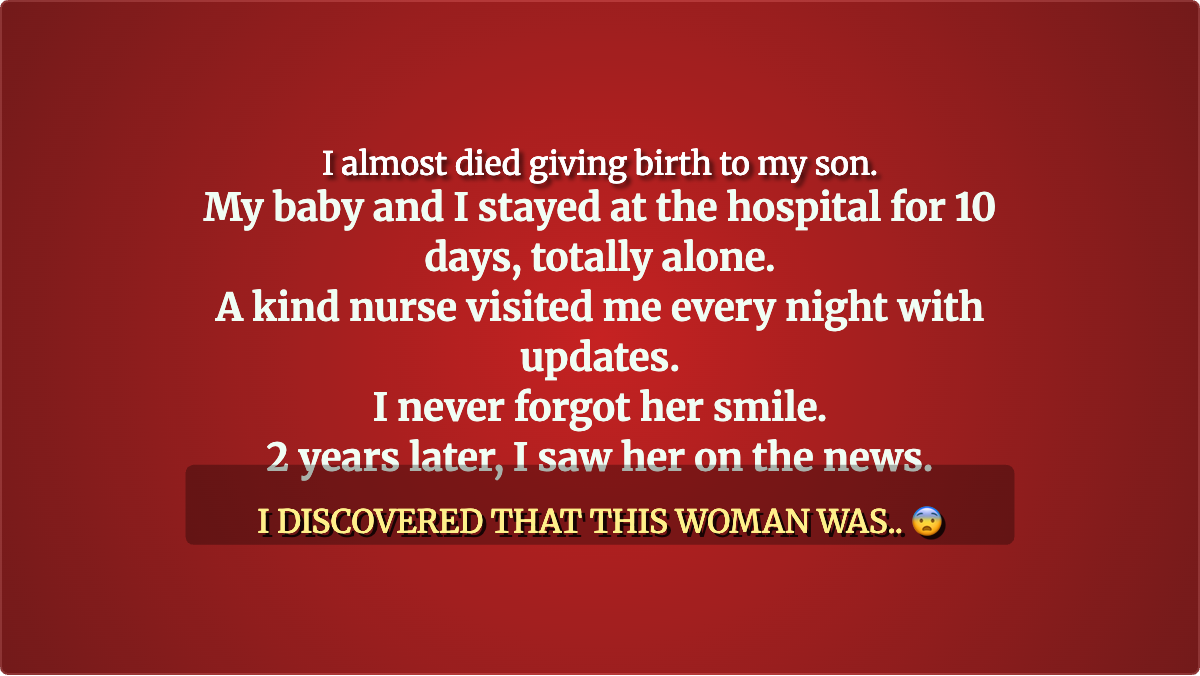
I came closer to losing my life on the night my son was born than at any other point before.
The delivery was traumatic, the recovery even more brutal, and for ten long days I lay in a hospital bed—exhausted, frightened, and entirely alone. My family lived hours away, my husband was trapped overseas for work, and the loneliness cut deeper than the physical pain.
Each night, when the corridors fell silent and the harsh lights softened, a gentle knock would break the stillness.
A nurse would step into my room—quiet footsteps, compassionate eyes, and a calm smile that made the air feel breathable again. Sometimes she talked, sometimes she simply stayed with me as I cried without warning or explanation.
She was the one who brought news about my newborn in the NICU.
Small improvements.
Small hopes.
And her presence somehow turned each update into a lifeline.
I never learned her first name.
She never lingered long enough for me to ask.
But when she was near, I felt held together by a quiet strength that seemed to pulse like a second heartbeat.
Eventually, life moved forward. I recovered. My son grew healthy. And slowly, the memories of those nights slipped into a distant corner of my mind—or so I believed.
Two years later, while folding laundry with the television playing in the background, a familiar voice made me look up.
There she was.
The nurse.
The same steady smile, the same warmth in her expression—the very presence that had steadied me when I was breaking.
The news segment introduced her as a volunteer who provided nighttime support for families with infants in intensive care. She worked demanding hospital shifts during the day and spent her nights offering comfort to strangers enduring their darkest hours.
Then the report revealed something I never knew:
She had once lost a baby shortly after birth.
Her grief had nearly destroyed her.
And instead of retreating, she chose to stand beside other parents living through the pain she understood too well.
A tightness formed in my throat.
Suddenly, so much made sense—the way she stayed just a little longer, the gentle pressure of her hand on my shoulder, the way she never offered false reassurance, yet somehow made the fear feel bearable.
She had given me the comfort she once needed herself.
When the segment ended, I sat frozen, tears falling onto the clothes in my lap. The memory of her—the dim hospital room, her voice in the silence—returned with overwhelming clarity.
Only then did I realize that I had never truly thanked her.
Not with understanding.
Not with the kind of gratitude that comes only once you’ve reached a safer place.
I contacted the hospital, unsure whether a message would ever reach her.
It did.
A few days later, an envelope arrived—my name written in handwriting I recognized instantly.
Inside was a short note.
She remembered me.
She remembered my son.
And she wrote that watching parents rediscover their strength—after feeling certain they had none left—was the most meaningful reward she could imagine.
The message was simple, yet profoundly powerful.
A reminder that some angels don’t appear with wings.
Sometimes they wear hospital scrubs.
Sometimes they tap lightly on your door in the middle of the night.
Sometimes they help you heal in ways you won’t understand until years have passed.
Even now, whenever life feels heavy, I think of her.
Of those nights when hope seemed impossibly far away, and she quietly guided it back to my bedside.
Because of her, I learned something I had never understood before:
Light doesn’t always arrive with noise or brilliance.
Sometimes it sits with you in the dark—asking for nothing, giving everything.
⸻
Disclaimer:
This narrative is inspired by real experiences but has been fictionalized for creative purposes. Names, characters, and details have been altered to protect privacy and to enhance the storytelling. Any resemblance to actual persons, living or deceased, or to real events is purely coincidental. The author and editor do not claim factual accuracy and are not responsible for interpretations made by the reader.