
The day a detective returned my son and told me he had been calling her “Mommy” became the moment my entire world shifted. Jamie had just turned four, and our outing to the mall was meant to be simple: ice cream and the small toy he had been asking for all week. It was supposed to be routine, nothing more.
He was holding my hand, laughing about gummy bears, and then—within a single heartbeat—he was no longer beside me.
I shouted his name and sprinted through the mall corridors. People stared. Some tried to help. Security made announcements I could barely understand through my panic. I kept convincing myself he must have wandered off. That he was nearby. That he would reappear any moment.
The mall shut down completely. Stores sealed their gates. Security checked cameras. Police arrived. Yet no one could find Jamie.
I trembled uncontrollably. Hours passed. Eventually the lockdown ended, and investigators told me they would continue searching, that there were leads, but their expressions betrayed their uncertainty.
That night, sleep was impossible. My mind replayed every detail. Had someone coaxed him away? Did he chase after a toy? Did I look away for too long?
The next morning, officials held a press conference. Jamie’s photo lit up every screen—his round cheeks, his dimple, his dinosaur backpack.
No progress followed.
Days became weeks.
Every knock at the door jolted me to my feet. I blamed myself relentlessly for letting go of his hand. His room felt frozen in time—his bed still unmade, his cereal bowl untouched in the sink.
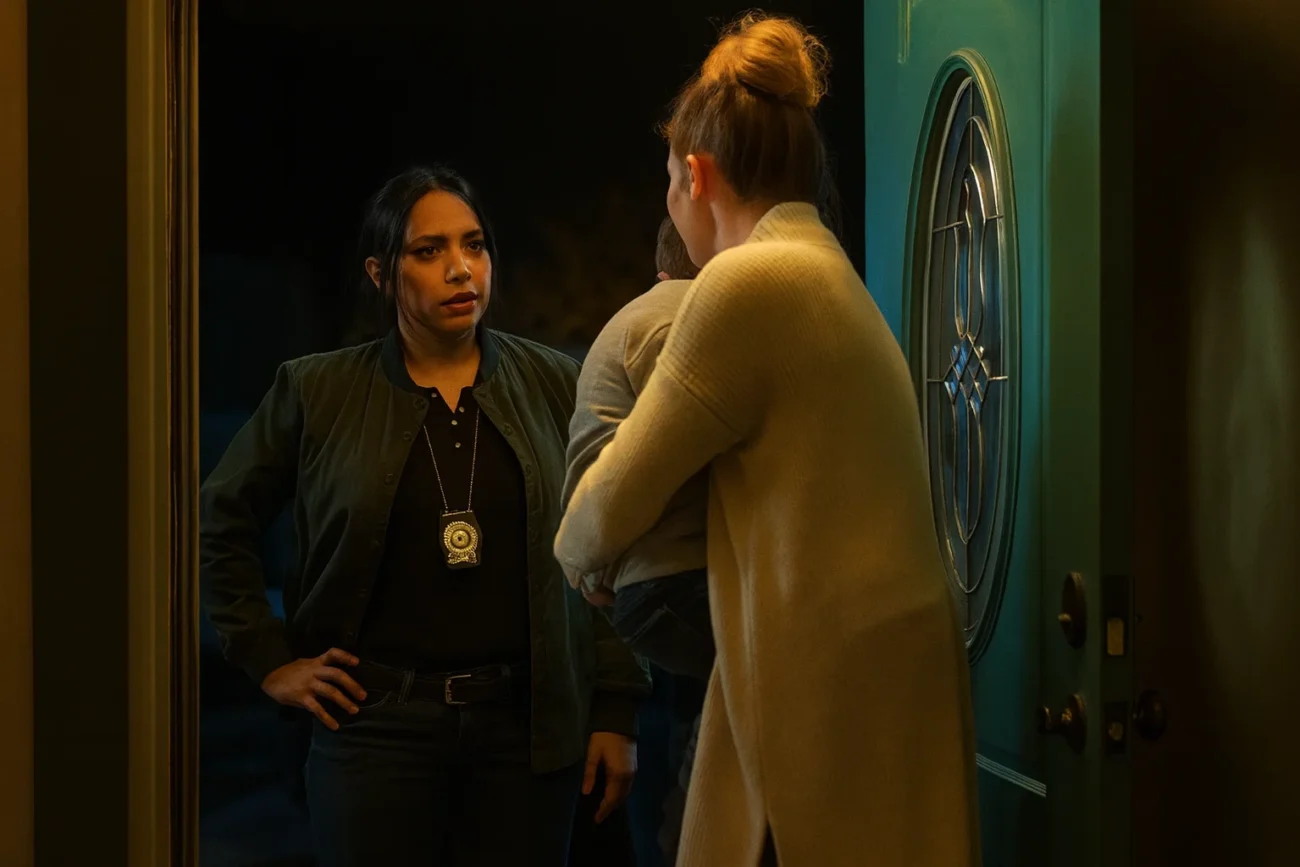
Then, in the fourth week, the doorbell rang.
A woman with a tired face and tied-back hair stood on the doorstep.
“I’m Detective Morgan,” she said. “We found Jamie.”
My legs gave out and I collapsed. A car door opened behind her, and Jamie ran toward me clutching a juice box and a small stuffed dog. I held him and cried into his shoulder.
But I noticed Detective Morgan was not relieved. She stepped closer and spoke softly: “Ma’am… evidence suggests your son was taken by a woman who pretended to be his mother.”
I felt the blood drain from my body.
She explained they discovered Jamie in a modest apartment an hour away. The woman was in her thirties, unmarried, with no children. Neighbors believed she had recently gained custody of “her” son.
Jamie had lived with her for nearly three weeks.
“She fed him, bathed him, bought him clothes,” Morgan said. “She even took him to a drugstore and let him choose toys. She gave him a different name—‘Jasper.’”
I asked how investigators found him.
Morgan showed me a photo on her phone: Jamie smiling, holding the woman’s hand inside a store. A clerk had posted it online as a sweet moment.
A teacher from Jamie’s daycare recognized him and called the tip line immediately.
Then Morgan revealed something that made me sway.
“When we recovered him, he told us, ‘This is Mommy now.’ He didn’t identify you as his parent.”
The room spun.
She reassured me it was a common response at his age, especially under emotional manipulation. “She told him you gave him away. That she had been chosen to take your place.”
That first night home, Jamie barely spoke. He sat on my lap, clinging to the stuffed dog. He avoided eye contact. At bedtime he asked whether “Mommy Jasper” would return.
I could not find the right words.
Anger should have consumed me, but the overwhelming feeling was grief. My child had been stolen and persuaded that I had abandoned him.
The next morning he rejected his usual cereal. He wanted the kind she had given him. He searched for blue pajamas I had never owned. He grew upset when he could not find the toothbrush she bought for him.
I cried in the bathroom with the water running to hide the sound.
Detective Morgan checked in every day for a week. Social workers joined the case. A child psychologist became involved. I agreed to every recommendation. I needed Jamie to recover—not just physically, but emotionally.
One evening, while sorting laundry, I discovered a drawing tucked into Jamie’s hoodie. A stick figure boy holding hands with a woman. Underneath, in unsteady crayon, it read: “Me and Mommy.”
The woman had black hair. Mine is blonde.
That night, I asked him if he wanted to draw again. We sat quietly at the kitchen table with a pile of crayons. I mentioned the earlier drawing. He hesitated, then whispered, “She said you were sick. She said you didn’t want me.”
It took all my strength not to break down in front of him.
“Jamie,” I said softly, “I searched for you every day. I love you more than anything. You were never unwanted.”
He looked directly at me for the first time since he returned, then leaned forward and hugged me.
It was the first real sign of healing.
Progress came slowly. Some days he laughed and played; other days he shut down completely, clutching the stuffed dog.
Detective Morgan later told me more about the woman—her name was Beth. She had a long history of mental health struggles. A decade earlier, she had lost her newborn. The trauma had never resolved. She moved from town to town, job to job, without any criminal record.
“We believe Jamie reminded her of the child she lost,” Morgan said. “Her grief distorted her reality.”
I asked what her future held.
“She’s in custody,” Morgan answered. “There will be a trial. She’s cooperating, but she does not understand that what she did was wrong.”
I attended the hearings. I needed closure. Jamie stayed with my sister; the courtroom would have been too much.
Beth looked fragile, worn down by years of internal turmoil. When photos of Jamie in her care were displayed, my breath caught. She had truly treated him as though he were her own child. But that did not excuse what happened.
At the end of her testimony, she turned toward me, tears falling.
“I’m sorry,” she said. “I only wanted to be a mother again.”
I had no words.
The judge sent her to a psychiatric facility rather than prison. Part of me agreed. Another part wanted her held accountable forever. But above all, I wanted Jamie to heal.
Months went by.
With counseling and time, Jamie slowly came back to me. His laughter returned. He began calling me “Mommy” without hesitation. He stopped asking for clothes and items he remembered from his time with her. The stuffed dog ended up on a shelf instead of in his hands.
Eventually, I gathered the courage to return with him to the mall. Jamie held my hand tightly but without fear. We passed the toy store, shared ice cream, and sat on the same bench.
“Do you remember being here?” I asked.
He nodded. “I got lost.”
“Yes,” I said, “but you were found.”
He looked up at me. “Because you didn’t stop looking.”
That night, he drew another picture—this one of the two of us standing in front of our home, hand in hand. The woman with dark hair was no longer part of his drawings.
It took months of patience, grief, and unwavering love, but I regained my son. He finally understood he had never been abandoned.
The most difficult part of the entire ordeal was not the waiting or the fear—it was rebuilding trust with a child whose world had been reshaped without his understanding.
But children possess remarkable resilience. They bend, but they do not always break. And steady, unconditional love can repair more wounds than we expect.