No one in the courtroom could ignore Richard “Tank” Peterson.
He was built like a wall, tattoos climbing from his collar to his knuckles, leather vest worn and scarred from years on the road. He didn’t look like the kind of man courts describe as “stable.” He looked like the kind of man they warn children about.
Beside him sat little Maya, her legs dangling far above the floor, fingers wrapped tightly around his pinky. She wasn’t afraid of him. She was afraid of the man in the black robe.
Judge Harrison had already formed his opinion.
He spoke about “proper households” and “appropriate guardians.” He referred to Tank as a thug. He questioned whether a biker had any business raising a child. The decision felt prewritten.
Tank didn’t argue. He didn’t explode. He kept his head lowered, swallowing the anger and the hurt, knowing how these things usually ended.
When the gavel came down and the judge ordered Maya returned to the orphanage, the sound echoed like something final.
Two guards stepped forward.
Tank released her hand slowly, careful not to cause a scene.
That was when everything changed.
Maya stood up on her chair.
“Wait!” she called out, her small voice cutting through the tension.
The room fell silent.
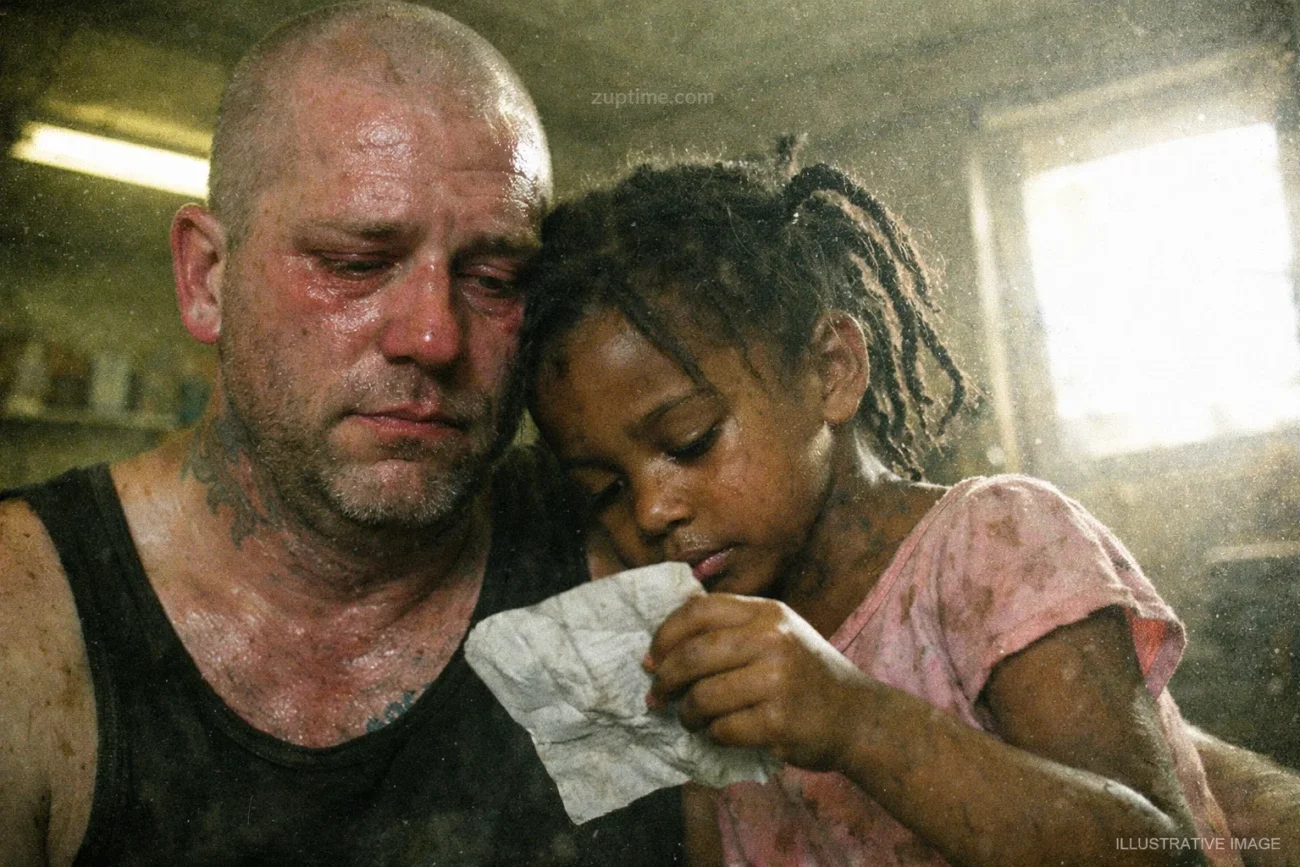
She reached into the pocket of her pink dress and pulled out a crumpled piece of paper. It was wrinkled, smudged, folded too many times. She walked past security, straight to the judge’s bench, and held it up.
Judge Harrison looked irritated at first. Then he unfolded it.
What he saw drained the color from his face.
His hands trembled. His breath shortened. The paper shook between his fingers.
It was a child’s drawing.
A crooked cabin. A leaning oak tree with one heavy branch bending toward the ground. A tire swing. A narrow creek. Beneath it, in uneven letters, she had written: “MY BAD HOUSE.”
But it wasn’t the house that unsettled him.
It was the tree.
He stared at it as if it had reached out of the past and grabbed him by the throat.
He looked at Tank for the first time not with suspicion, but with urgency.
“Mr. Peterson,” he said, voice unsteady. “Recess. Now. My chambers.”
The gavel fell again, softer this time.
Maya rushed back to Tank, pressing her face into his vest.
The courtroom buzzed with confusion.
Inside the judge’s private office, something far heavier than a custody case unfolded.
Judge Harrison paced, clutching the drawing.
“Describe that cabin,” he demanded. “Every detail.”
Tank thought back to the afternoon months earlier when his motorcycle broke down on a deserted road. He had followed a narrow trail into the woods, hoping to find help. Instead, he found decay.
“The roof was collapsing,” Tank said quietly. “Windows shattered. Looked abandoned for years. There was a big oak tree beside it. One branch twisted down low, like it was broken. Had a rotted tire swing hanging from it.”
The judge closed his eyes.
Thirty-five years earlier, that same cabin had belonged to his family. It had been their escape from the city. The oak tree had been planted by his father. The swing had once carried his little sister, Eleanor.
One afternoon, while Harrison was supposed to be watching her, she disappeared.
Search teams combed the woods for weeks. They found nothing. No body. No evidence. Just absence.
The guilt reshaped his entire life. It pushed him toward law, toward order, toward control.
Now that drawing sat in his trembling hands.
“How did you find the child?” he asked.
Tank explained how he heard a faint sound inside the cabin. How he pushed open the warped door and found Maya huddled under rags, thin and frightened. No adults present. Only empty food cans and a worn mattress. Signs someone had fled.
He pulled a faded photograph from his wallet.
It showed a tired young woman holding baby Maya. The resemblance struck instantly — the same jawline, the same eyes.
Judge Harrison’s voice cracked.
“My sister,” he whispered. “That’s Eleanor’s daughter.”
Eleanor had survived all those years. She had a child. And that child had somehow ended up back at the cabin, the one place her mother had once felt safe.
The man he had nearly stripped of custody was the man who had saved his grand-niece.
When they returned to the courtroom, the atmosphere was different.
Judge Harrison no longer looked down at Tank.
He looked at him as an equal.
“This court has made a grave error,” he announced. “An error born from prejudice.”
He admitted openly that his initial ruling had been shaped by appearances. Leather. Tattoos. Reputation.
He explained that the cabin in Maya’s drawing connected to a painful chapter of his own past. Without revealing every family detail, he acknowledged that Tank had unknowingly closed a wound that had been open for thirty-five years.
“This man did not create danger,” the judge said firmly. “He stepped into it to protect a child.”
Then came a deeper confession.
Years ago, Judge Harrison had sentenced a young man named Daniel Miller to the maximum term for a non-violent offense. He had believed harsh punishment prevented cycles of failure.
Daniel Miller’s son was Maya’s father.
The same father who abandoned her at the cabin.
“My decisions,” the judge said, voice steady but heavy, “may not have broken a cycle. They may have strengthened it.”
The courtroom was silent.
“Today,” he continued, “we choose differently.”
He granted full legal custody of Maya to Richard Peterson.
The gavel struck with certainty this time.
Applause broke from the small group of bikers seated in the back. Tank stood frozen, tears cutting through his beard as Maya clung to him.
But the judge was not finished.
“I will be taking a leave of absence,” he added. “There is family I need to know.”
The story did not end at that ruling.
Judge Harrison — who soon insisted they call him Arthur — stepped away from the bench and into their lives.
At first, it was awkward. The retired judge and the biker father shared little in common beyond Maya. But common ground grew.
Arthur helped Tank secure funding to purchase and run a small auto garage, providing stability without stripping dignity. Tank, in return, helped Arthur shed layers of rigid formality that had defined him for decades.
Dinner became routine. Homework was supervised. Laughter returned to spaces once filled with loss.
They pieced together Eleanor’s story. She had run away years ago, struggled, but always spoke of the cabin as a sanctuary from her childhood. When Maya’s parents fell into crisis, they returned to the only place they associated with safety — and then failed her.
In a tragic turn, the past had guided Maya to the very location where she would be found.
A year later, the three of them returned to the cabin.
Tank had restored it carefully — new roof, reinforced walls, safe flooring. The oak tree still stood. A new swing hung from the same crooked branch.
Arthur pushed Maya gently while Tank watched from the porch.
The cabin that once symbolized disappearance now held laughter.
The courtroom had judged a man by his vest and ink.
A child had judged him by his actions.
In the end, the drawing was not evidence of guilt or innocence.
It was proof that love can appear in unlikely forms, and that sometimes redemption arrives not through power, but through humility.
Editorial Note: This story is a work of fiction created for narrative purposes. The characters, events, and circumstances described are part of a fictional construct. Any resemblance to real individuals, cases, or situations is purely coincidental.