
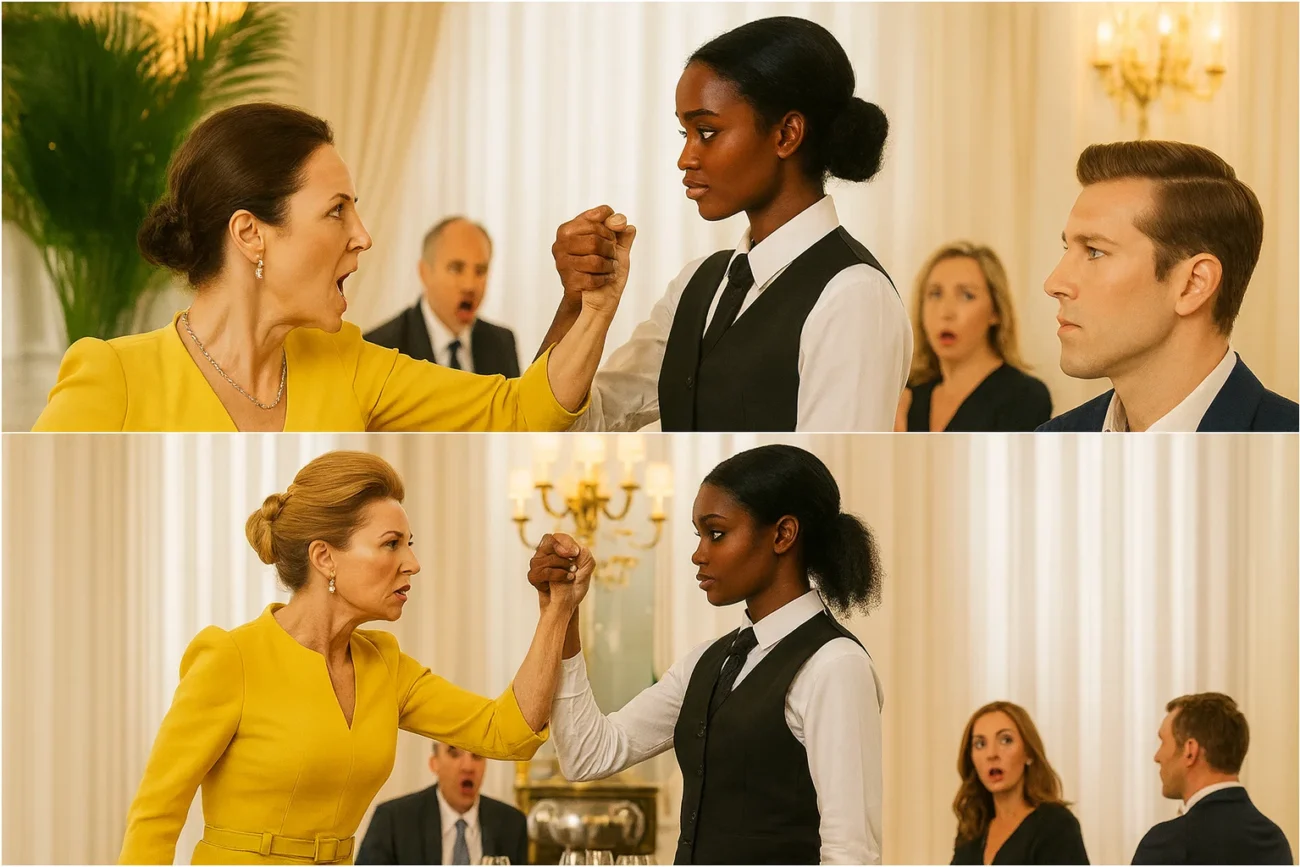
She had once reduced a young waiter to tears as she watched him lose his job, and she had smiled while it happened. For a full decade, the billionaire’s wife had intimidated everyone who crossed her path. Nobody confronted her. Nobody even considered trying—until the day a financially struggling waitress, with nothing left to lose, uncovered the truth she had spent her life hiding. This is the account of how one woman dismantled a tyrant. Not with money, nor with influence, but with a single word. And by the time this story ends, you may never view powerful people the same way again.
Welcome to Voice of Granny.
Before we begin, feel free to subscribe and share your thoughts, including where you are watching from.
This story is about power, about secrets, and about what unfolds when someone finally refuses to accept abuse.
In central London stood a restaurant called the Golden Rose—a place where the cost of a single dinner surpassed most people’s monthly earnings. Crystal chandeliers hung overhead like frozen cascades. The cutlery was true silver. Even the atmosphere felt expensive. And within this refined world, one name could silence an entire room: Victoria Ashford.
Victoria was married to Lawrence Ashford, a billionaire whose technology empire stretched across Europe. His wealth had built towers that scraped the sky. But Victoria had built something else—an empire of fear. Every Friday evening at precisely eight o’clock, she would appear. Always in the same booth. Always dressed with regal extravagance. Always prepared to ruin someone’s life over the slightest perceived flaw. Staff members trembled when she entered, and they had reason to.
There was Thomas, a young server saving money for university, dismissed instantly because his sleeve had brushed near her plate. She had not only demanded his termination—she had watched his devastation, and, witnesses claimed, she had smiled. This was who Victoria Ashford was.
Into this environment stepped Rachel Bennett. She was thirty-two, and three months earlier her life had collapsed. She had been a research assistant for one of London’s best investigative journalists. She loved the work—she excelled at uncovering hidden information and connecting details that seemed unrelated. But when the newspaper dissolved her department due to budget cuts, everything she had built vanished overnight.
Now she found herself straightening the stiff collar of a waitress uniform, struggling to remember service etiquette, and feeling as though she had fallen into a foreign world.
On her first day, an older waiter named George pulled her aside. He had worked at the Golden Rose for fifteen years, and his expression showed it.
“See that booth?” he whispered, pointing discreetly. “That’s where she sits. Victoria Ashford, wife of Lawrence Ashford. You know who he is, right?”
Rachel nodded—everyone knew Lawrence. His companies regularly appeared in headlines.
“Well, his wife,” George continued, lowering his voice, “is our worst nightmare. One misplaced word, one tiny mistake, and she will have you fired. And she will not stop there—she will destroy your reputation so you never find work in a high-end restaurant again. I’ve watched her ruin people simply because she felt like it.”
Rachel’s stomach tightened. “Is she truly that cruel?”
George gave a hollow laugh. “Last month she claimed a waiter’s presence was ‘contaminating’ her food. He never touched her plate—he merely stood nearby. Her outburst cost him his job, and I heard he left London entirely because he couldn’t find another position.”
That evening, Rachel observed Victoria’s entrance. She swept into the dining room like a monarch returning to her throne. Her gown probably cost more than Rachel’s entire annual income, and diamonds gleamed at her neck. Yet it was her eyes that stood out—icy blue, sharp, and merciless. When her gaze scanned the room, people visibly recoiled.
Beside her walked Lawrence. Distinguished, silver at the temples, but his posture revealed resignation—the look of a man living in a beautiful prison.
Rachel was assigned to work near their table. Close enough to hear everything.
During the first hour, she focused on her own tables. But she could not avoid hearing Victoria’s voice—controlled, soft, and slicing. She returned her wine, complaining it tasted “common.” She declared the lighting made her husband appear old. Every criticism was a calculated performance, a reminder that her status allowed her to dominate anyone in her vicinity.
Then came the moment that transformed everything.
A nervous young server named Daniel was assisting the table next to the Ashfords. As he leaned forward to deliver a dish, his sleeve hovered—just for a fraction of a second—over the edge of Victoria’s bread plate. He did not touch it. He was not even close.
Yet Victoria recoiled dramatically, as if he had attempted to poison her.
“Excuse me,” she said.
Two quiet words, and the entire restaurant froze.
Daniel’s face drained of color. “Yes, Mrs. Ashford?”
“Do you see what you just did? Your sleeve passed above my plate. My food is now contaminated. I cannot even look at it.”
She pushed away her untouched plate with a single finger. Within seconds, the manager rushed over, apologizing desperately. Daniel stood trembling, looking like a man awaiting execution.
Rachel watched the scene unfold. She understood then—this was not about food; it was a deliberate display of power.
And something stirred in Rachel’s chest—the same instinct she had relied upon as a journalist when she witnessed injustice.
George had called the Golden Rose “the dragon’s lair.”
What he did not know was that Rachel had spent years learning how to find cracks in seemingly invincible structures.
And she suspected this particular “dragon” had plenty.
One week later, fate placed Rachel directly in Victoria’s path.
It was another crowded Friday. The waiter assigned to Victoria’s table had called in sick. The manager, Mr. Peton, scanned the staff like a commander assigning a soldier to dangerous duty. His eyes landed on Rachel.
“Bennett,” he murmured. “You’re calm under pressure. You will take table twelve tonight.”
Table twelve—Victoria’s booth.
Rachel heard the staff’s quiet murmurs. George shook his head in warning. But Rachel simply replied, “Yes, sir.”
She prepared meticulously. She memorized every detail of Victoria’s preferences:
Still water. No ice. A slice of lime so thin it was almost transparent.
Only sourdough rolls in the bread basket.
Everything had to be flawless.
When the Ashfords arrived, Rachel greeted them professionally. Victoria barely glanced at her.
Rachel executed every task perfectly. And for a moment, she believed she might survive the night.
But then Victoria ordered French onion soup.
When Rachel presented the dish—steaming, golden, freshly prepared—Victoria stared at it, then lifted a spoonful halfway to her lips. She paused, lowered the spoon, and announced:
“Is there a problem in the kitchen this evening?”
Rachel felt her heart quicken. “Not at all, Mrs. Ashford.”
“This soup,” Victoria declared loudly, “is cold. Completely cold.”
Rachel knew it was not. She had personally seen the steam. But she also understood what this was: the ritual test, the attempt to break her confidence.
Rachel refused to panic.
“I apologize, Mrs. Ashford,” she said evenly. “I will bring a fresh, steaming bowl right away.”
As she reached for the dish, Victoria placed her hand atop it.
“No. The moment is ruined,” she said sharply. “The standards in this restaurant are deteriorating.”
Her gaze sliced toward Rachel. “Tell me again—what is your name?”
“Rachel, Mrs. Ashford.”
“Rachel,” Victoria repeated with disdain. “Learn the difference between hot and cold if you expect to remain employed.”
The threat hung unmistakably in the air.
Rachel met her gaze without flinching.
“Thank you for your feedback, Mrs. Ashford. I will ensure everything else is flawless.”
The rest of the evening, Victoria observed Rachel with irritation. Her target had not reacted the way she desired.
As the Ashfords left, Lawrence discreetly placed a folded banknote in Rachel’s hand, muttering, “I’m sorry. She’s under pressure.”
But Rachel knew this was not about stress. It was about a woman who had built her identity on dominance.
The encounter ignited something in Rachel—not revenge, but purpose.
She wanted to understand who Victoria really was.
Restaurants, she quickly learned, were filled with stories.
She listened to every one.
There were tales of Victoria berating a wine expert because he suggested an Italian vintage.
Stories of her forcing a hostess to remove her lipstick mid-shift.
And a pattern emerged: Victoria was consumed by performing the role of refined aristocracy. Anything that threatened that image provoked fury.
One quiet evening, Rachel asked George what Victoria had been like when she first visited the Golden Rose.
“Different,” he said. “Trying to imitate the wealthy, watching others closely. She didn’t grow up in that world. And strangely, before she married Lawrence, nobody had heard of her.”
That night, Rachel began digging.
She searched for Victoria’s supposed maiden name—Victoria Sterling.
But records were scarce. Almost nonexistent.
The identity seemed fabricated.
She investigated Victoria’s early photos and used reverse-image tools.
On page twelve of obscure results, she found an old modeling agency website from Manchester.
And on that page, she saw a younger version of Victoria—brassy blond hair, excessive makeup, unmistakable features.
But the name beneath the photograph was not Victoria Sterling.
It was Vicky Brightwell.
Rachel searched further, discovering local news stories and references to a 2004 reality show called Motorway Dreams, featuring promotional models working on a racing circuit. One of the show’s dramatic personalities—known for shouting matches and emotional outbursts—was none other than Vicky Brightwell.
Rachel watched grainy footage: the same face, same eyes, but entirely different accent and mannerisms.
Victoria Ashford was a constructed persona.
Rachel contacted a former classmate of Vicky’s, Beth Collins, who described Vicky’s desperate attempts to escape her working-class origins and her complete reinvention after the reality show damaged her image.
Rachel now understood everything.
Victoria’s cruelty toward staff members had been an effort to obliterate any reminder of the person she once was.
Three weeks after the soup incident, Victoria returned to the Golden Rose.
This time she arrived alone—no elaborate gown, only a severe black suit.
She went straight to her booth and summoned Rachel with a single commanding gesture.
Mr. Peton attempted to intervene, but Rachel approached.
“Sit,” Victoria ordered.
“I’m on duty, Mrs. Ashford.”
“Sit,” she repeated. “Or I will buy this restaurant tomorrow and turn it into a car park.”
Rachel sat.
Victoria leaned forward. “I know you discovered that name. I know you think you have something over me. But let me be clear: I have had my husband’s legal team investigate you. I know everything about your life—your failed career, your financial struggles, your apartment. You are nothing. And when I am finished with you, you will not be able to find work cleaning restrooms.”
Rachel listened quietly.
Then she leaned forward.
“You are right about one thing,” she said calmly. “I am very good at research. I know you are not Victoria Sterling. I know you are Vicky Brightwell.”
Victoria’s expression shifted instantly.
“I know about Motorway Dreams,” Rachel continued. “I know about the final episode—the pageant—the breakdown. The footage that still exists.”
Victoria’s composure shattered.
Rachel spoke softly: “Here is what will happen. You will leave this restaurant and never return. You will not threaten or harass anyone here again. If you do, I will release that footage. Every newspaper, every website, every social circle will know the truth. Your husband may overlook dramatic behavior over soup, but how will he react when he sees who you once were?”
Silence fell between them.
Victoria realized she had been exposed.
Shaking, she rose from the table and left without a word.
The dining room was stunned.
Then quiet applause rose from the kitchen.
Victoria’s reign had ended.
Rachel returned to her duties with calm dignity.
Weeks later, a wealthy entrepreneur named David Chun, who had witnessed the confrontation, offered Rachel a position as lead investigator at his private firm. Her skill for uncovering truth was exactly what he needed.
Rachel accepted.
Victoria withdrew from public life, while Lawrence eventually filed for divorce, thanking Rachel for revealing what he had lacked the courage to confront.
And Rachel learned a lasting lesson:
Bullies thrive on silence.
They wield power only when others are too afraid to challenge them.
But one voice—steady, fearless, unwilling to bend—can end a decade of intimidation.
Because most bullies, no matter how wealthy or influential, are simply frightened people wearing expensive masks.
And when someone dares to remove that mask, they have nothing left.