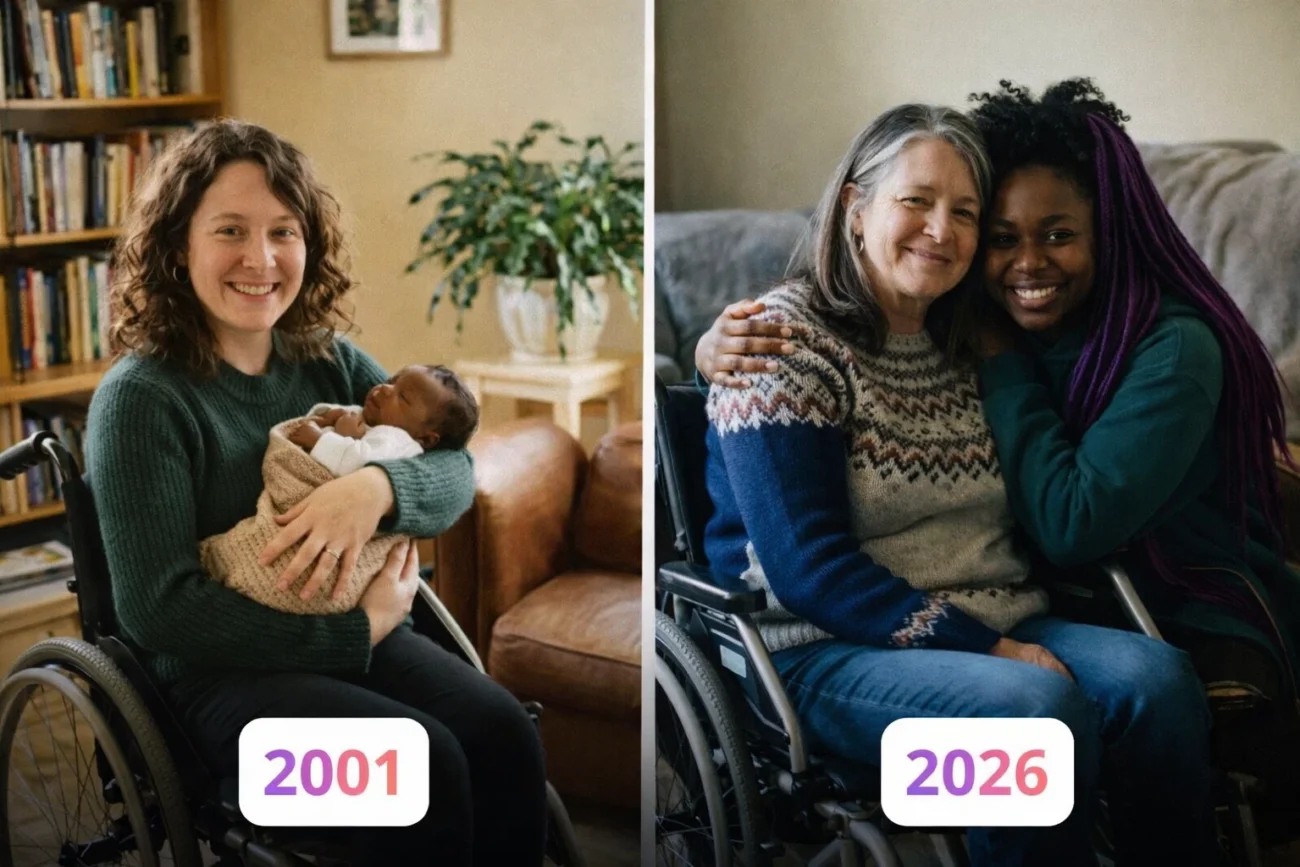
I was left on a stranger’s doorstep as a newborn and adopted by a single woman who used a wheelchair. Twenty-five years later, my understanding of what family truly means was put to the ultimate test.
My name is Isabel. I’m 25 years old.
My mother has used a wheelchair for as long as I can remember. In her early twenties, her life changed forever when a drunk driver crashed into her car. She survived, but the injuries left her paralyzed from the waist down. Doctors told her she would never walk again and that having children would not be possible.
She once told me she cried only one time—lying in that hospital bed. Then she made a decision: this would still be her life, and she would live it fully.
She moved into an apartment, learned how to drive with hand controls, worked as a paralegal, and built a stable routine. Motherhood was no longer part of her plans.
Until one freezing morning.
She was getting ready for work when she heard a sharp, desperate cry outside her front door. It wasn’t an animal. It was unmistakably a baby.
She opened the door and froze.
On her doormat sat a baby carrier. Inside was a newborn, red from the cold, wrapped in a thin blanket. Next to the carrier was a folded note.
She kept that note. I’ve read it many times. It said only:
“I can’t keep her. I have no choice. I’m sorry.”
She called emergency services immediately. Paramedics checked me and said I was cold but otherwise healthy. They told her social services would take over and asked whether she wanted them to take me right away.
She looked at me and said, “I’m going to be her mother.”
People told her she was being unrealistic. She was single. She used a wheelchair. They said a “normal family” would be better for me.
She listened—and ignored them.
She went through inspections, interviews, and subtle discrimination. People questioned whether a disabled woman could raise a child. She refused to accept that logic.
Months later, the adoption was finalized. She named me Isabel.
To me, she was never “the woman who adopted me.”
She was simply my mom.
It was always just the two of us. No nearby family. No backup. She was at every school event, every meeting, every performance. If a building wasn’t accessible, she demanded it be. If someone spoke past her, she corrected them.
On my first day of school, she fixed my backpack and told me I was braver than I felt.
She helped me with homework, taught me how to cook safely, and never dismissed my feelings. She taught me that emotions mattered—but so did resilience.
I always knew I was adopted. She told me early and honestly.
“One night, someone left you at my door,” she said. “I opened it. From that moment on, you were mine.”
I never felt abandoned.
I felt chosen.
When I went away to college, she cried and tried to hide it. She told me to build something meaningful and to never forget where I came from.
During college, that “something” began. A friend and I started designing simple, comfortable clothing. We named the brand Doorstep. We had no investors—just savings, long nights, and determination.
The business grew slowly, then faster. After graduation, we rented a tiny office. We made mistakes, fixed them, and kept going.
My mom was there for all of it. She folded shirts, answered emails, reviewed contracts. She was our unofficial third partner.
When I bought my first car with money I earned myself, I showed her the keys. She cried—not because of the car, but because I had built something on my own.
I thought that was the most emotional moment of my life.
Then one morning, I opened the door—and everything changed.
A woman stood outside. Well-dressed. Confident. She looked at me like she already knew me.
She introduced herself as my biological mother.
She said she had found me through my business. She said she always knew I would be successful. She claimed my life turned out well because she had chosen the “right door” to leave me at.
Then she demanded half of my company—and my car.
I invited her inside, in front of my mom. I placed a photo album on the table—my life, from infancy to adulthood.
I asked her to find one picture where she had been there.
She couldn’t.
She argued that giving birth should be enough. I told her it wasn’t.
She made her choice 25 years ago.
I was making mine now.
I told her she was not entitled to my money, my business, or my life. If she contacted me again, it would be considered harassment.
She left.
I locked the door and leaned against it, shaking. My mom came to me, terrified that I might wish I had chosen differently.
I hugged her and told her the truth.
She opened the door.
She stayed.
She showed up every single day.
That night, we sat together, turning page after page of my life—each one with her in it.
That’s when it became permanent in my heart:
Family is not created by DNA.
It’s created by love, commitment, and staying when it’s hard.