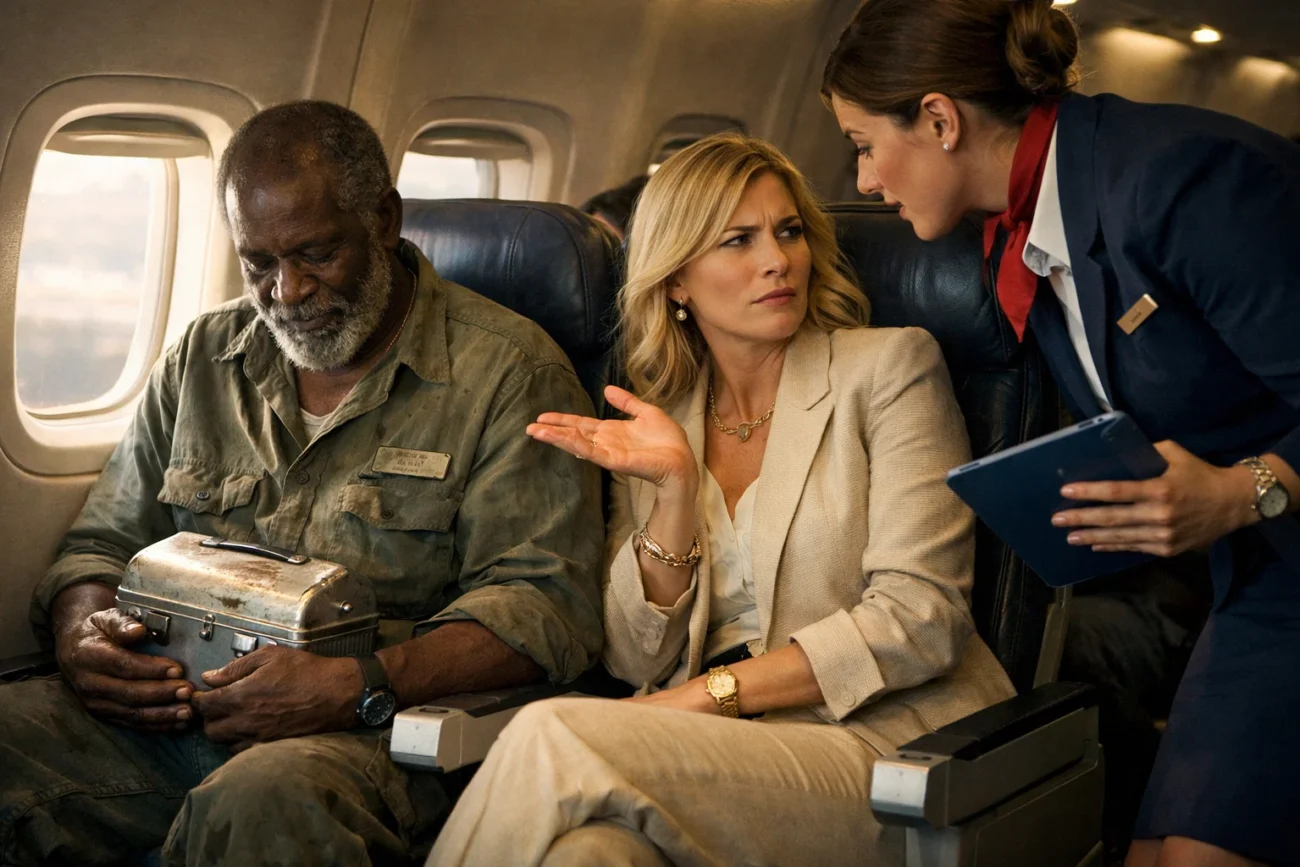
I was seated in 2C, directly across the aisle, when the man boarded the plane. His utility jacket was stained and worn, his boots crusted with dried mud. In his hands, he held a dented metal lunchbox, gripping it with the care someone might give to a priceless heirloom.
The woman by the window reacted immediately.
She let out an exaggerated groan and recoiled, her face twisted in open disgust.
“You have got to be kidding me,” she snapped, waving frantically at a flight attendant. “I paid two thousand dollars for this seat. I will not sit next to the help.”
The man’s name tag read Curtis. He stiffened, shrinking into himself as if trying to disappear. His eyes dropped to his rough, calloused hands. He didn’t argue. He didn’t protest.
“Ma’am, please lower your voice,” the flight attendant said calmly. “That is his assigned seat.”
“I don’t care,” the woman hissed. “He smells like oil and dirt. Check his ticket again. He probably stole it.”
Curtis stood slowly, humiliation written across his face.
“It’s alright,” he said quietly, his voice barely steady. “I saved for five years to afford this ticket. I just wanted to experience it once. But I’ll move.”
He began gathering his things. The woman smirked, glancing around the cabin as if expecting support. None came.
Suddenly, the cockpit door swung open.
The Captain stepped out, moving fast and with purpose. He had clearly heard everything.
The woman straightened, satisfied. “Finally,” she said. “Captain, remove this man.”
But the Captain didn’t even look at her.
He stopped in front of Curtis, his face draining of color. Then, without hesitation, he snapped to attention and saluted him sharply—right there in the aisle.
“Sir,” the Captain said firmly, “please remain where you are.”
The cabin froze.
“What are you doing?” the woman shrieked. “He cleans toilets!”
The Captain turned on her, his expression blazing with controlled fury.
“Ma’am,” he said, “collect your belongings and leave this aircraft immediately.”
“You can’t be serious!” she screamed. “Do you know who I am?”
“I don’t care,” the Captain replied coldly. “Because you are not fit to sit near this man. He is the reason my family was able to bury my brother.”
A stunned silence swept through first class.
“My brother, Sergeant Mark Harrison, served alongside him,” the Captain continued, his voice thick with emotion. “He didn’t survive. But because of Curtis, he came home.”
Curtis stood frozen, his lunchbox still clenched in his hands.
“This man,” the Captain said to the cabin, “is Sergeant First Class Curtis Miller. He is a hero.”
The woman sputtered. “A hero? He’s a janitor!”
“The kind of hero who already gave more than you ever will,” the Captain shot back. “Now get off my plane.”
Security arrived moments later. The woman stormed out, red-faced and shaking with rage, threatening lawsuits no one believed.
As she left, quiet applause began—slow, respectful, directed entirely at Curtis.
He took his original seat by the window, stunned.
Later, the Captain invited him into the cockpit.
They spoke of loss, of war, of promises kept and lives changed forever.
Curtis explained the flight was for his daughter—Lily—whom he hadn’t seen in years. He hoped the trip might be a first step toward healing.
When the plane landed, the Captain asked the entire cabin to remain seated.
“Today,” he said over the intercom, “we flew with a true hero.”
The plane erupted in a standing ovation.
At the gate, reporters waited.
The woman’s name was revealed: Eleanor Albright, CEO of Albright Defense Dynamics—the same company responsible for the faulty armored vehicles that had cost lives.
The irony was devastating.
Investigations reopened. Careers collapsed.
Curtis said nothing.
Days later, he stood in a quiet apartment as his daughter knocked on the door.
“Dad,” she whispered.
And that was enough.
Curtis declined lawsuits, money, fame.
His reward was already in his arms.
Because real worth is never measured by status or appearance—but by what you give when no one is watching.
And some heroes don’t wear uniforms anymore.
They carry lunchboxes.