
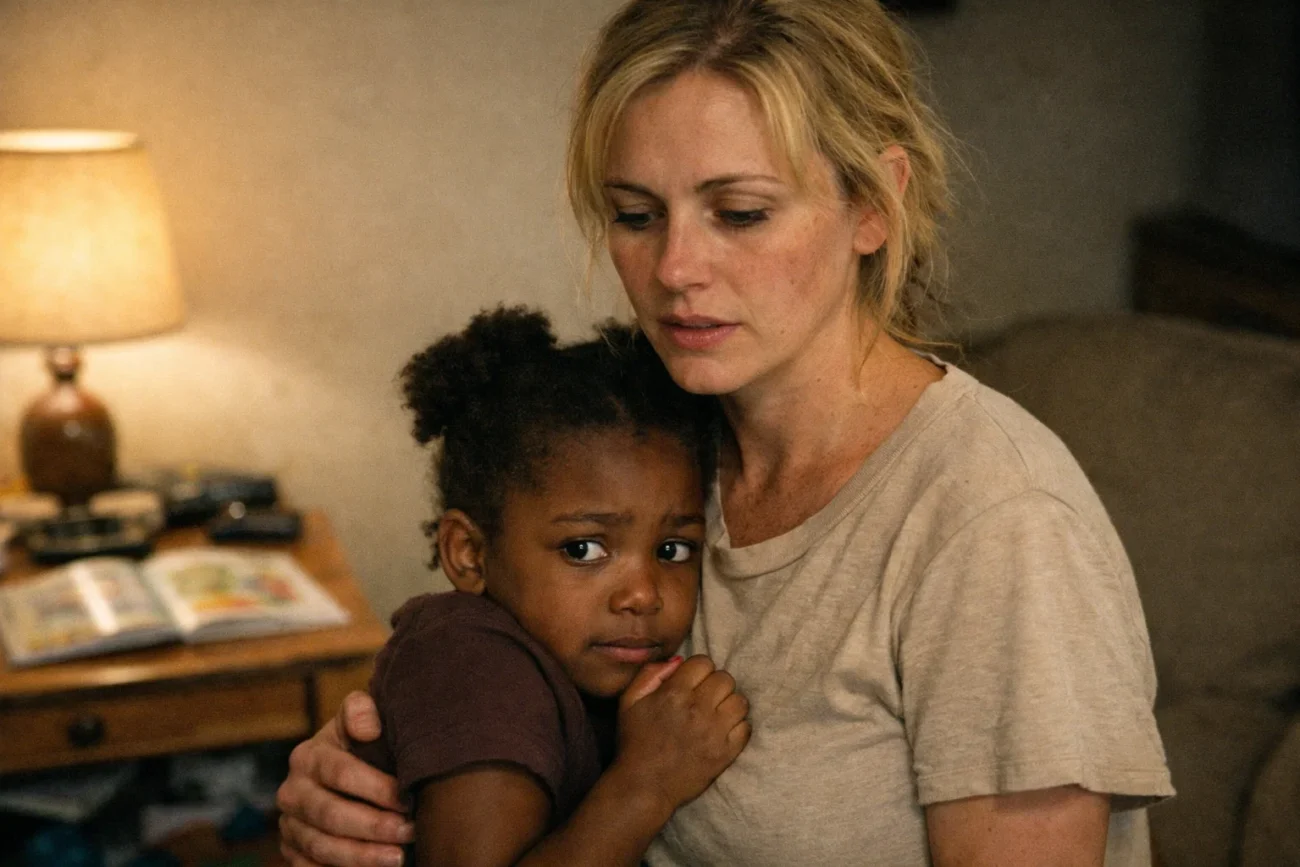
Nancy always believed that motherhood would be her ultimate healing. After years of staring at the bright yellow walls of an empty nursery, the arrival of seven-year-old Giselle felt like the final piece of a broken puzzle. But the dream of a perfect family didn’t just crack—it shattered the moment the front door opened. When Giselle saw Nancy’s husband, Stephen, for the first time, she didn’t see a father. She saw a monster from her darkest memories, and her scream would haunt them both for years.
The silence of the yellow room
For Nancy, the journey to motherhood was paved with medical reports and the heavy silence of “congenital infertility.” At twenty-three, her world had been reduced to a clinical diagnosis. Her husband, Stephen, a dedicated trauma surgeon, tried to fill the void with hope. He painted a room yellow, laid down soft carpets, and filled shelves with books for a child they hadn’t met yet. He promised her that they would give a home to someone who had none.
The opportunity finally arrived when Stephen was called away on a month-long humanitarian mission. Left alone to finalize the process, Nancy visited a local orphanage. There, she found Giselle—a quiet girl coloring a “rainbow house” for people who didn’t have one. The connection was instantaneous. Giselle moved in three weeks later, and the house finally had the “street smell” of a real home: pancake batter on the counter, smudged crayons on the floor, and the sound of small feet.
The doorbell that changed everything
Nancy intentionally kept Stephen a mystery. She wanted the first meeting to be a pure, cinematic moment of joy. She didn’t show Giselle pictures; she wanted her to see his face in person. On the day of his return, Nancy dressed Giselle in a pink dress and cooked a massive roast chicken dinner.
When the doorbell rang, Stephen stood there with balloons and dolls, his face radiant with anticipation. But as his eyes met Giselle’s, the atmosphere in the room turned ice-cold. Giselle didn’t run to him. Instead, she yanked her hand away from Nancy and retreated into a corner, her voice trembling with a raw, primal terror: “OH NO, NOT HIM AGAIN! Do not let him touch you! PLEASE!”
The balloons floated to the ceiling, forgotten. Stephen’s presents hit the floor with a hollow thud. He looked at the girl not with confusion, but with the hollow gaze of a man who had just seen a ghost.
A secret buried in the ER
The truth was far more tragic than a simple misunderstanding. A year prior, long before the adoption papers were signed, Stephen had been the lead surgeon on a high-stakes trauma case. A woman had been brought in after a catastrophic car accident. Her young daughter had wandered into the hallway and peered through the glass of the trauma bay.
In that room, the girl had seen a man in scrubs pressing paddles to her mother’s chest, the violent jolts of defibrillation looking like an assault to a six-year-old’s eyes. That man was Stephen. Despite his desperate efforts to restart her heart, the mother didn’t survive. To Giselle, Stephen wasn’t the man who tried to save her mother; he was the man she saw “hurting” her.
The cruelty of a broken father
Seeking clarity, Nancy and Stephen tracked down Giselle’s biological father, Matthew. The meeting in a crowded coffee shop revealed a reality “dirtier” than any fiction. Matthew hadn’t just lost his wife; he had lost his humanity. He had abandoned Giselle at the orphanage gate with a lie about getting candy because he couldn’t look at her without seeing the wife he lost.
“She’s the reason my wife is dead,” he spat, showing an arrogance that only a broken man could harbor.
Nancy held Giselle close, realizing that the girl had been abandoned twice—once by a father who blamed her, and once by a world that left her with a traumatizing memory. Stephen, however, made a different choice. He didn’t walk away from the girl who feared him; he chose to stay and dismantle the fear he had accidentally created.
Healing with a teddy bear
The path to trust was built on the floor of their living room. Using a teddy bear as a patient, Nancy and Stephen gently explained the mechanics of a heart and the desperate measures of a surgeon.
“He wasn’t hurting my mommy?” Giselle asked, her eyes searching Stephen’s face for the first time without flinching.
“I tried as hard as I could, sweetheart,” Stephen whispered.
The healing didn’t happen overnight, but it was anchored in reality. A week later, Giselle helped hang a framed photo of the three of them. She looked at the image—a trauma surgeon, a woman who refused to give up, and a girl who finally understood what “forever” meant—and realized she was finally home.
Narrative Fiction → This narrative is a work of creative fiction inspired by the psychological complexities of real-world social archetypes.