For three hours, no one stopped.
Seven-year-old Tyler Morrison sat behind a small folding table at the edge of our quiet suburban street, trying to sell lemonade. His bald head was hidden under a faded yellow baseball cap, and his thin fingers kept rearranging the plastic cups like maybe that would make people notice him.
No one did.
Everyone in the neighborhood already knew.
The doctors had said Tyler’s cancer was terminal.
So cars slowed down when they reached his stand… and then quietly sped back up again. Parents walking their children crossed to the other side of the street before they reached him. One woman actually covered her little girl’s eyes as they hurried past, as if seeing a dying child might somehow bring bad luck.
Tyler didn’t cry.
He just sat there in a bright yellow T-shirt that hung loosely on his fragile frame. His mason jar for money stayed empty. Every once in a while his lip trembled, but he kept smiling anyway.
Waiting.
Then the sound came.
Low. Heavy. Like thunder rolling down the road.
Tyler looked up instantly.
Four Harleys turned onto the street, their engines rumbling through the quiet neighborhood. Leather vests. Chrome shining in the afternoon sun.
The reaction was immediate.
Doors started closing. Parents pulled their kids inside. Mrs. Henderson nearly ran to her porch and slammed the door like trouble had just arrived.
But Tyler did the opposite.
For the first time in three hours, he stood up.
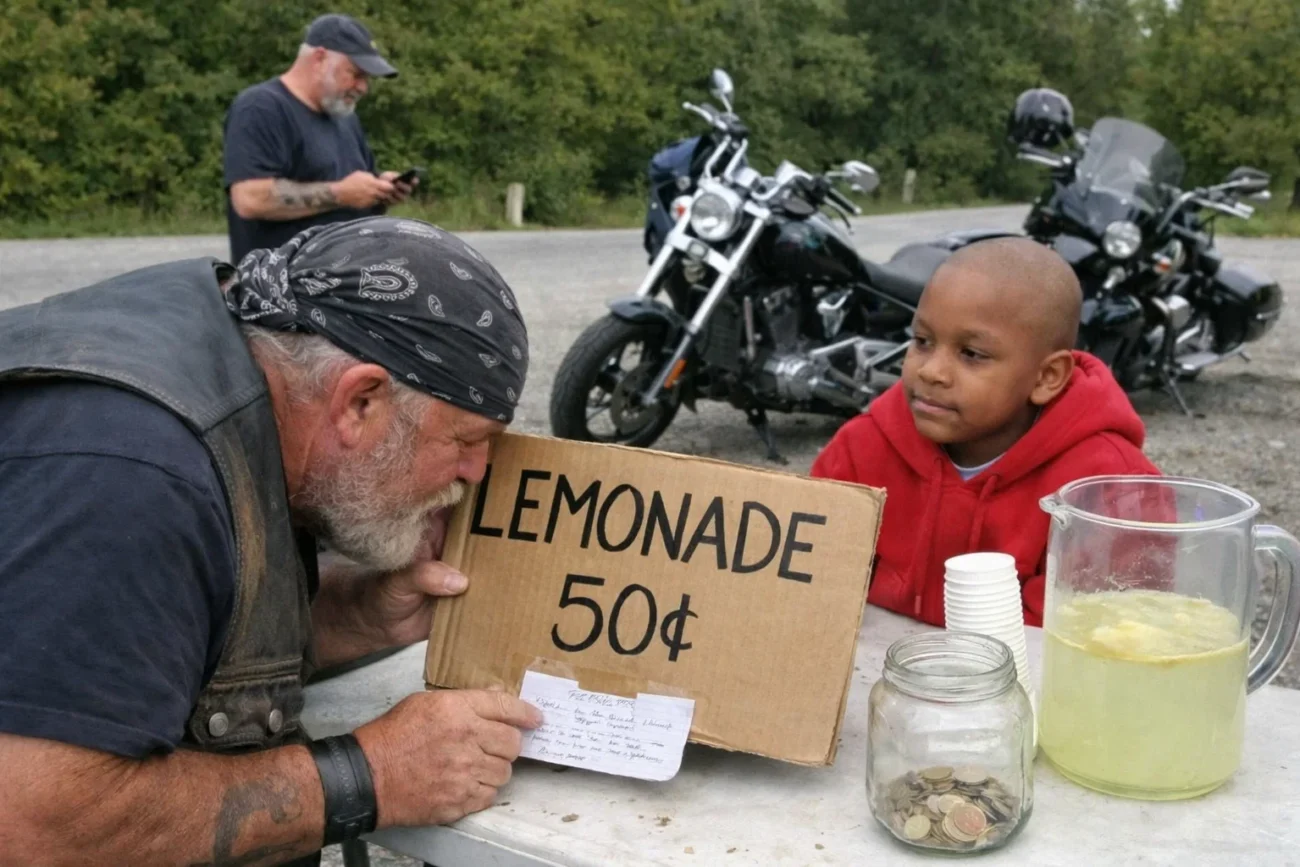
The lead rider was enormous—easily three hundred pounds—with a long gray beard and tattoos climbing both arms. He pulled his Harley to the curb right in front of Tyler’s table and shut off the engine.
When he removed his helmet, that’s when he noticed it.
The small handwritten note taped underneath the cardboard sign that read “LEMONADE – 50¢.”
His expression changed instantly.
He glanced at the other bikers and muttered something under his breath. One by one, their engines went silent.
The big man walked over to the stand and crouched down.
“Hey there, little man,” he said gently. “How much for a cup?”
Tyler’s voice barely carried.
“Fifty cents, sir. But… you should read the note.”
He pointed underneath the sign.
The biker leaned closer and slowly pulled the paper loose so he could read it.
From my porch, I watched his shoulders start to shake.
This giant man who looked like he could lift a truck with his bare hands suddenly couldn’t stop crying.
The note read:
“I’m not really selling lemonade.
I’m selling memories.
My mom needs money for my funeral but she doesn’t know I know.
Please help me help her before I die.
– Tyler, age 7.”
The biker stood up slowly.
He opened his wallet and placed a crisp hundred-dollar bill into Tyler’s jar.
“I’ll take twenty cups,” he said.
Tyler blinked in surprise.
“But I only want one. The rest are for my brothers.”
The boy’s eyes filled with tears.
“You don’t have to do that…”
“Yes,” the biker said quietly. “I do.”
He knelt again and extended a hand.
“What’s your name, warrior?”
“Tyler… Tyler Morrison.”
“Well, Tyler Morrison,” the biker replied, “my name is Bear. These are my brothers—Diesel, Tank, and Preacher. We’re from the Leathernecks Motorcycle Club.”
He paused.
“All Marines.”
Tyler’s eyes widened.
“You were soldiers?”
“Marines,” Bear corrected softly. “And we recognize courage when we see it.”
Just then the front door of Tyler’s house flew open.
His mother, Janet, rushed out.
“Tyler! What are you—”
She stopped when she saw the bikers gathered around him.
Fear crossed her face.
Bear removed his sunglasses and spoke carefully.
“Ma’am… your boy is something special.”
Janet’s expression collapsed.
“Tyler, sweetheart… you don’t need to worry about money.”
“But Mom,” Tyler whispered, “I heard you crying on the phone. You told Grandma you didn’t have enough for… after.”
Janet sank into a nearby lawn chair, sobbing.
Bear knelt beside her.
“How long?” he asked gently.
“Six weeks,” she whispered. “Maybe less.”
Bear stood up and pulled out his phone.
“Diesel,” he said quietly. “Call the brothers. All of them.”
Within an hour, motorcycles filled the street.
Forty-seven bikers showed up that afternoon.
Each one walked up to Tyler’s table.
Each one read the note.
And each one dropped money into the jar.
Twenty dollars.
Fifty.
One biker placed five hundred dollars in and couldn’t speak through his tears.
Tyler tried to pour lemonade for everyone, but his hands trembled too badly.
Bear took the pitcher.
“You direct,” he said with a grin. “I’ll pour.”
For three hours the bikers stayed.
They drank lemonade.
They told stories about their motorcycles.
They let Tyler sit on their bikes and take pictures.
But more importantly, they made a promise.
Over the next five weeks, Tyler’s lemonade stand became something none of us had ever seen.
Every Saturday the Leathernecks MC came back.
And they didn’t come alone.
Other clubs arrived. Veterans groups. Riders from neighboring states.
Tyler’s tiny mason jar turned into a pickle jar.
Then a five-gallon bucket.
The story spread.
By the end, Tyler had raised $47,832.
Enough to pay for his funeral.
Enough to keep his mother in their home for a year.
Enough to create a small fund to help other families facing the same nightmare.
Tyler passed away on a Tuesday morning at 4 a.m.
Janet called Bear.
Within two hours, motorcycles began arriving again.
Dozens of bikers stood in the rain outside the house, forming an honor guard as Tyler was taken to the funeral home.
At the funeral, 347 bikers came.
They filled the cemetery.
When Tyler’s small casket was lowered into the ground, hundreds of engines roared one final time.
Bear stepped forward to speak.
“Tyler Morrison was seven years old,” he said, his voice breaking. “And in five weeks he showed more courage than most of us manage in a lifetime.”
“He wasn’t selling lemonade.”
“He was reminding us what it means to take care of each other.”
Today the Leathernecks MC runs the Tyler Morrison Memorial Fund.
Every year, bikers across the state set up lemonade stands to raise money for families battling childhood cancer.
They’ve raised over $300,000 so far.
But in Janet’s garage, one thing never moved.
The old folding table.
The cardboard sign.
And the little note Tyler taped underneath it.
Because that’s what he was really selling that day.
Not lemonade.
Hope.
And the kind of courage that even grown men on Harley motorcycles will never forget.
This story is written as a narrative feature inspired by real situations shared within communities. Some names, dialogue, and minor details may be adapted or dramatized for storytelling clarity and reader experience while preserving the core message of the events described.