The accusation came without warning.
“Step away from the vehicle. Now.”
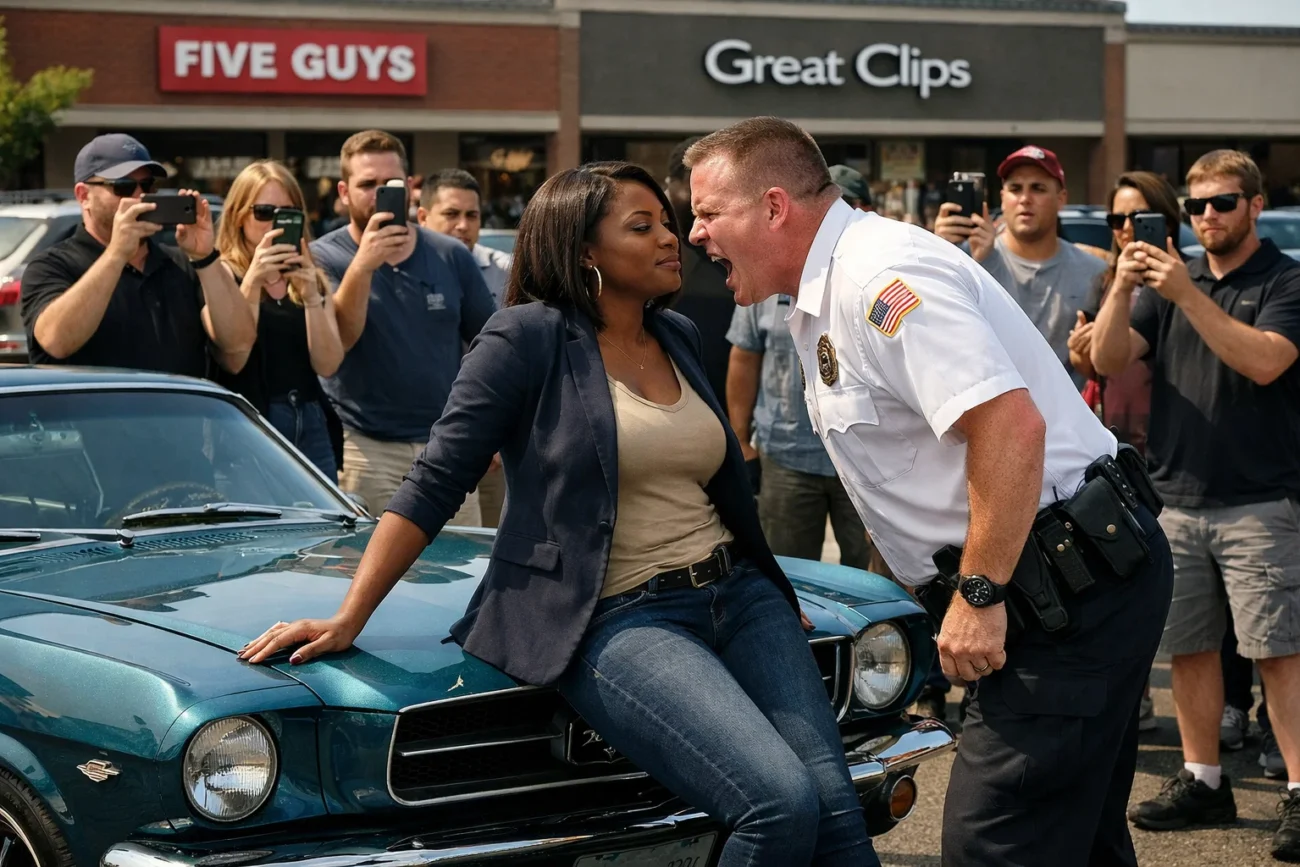
The command echoed across the shopping center parking lot, sharp enough to turn heads. Officer Derek Mitchell stood rigid beside a flawless blue 1967 Mustang, one hand resting near his holster. His eyes never left the woman standing by the driver’s door.
Keisha Washington froze.
She lifted her hands slowly, the afternoon sun reflecting off the polished chrome of the car behind her. Around them, the ordinary hum of a Saturday afternoon began to fracture. Shoppers slowed. Phones appeared. A loose circle of strangers formed, instinctively sensing that something wasn’t right.
“That car is reported stolen,” Mitchell said loudly. “And I know you didn’t buy it.”
Keisha’s handbag slid from her shoulder as she complied with his orders, placing her palms against the hood. Inside the car, on the passenger seat, sat a leather portfolio—its official seal half-hidden beneath loose papers. No one noticed it yet.
Ten minutes.
That was all the time left before courthouse staff would realize Judge Keisha Washington was missing from an emergency judicial session downtown.
Mitchell paced around the vehicle, studying her like a puzzle he believed he’d already solved. In his mind, the equation was simple—and deeply flawed.
A Black woman. Casual clothes. A car worth more than most people earned in a year.
It didn’t make sense to him.
“This vehicle costs more than you make in years,” he said, his voice intentionally loud for the crowd gathering behind him. “So let’s stop pretending and start telling the truth.”
Twenty feet away, a college student named Amara Johnson held her phone steady, livestreaming everything. The viewer count climbed fast—hundreds, then thousands. Comments flooded in faster than she could read.
Keisha inhaled slowly, forcing calm into her voice. “Officer, there’s an explanation.”
“No,” Mitchell snapped. “You’ll explain later. Right now I need registration, insurance, and proof you didn’t steal this car.”
An elderly woman in the crowd stiffened, recognition flickering across her face.
“That’s not—” she began.
“Ma’am, step back,” Mitchell warned without looking away. “This doesn’t concern you.”
Keisha felt her phone vibrate against her hip. The Chief Justice—again. She couldn’t answer. Not like this.
The car wasn’t just a car. It was her father’s. Every inch of it restored with care. Every drive a memory.
“I need you to empty your pockets,” Mitchell continued. “Backup is on the way.”
The word backup rippled through the crowd. More phones came out.
Amara’s stream jumped past 8,000 viewers.
“This is insane,” someone muttered. “She’s not even resisting.”
Mitchell ignored them.
“How did you get the vehicle?” he demanded again.
“It belonged to my father,” Keisha said evenly. “Judge Robert Washington.”
The name landed softly—but meant nothing to Mitchell.
“I need documentation.”
The crowd murmured.
The elderly woman tried again. “Officer, I worked at the courthouse for—”
“Final warning,” Mitchell barked. “Interfere and you’ll be detained.”
Keisha closed her eyes briefly.
Her briefcase was in the back seat. Inside it—everything that could end this instantly. Judicial ID. Registration. Court documents.
But reaching for it now would only escalate things.
So she waited.
Minutes passed. Sirens approached. Two patrol cars pulled in, lights flashing. Sergeant Reynolds stepped out, taking in the scene with practiced caution.
“What’s going on?” he asked.
“Suspected vehicle theft,” Mitchell replied. “She won’t provide documentation.”
Reynolds studied Keisha more closely. Something didn’t sit right.
Officer Janet Torres arrived next, immediately managing the crowd as local media vans rolled into the lot. Cameras set up. Microphones raised.
Amara’s stream surged past 20,000 viewers.
“Ma’am,” Reynolds said more calmly, “can you tell us where your documents are?”
“In my briefcase,” Keisha replied. “In the back seat.”
“I’ll retrieve them,” Mitchell said, stepping forward.
“No,” Keisha said sharply. “That briefcase contains confidential legal materials. You cannot search it.”
Mitchell smirked. “If you have nothing to hide—”
“I am asserting my Fourth Amendment rights,” she said firmly.
The crowd stirred.
Then a voice broke through.
“That woman is Judge Keisha Washington.”
Everyone turned.
The elderly woman had pushed forward, shaking but determined. “I worked in that courthouse for forty years. Her father drove that car for decades.”
Mitchell scoffed. “Anyone can claim that.”
But Reynolds hesitated.
Dispatch crackled over the radio.
“All units be advised. Judge Keisha Washington is missing from an emergency judicial session. Last seen driving a blue 1967 Mustang, license plate JRW-1967.”
Reynolds looked at the plate.
JRW. 1967.
Judge Robert Washington.
Everything clicked.
Mitchell’s face drained of color.
Keisha’s phone rang again.
She spoke calmly. “I’m going to retrieve my identification now.”
Reynolds nodded. “Go ahead.”
The parking lot went silent.
She reached slowly into the car, opened the portfolio, and held it up.
Inside was a judicial ID bearing the seal of the Superior Court.
Judge Keisha Washington.
The crowd erupted.
Amara’s stream exploded past 50,000 viewers.
Mitchell staggered back as if struck.
“Your badge number,” Keisha said quietly, “is 4847. And you just violated my constitutional rights.”
Reynolds removed his cap. “Your Honor… we had no idea.”
“Because you didn’t look,” she replied. “You assumed.”
She laid out the facts. Her father’s ownership. The transfer. The registration. The pattern.
The media closed in.
“Judge Washington,” a reporter asked, “what does this say about policing today?”
“It says bias doesn’t disappear just because someone wears a uniform,” she replied. “And accountability cannot be optional.”
Then came the final blow.
“The case I missed today?” she said, looking directly at Mitchell. “Your federal civil rights lawsuit. I was the deciding vote.”
The silence was absolute.
Commissioner Hayes arrived moments later—his mother standing proudly in the crowd.
Mitchell was suspended on the spot.
Six months later, his testimony before the legislature helped pass sweeping police reform.
The Mustang still sits in Judge Washington’s driveway.
A reminder.
Not of humiliation—but of truth revealed.
Because justice doesn’t need shouting.
Sometimes, it only needs patience—and proof.