
Part 1
The floors of the Montclair mansion were stone, polished smooth and unforgivingly cold. The chill rose through my feet, a sharp contrast to the oppressive August heat that clung to my linen shift. It was 1840, deep in New Orleans, and I was being sent to the west wing of the estate.
I walked barefoot, silently. Silence was a skill I had learned quickly. Those who moved unseen tended to survive longer.
This wing was known by a single name among the servants: the Devil’s Wing. It was where Alexander Montclair lived—the only son of the Montclair dynasty, heir to an empire built on shipping lanes and sugarcane fields.
As I passed through the house, the other servants watched me with open sympathy. Sweat streaked their faces; fear lived plainly in their eyes.
“He will destroy you,” Hattie, the cook, murmured as she pressed a small sachet of dried lavender into my palm. “Keep your eyes lowered. Speak only if spoken to. And whatever you do—do not stare.”
Alexander Montclair’s reputation preceded him. He was known for his cruelty, his sharp temper, and the deliberate ways he broke those assigned to him. Only days earlier, a young servant named Delia had returned from his rooms trembling so violently she shattered a porcelain tray. At dawn the next day, she was sent to the fields. No one ever came back from the fields unchanged.
Now it was my turn.
I had been purchased three weeks earlier at the St. Louis market. I was quiet, obedient, forgettable. I had hoped that would be enough. But Alexander Montclair had noticed me in the corridor and requested me specifically.
That was what frightened me most.
I stopped before the towering mahogany doors. They loomed like a warning. From behind them drifted the scent of tobacco, leather, and old books—wealth and restraint layered over something sharper.
I knocked once.
“Enter.”
His voice was calm, uninterested. That unsettled me more than shouting ever could.
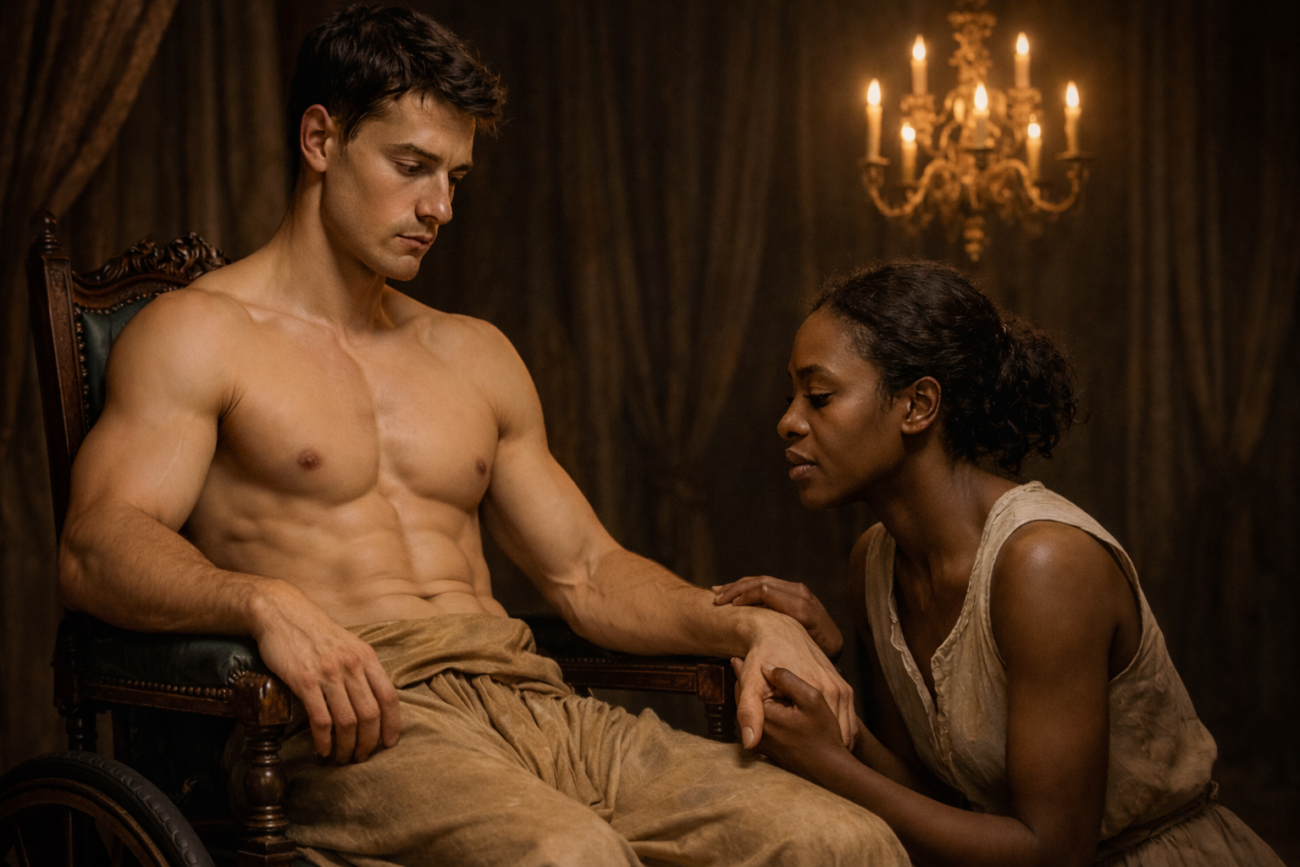
The door opened into a dim, heavy room. Velvet curtains blocked the sunlight. The air was thick, still. At the center sat Alexander Montclair in a massive wheelchair carved from rosewood and brass, as ornate as a throne.
His torso was bare. I dropped my gaze immediately, though not before noticing his strength—broad shoulders, solid arms, a chest shaped by power rather than fragility.
He watched me closely, unmoving, as if examining a specimen.
“You are the new one,” he said.
“Yes, Master. My name is Isidora.”
“Look at me.”
Cold spread through my chest as I obeyed. His eyes were gray-blue, sharp and distant, like storm water in the harbor.
“I was told you do not cry,” he said. “The last one did.”
He gestured toward the copper bathing tub where steam rose steadily. A boy tending the water bowed and fled the room, leaving us alone.
“I dislike shaking hands,” Alexander continued. “If you are to bathe me, begin.”
The silence felt charged, tense as a held breath.
I moved with care, testing the water, adding the herbs Hattie had given me. I focused on precision, on control. Fear would betray me. Professionalism was my only shield.
I washed his back and shoulders, then his chest and arms. His body was powerful, but rigid with pain. His gaze never left me, as if waiting for a mistake.
At last, only the linen covering his lap remained.
As my fingers reached for the knot at his waist, his body stiffened.
“Stop.”
I froze.
“Look at me,” he said, his voice strained.
His face was pale, his jaw tight. The cruelty vanished, replaced by something raw.
He was afraid.
“If you speak of what you see,” he warned quietly, “if you show disgust or pity, I will not send you to the fields. I will have you whipped and sold downriver. Do you understand?”
“I do,” I replied calmly.
After a long pause, he nodded.
“Proceed.”
I untied the cloth. It slid into the water.
What lay beneath stole my breath.
His legs were not merely weak or wasted. They were marked beyond recognition—burn scars arranged with intention, blade marks crossing pale flesh, puncture wounds driven deep and repeated.
This was not illness. This was deliberate cruelty.
Alexander watched my face, waiting for horror or revulsion.
I showed none.
After a long silence, he spoke.
“I was seventeen.”
Part 2
His gaze drifted to the curtains as he continued.
“My father sent me to oversee shipping routes in the Caribbean. He believed hardship would shape me.”
A bitter sound escaped him.
“I was ambushed. The Devereaux family. They did not want money. They wanted an example.”
He described three days of captivity—fire, knives, spikes—methods designed not to kill, but to erase.
“They wanted to ensure I would never stand above anyone again.”
They left him in a swamp, expecting death. Instead, he survived—only to return broken and confined to the chair.
When he finished, the room fell silent.
He waited for my reaction.
Instead, I knelt before him and placed my hand gently against one of the scars.
His body shuddered.
“This is not shame,” I said softly. “This is survival.”
Something within him collapsed. He wept—not loudly, but deeply.
From that day forward, everything changed.
I became his sole attendant. I bathed him, dressed him, read aloud from philosophy texts and ledgers. The baths became a form of care rather than confrontation.
Alexander spoke of pain, of resentment toward his father, of isolation. I did not need to share my own history. He understood it without words.
Over time, the household noticed the change. The Devil of Montclair no longer ruled through cruelty.
Then his father intervened.
One evening, Master Montclair entered unannounced and declared I would be sold.
Alexander refused.
For the first time, he confronted his father—not with rage, but with certainty. He threatened exposure of crimes and corruption.
His father retreated.
The following day, Alexander summoned me. On his desk lay my manumission papers and the deed to a small house.
“You gave me back my will,” he said. “This is only justice.”
At sunrise the next morning, I walked out of the Montclair estate free.
From the west wing window, Alexander Montclair watched me go, knowing that healing had begun—for both of us.
⸻
Editorial Note
This text is a work of historical fiction. It portrays themes of enslavement, violence, and trauma in a non-graphic, contextualized manner for narrative and educational purposes. No endorsement of historical injustices is implied.