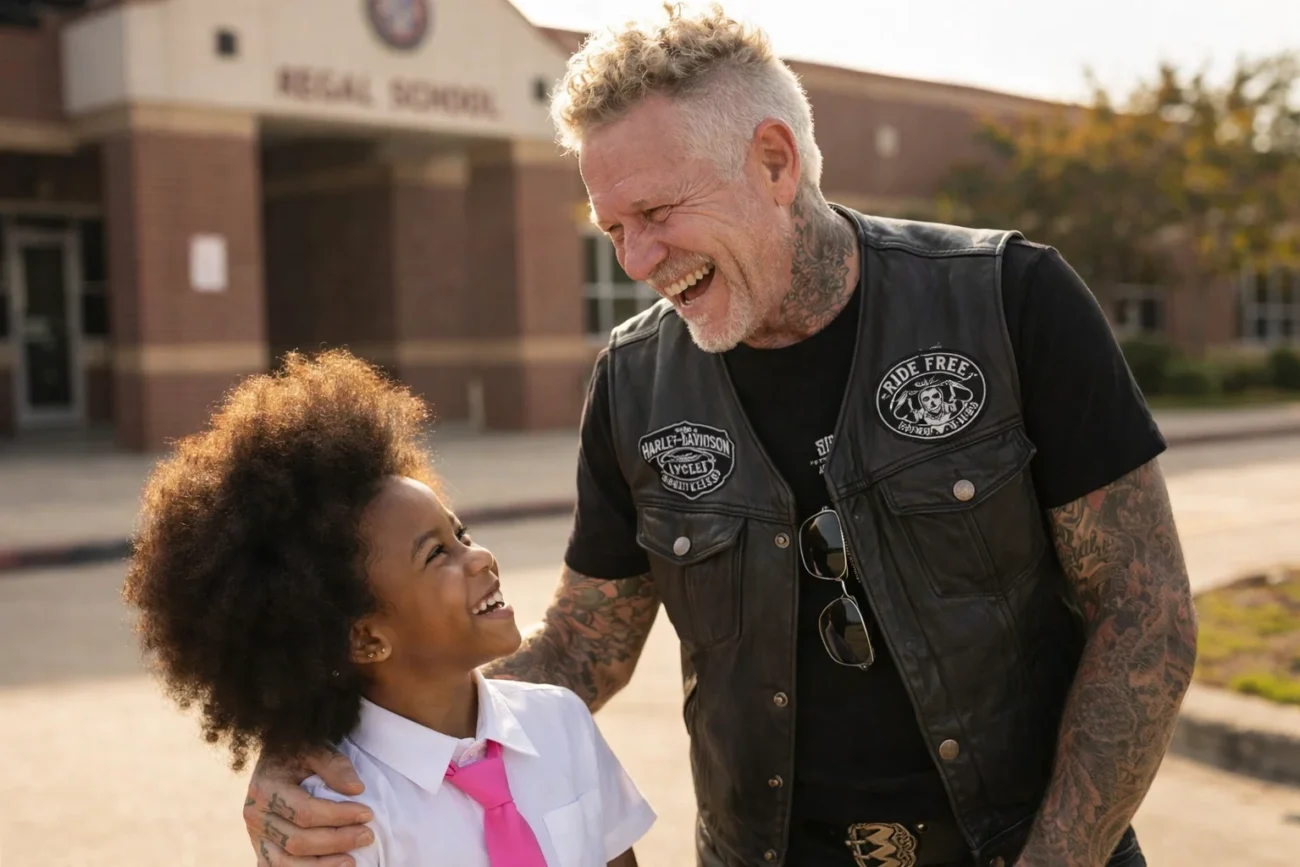
For a long time, I believed I was doing nothing more than a simple favor. After finishing my night shifts, I would walk my neighbor’s young daughter to school each morning. It all began on a day I will never forget, when I heard a child sobbing behind an apartment building. It wasn’t loud crying, but the quiet, exhausted kind that suggests it has gone on far too long. I found her sitting alone near a dumpster, already dressed in her school uniform, holding her backpack as if it were her only anchor.
When I asked what was wrong, she explained that it was “daddy-daughter day” at school and that there was no one to walk with her. In that moment, something inside me broke open. I didn’t plan to get involved or consider the consequences. I simply offered to walk her to school. That small, instinctive choice ended up reshaping my entire life.
Her name was Marissa. She lived with her grandmother, an elderly woman whose health made it difficult for her to get around. On that first walk, Marissa gripped my hand with surprising strength, as if terrified I might disappear too. When I brought her back home later that day, her grandmother thanked me with a gratitude that sounded more like relief than courtesy. I told myself it would only happen once. But the following morning, Marissa was already waiting on the porch, watching for me as though she had been counting every second.
One walk turned into a daily habit, and the habit slowly became a connection neither of us had expected. Months passed, and one day Marissa proudly introduced me at school as “Daddy Mike.” I tried to gently correct her, but her grandmother asked me not to. She explained that it made Marissa feel secure. To my surprise, it also made me feel useful and needed in a way I hadn’t felt for years.
Then, one ordinary morning, everything changed.
I arrived at seven o’clock as usual, but Marissa was already outside, crying. A man stood beside her, gripping her hand while she tried to pull away. He looked unsettlingly familiar—similar eyes, similar features—and before he spoke, I felt a knot tighten in my stomach. He told me he was her uncle and that Marissa’s grandmother had passed away earlier that morning. He said he was there because he was “legally required” to be.
There was no warmth or sorrow in his voice. He sounded impatient, as if Marissa’s distress was an inconvenience. Then he presented his solution. He said he could take her out of state and she would “get used to it,” or I could keep her, since she was already attached to me and he didn’t want the responsibility. The way he spoke was chilling, as though he were negotiating over property instead of a child.
Fear flooded me—fear that I was too old, fear that I wouldn’t be enough for her, fear of loving someone only to lose them. But Marissa looked at me with complete trust, as if I were the last solid thing in her world. I remembered every promise I had ever made to her about not leaving. And in that moment, I said yes.
The next morning, at the school office, I signed the necessary documents and checked the box labeled “guardian.” That was when it truly sank in: my life hadn’t ended when it fell apart years before. It had simply been waiting—quietly—for a reason to begin again.
Disclaimer: This text is a fictional narrative created for storytelling purposes. Any resemblance to real persons or events is purely coincidental.