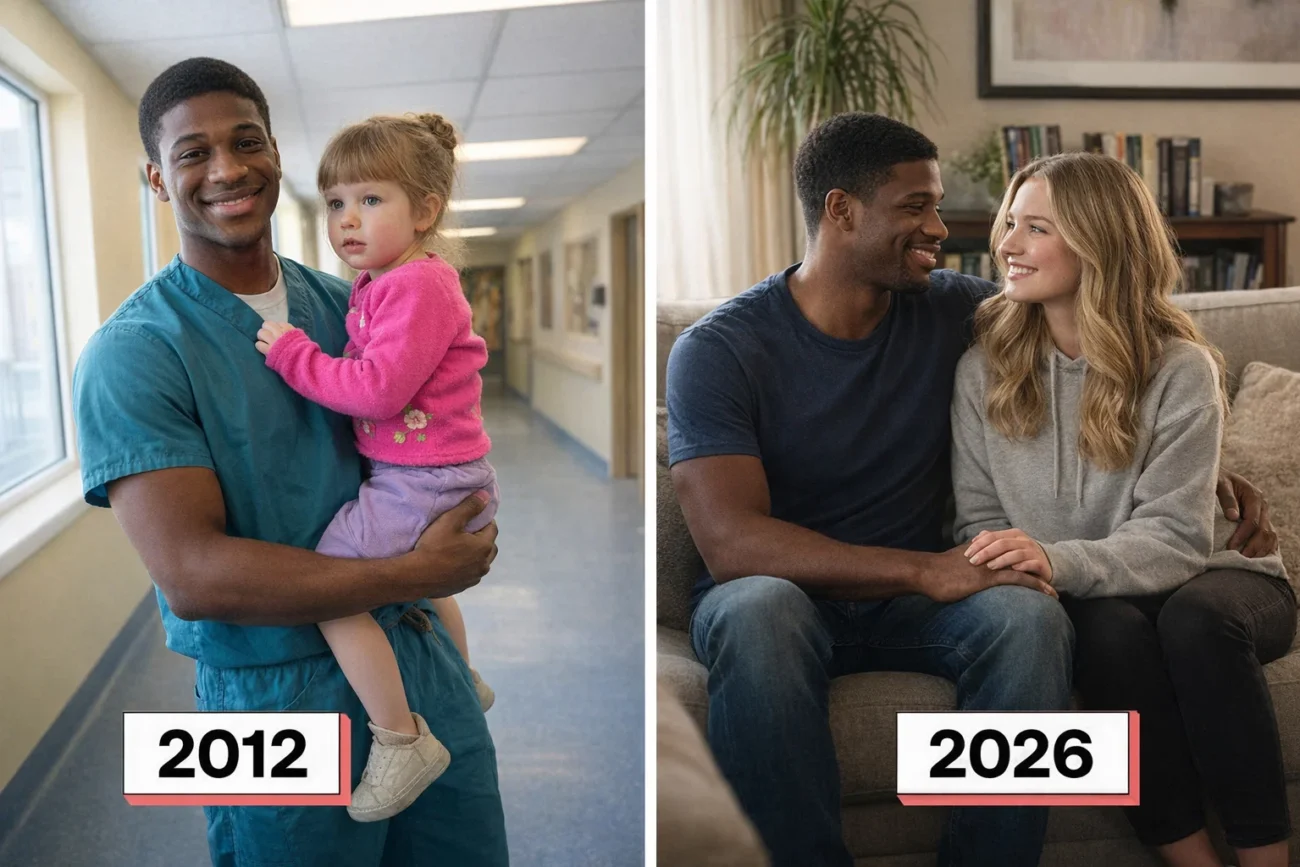
Thirteen years ago, during what began as an ordinary overnight shift in the emergency room, my life took a turn I could have never anticipated. I was reviewing a patient chart when paramedics burst through the doors with a car crash victim—a little girl, no more than three years old, covered in bruises and crying out for her parents. The tragic reality struck us fast: both her mother and father had died on impact.
Amid the chaos of trauma nurses, surgeons, and social workers, this tiny girl clung to my arm with trembling hands and whispered through tears, “Please don’t leave me.” It wasn’t my job to stay with her—my shift was nearly over, and the case had already been handed off. But I did stay. I stayed because something in her voice, in her eyes, called to a place deep within me. That one decision, born of instinct and compassion, laid the foundation for everything that followed.
I took her home that night because there was no immediate foster placement available. It was supposed to be temporary—just a few nights until the proper paperwork came through. But a few nights turned into a week. A week became a month. And before long, I couldn’t imagine life without her. I adopted her legally and emotionally. Her name was Avery. She wasn’t my blood, but she was my daughter in every way that mattered.
Raising Avery changed my priorities. I reshaped my career to allow for more presence at home, moved into a quieter neighborhood with a backyard and a swing set, and became the kind of dad who attended school plays, packed lunch boxes with smiley faces, and read bedtime stories twice just because she asked. Our home became a place where Avery never had to wonder if she was wanted. She was wanted. Fiercely, unconditionally.
Avery grew into a sharp, sarcastic, brilliant teenager. She had my stubbornness and her own fierce independence. She teased me relentlessly, but she always checked the bleachers to make sure I was there before every soccer game or school presentation. Our bond wasn’t forged by genetics but by shared life—by every scraped knee I bandaged, every nightmare I calmed, every tough conversation and every inside joke.
Eventually, I began to open myself up to the possibility of having a partner. I hadn’t dated much, not with the demands of single parenthood and work. But then came Marisa—a colleague at the hospital. She was kind, efficient, and seemed to understand the demands of my world. She asked about Avery, brought her favorite snacks, and even remembered her schedule better than I sometimes did. For the first time in years, I let myself dream of more—of partnership, of building a life with someone who could join the one Avery and I had created.
After a year together, I began planning to propose. I bought the ring and rehearsed the words. But before I could say any of them, everything shattered.
One night, Marisa came over, pale and visibly shaken. She told me she had something to show me. Her hands trembled as she pulled up security footage from my own home—from the camera in my bedroom, pointed at the wall safe where I kept emergency cash and personal documents. The footage showed a hooded figure entering, opening the safe, and removing a stack of bills. Marisa paused the video and turned to me, her voice low. “I think Avery’s been stealing from you.”
I couldn’t breathe. I stared at the image—a figure in a gray hoodie that looked just like Avery’s favorite one. The idea that Avery would steal from me was like trying to believe the sky had turned green. But the footage didn’t lie.
Still, I approached Avery with caution, with gentleness. I asked her if she’d been in my room. Her confusion was immediate and genuine. Then her face shifted as she remembered something. “My hoodie’s been missing for days,” she said. And something inside me—something honed by years of reading people in crisis—clicked.
I went back to the footage. This time, I looked at the figure’s movements, posture, size. And the unease began to shift from Avery to Marisa. The hoodie was a distraction. When I confronted Marisa and asked how she knew exactly what time to check the footage, her mask slipped. Not all at once, but in pieces.
She tried to deflect, then to deny, then finally to rage. Her words cut deep. “She’s not even your real daughter,” she snapped. “You gave up everything for someone who isn’t even yours.”
That was all I needed to hear.
I asked Marisa to leave. Permanently. And as I turned around, I saw Avery standing in the hallway, silent, afraid, tears filling her eyes. She had heard it all.
I pulled her into my arms and held her tight. I told her the truth. That none of what had happened changed anything. That I chose her once, and I would choose her again every day, no matter what anyone said.
The next day, I filed a police report. I gave them the footage and documented everything. Marisa was gone from our lives.
That evening, I sat Avery down at the kitchen table. I showed her her college fund, the one I’d been building since I first adopted her. I reminded her that she was mine not because we shared DNA, but because we shared something stronger: choice. Love. Family.
Thirteen years ago, a scared little girl in an ER held onto me and asked me not to leave. And I didn’t. I never will. Because family isn’t built on bloodlines. It’s built on choice. On showing up. On standing firm when it matters most.
And I will always, always choose her.