I have worked as a pediatric nurse for twenty-three years, yet nothing prepared me for what occurred in our clinic’s waiting room that Tuesday morning.
My six-year-old son, Marcus, was in the midst of the most severe meltdown I had ever seen, and in that moment I felt helpless—both as a medical professional and as his mother. He was lying on the floor, screaming and striking his head against the tiles, completely unreachable.
That was when the biker walked in for his scheduled appointment.
Marcus has profound autism. He communicates very little, and when he becomes overwhelmed, he withdraws so deeply that no one can reach him. His usual aide had called in sick that morning, and I had no option but to bring him with me to the clinic. I believed I could manage. I was wrong.
For the first hour, everything seemed stable. Marcus stayed in the break room with his iPad and weighted blanket. Then the fire alarm sounded for a drill I had completely forgotten about.
The noise shattered his composure.
By the time I reached him, he had already collapsed on the waiting room floor, rocking and screaming with a raw, agonizing sound—one that children with sensory overload sometimes make when the world becomes unbearable and they cannot explain why.
I tried every method I knew. I wrapped him in his weighted blanket. I placed his noise-canceling headphones over his ears. I quietly sang his favorite song. Nothing eased his distress. He continued to scream and hit his head. People stared. Some moved away. A woman picked up her toddler and left. I wanted to disappear.
“Marcus, sweetheart, please,” I whispered. “I’m right here. You’re safe.”
But he could not hear me through his panic.
That was when the entrance door opened and a large biker stepped inside. He looked to be around sixty, with a long gray beard, a leather vest covered in patches, and muscular arms. He had an appointment with Dr. Stevens for a diabetes check.
He halted the moment he saw Marcus.
My supervisor hurried to him. “Mr. Daniels, I apologize for the commotion. We can reschedule if you prefer.”
“That boy is autistic,” he said calmly, not as a question but as a certainty.
I looked up in tears. “Yes. I’m his mother. I’m so sorry. I’m doing everything I can.”
“Don’t apologize,” he replied softly. “I recognize that sound. My grandson is autistic.”
He approached, and I instinctively stepped between him and Marcus, uncertain of his intentions.
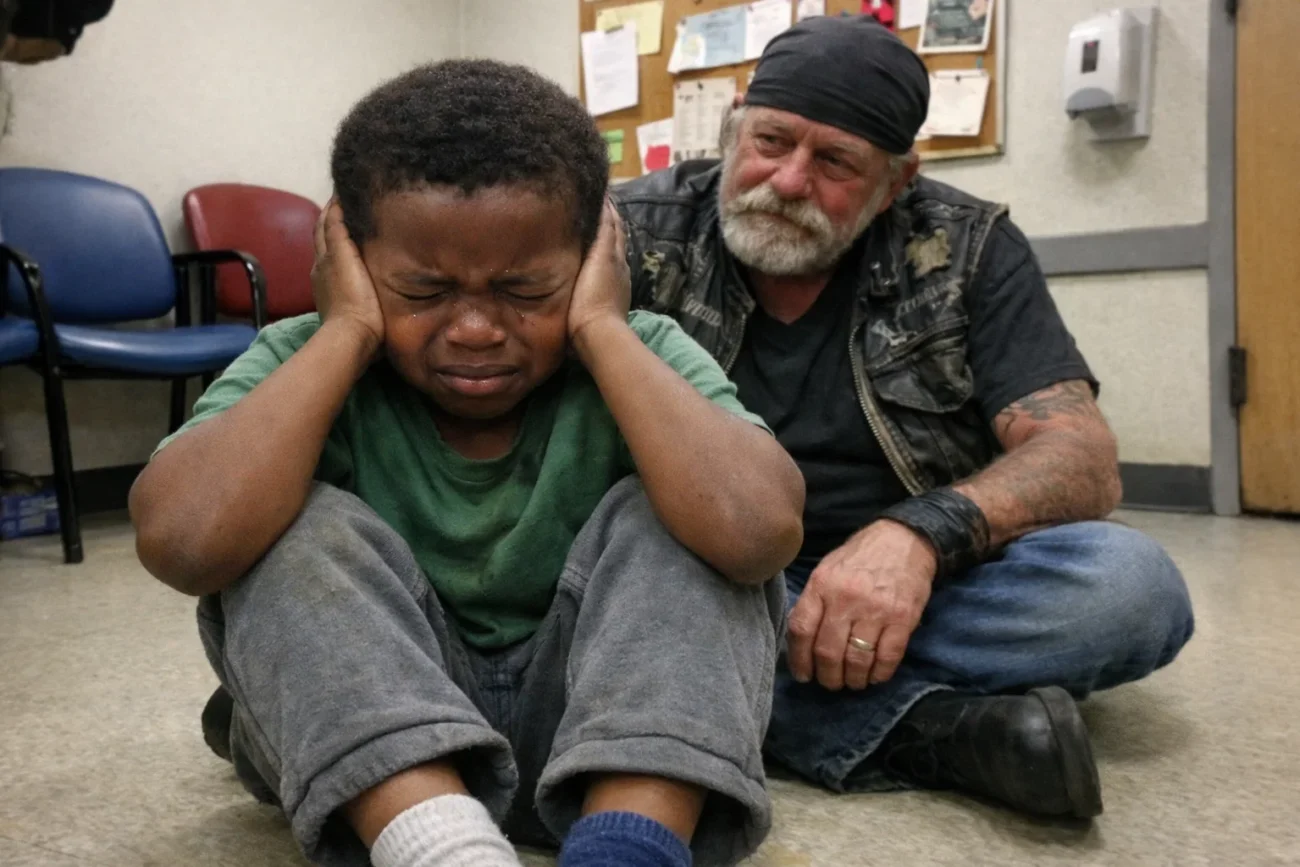
But he stopped at a respectful distance and did something I had never witnessed. He slowly lowered himself onto the floor, lying face-down, mirroring Marcus’s position. He did not touch him or speak. He simply lay there on the waiting room floor in his leather vest and boots.
“What are you doing?” I whispered.
“Just give it a moment,” he said quietly. “Don’t touch him. Don’t talk. Just wait.”
So I did.
For about thirty seconds Marcus continued screaming. Then the sound changed. It softened. He raised his head just slightly and noticed the man beside him.
The biker remained still and avoided eye contact.
Marcus stopped screaming.
The silence was overwhelming. Everyone in the room watched without moving.
Very slowly, Marcus inched toward him. A few inches more. Then he lay down again, positioning himself exactly as the biker had.
They remained like that, face to face, for nearly five minutes.
Then the man began to hum. It was not a song, just a steady, low hum—a soothing, grounding sound. Marcus’s breathing gradually slowed, and his fists relaxed.
“You’re okay,” the man murmured. “The noise is gone. You’re safe now.”
Marcus responded with a faint hum of his own, matching the tone. It was the first real communication I had heard from him since the meltdown began.
“That’s it,” the biker said gently. “We’ll stay here until you feel better. No rush.”
Tears streamed down my face. In a matter of minutes, this stranger connected with my son in ways that even experienced professionals often struggled to achieve.
After a while, Marcus reached out and touched the man’s leather vest, exploring its texture. He brushed the material between his fingers—he has always sought tactile comfort.
“You like that?” the man asked. “Old leather. Had this vest for thirty years.”
Marcus inspected a flag patch, then another with a military insignia.
“You’ve got an eye for detail,” the biker said. “That one’s from my time in the Marine Corps, long ago.”
Marcus traced its edge.
The biker slowly sat up so he would not startle him. Marcus followed, still drawn to the vest.
“I’m Robert,” he said. “But people call me Bear. What’s your name?”
I answered for Marcus because he usually cannot respond verbally. “His name is Marcus. He’s six.”
“Marcus is a good, strong name,” Bear said. “My grandson is seven. His name is Tyler. He’s autistic too. And do you know what Tyler loves most?”
Marcus lifted his gaze and made direct eye contact—something he rarely did with strangers.
“Motorcycles,” Bear said. “The noise, the vibration. Some people think they’re too loud. Tyler thinks they’re perfect.”
He took out his phone and showed Marcus a picture of a little boy sitting on a motorcycle wearing a helmet far too big for him and smiling broadly.
Marcus studied the picture. Then he smiled—a full, genuine smile I had not seen for months.
“Want to hear what a motorcycle sounds like?” Bear asked.
Marcus nodded.
Bear opened a video of his motorcycle starting and idling. The deep, rumbling vibration filled the room. I feared it would overwhelm Marcus again, but instead he placed his hand on the phone to feel the vibration.
“Nice, isn’t it?” Bear said. “That’s my Harley. I rode it here today.”
He turned to me. “If you’re comfortable with it, maybe Marcus would like to see it. It’s parked just outside.”
I hesitated because of clinic policies, but this man had just achieved the impossible. He had reached my son.
“All right,” I said. “A short visit.”
Bear rose carefully and offered his hand to Marcus. My son paused, then took it.
I nearly collapsed in shock. Marcus almost never holds hands except with me or his father.
We walked outside to the parking lot where Bear’s motorcycle waited—large, shining chrome and black leather, saddlebags covered in patches. To me it looked imposing. To Marcus it was enchanting.
“You can touch it,” Bear said.
Marcus ran his hands along the seat, the chrome, the mirrors. Bear started the engine gently. The steady vibration filled the air.
Marcus pressed both hands on the seat, feeling the rhythmic pulse. His eyes closed, and he smiled deeply.
“Feels good, doesn’t it?” Bear said. “That’s twelve hundred cc’s working smoothly.”
We stayed beside the bike for ten minutes. Marcus explored every part he could reach. When Bear eventually switched off the engine, Marcus looked disappointed.
“I’ll make you a deal,” Bear told me. “If it’s all right with you, I’d like to visit again. I’ll bring my grandson Tyler. The boys can meet and look at the bike together.”
“You would do that?” I asked, overwhelmed.
“Yes,” he said. “I know how hard this life can be. My daughter and son-in-law deal with it every day. People stare. People judge. Unless you’ve lived it, you cannot truly understand.”
He knelt beside Marcus. “You’re a good kid. You just experience things differently. That’s not wrong. It’s simply different.”
Marcus met his eyes again, then leaned forward and hugged him—an act he reserves for only a few people.
The large biker wrapped him in his arms. “You’re going to be all right,” he whispered. “You’re going to be just fine.”
Inside, the waiting room felt changed. People who had stared earlier were now smiling. An elderly woman approached me. “Your son is beautiful,” she said. “And that man is a blessing.”
Bear completed his appointment and found me before leaving. He handed me a slip of paper with his number. “Call me anytime. If Marcus is struggling and you need help, I’ll come.”
“Why?” I asked. “You don’t even know us.”
He blinked back tears. “Three years ago, Tyler had a meltdown in a grocery store. My daughter was crying, people were filming, and no one helped. Until one woman sat down on that dirty floor and sang to him. Just sang. Tyler calmed down, and my daughter wept in her arms because someone finally understood.”
He took a breath. “That woman told my daughter, ‘Pass it on. When you see another parent struggling, pass it on.’ So that is what I’m doing.”
That was four months ago. Bear now visits twice a month, always with Tyler. The boys sit together—often silent, but connected in their own quiet way.
Last week Tyler had a meltdown at Bear’s home. Marcus lay down beside him and hummed, exactly the way Bear had done.
Tyler settled. Bear cried.
“They’re teaching each other,” he said. “They’re teaching us too.”
After decades as a nurse, I have seen countless medical miracles. But the most profound moment I have ever witnessed happened on a waiting room floor, where a biker named Bear reminded my son and me that compassion still exists in this world.
Marcus now talks about “Mr. Bear” constantly. He draws motorcycles. And when he feels overwhelmed, he lies on the floor and waits for me to lie beside him—something Bear taught him. Hard moments do not have to be faced alone.
People look at Bear and see a tough biker—leather, tattoos, a roaring motorcycle. I see the man who knelt on a floor when no one else would. The man who understood my son when I could not. The man who showed me that being different is not the same as being broken.
Marcus is seven now. He still has difficult days. But now he has Mr. Bear, Tyler, and a small community that truly understands him.
All because one person chose to pass kindness forward. One biker paused in a waiting room, and everything changed.
⸻
Note: This text is a human-interest story highlighting empathy, neurodiversity, and supportive community behavior.