Twenty-five years earlier, in the port district of Dakar, survival came before dreams.
Jake Fall grew up in a one-room tin-roof home that smelled of salt and diesel. His father died in a port accident when Jake was seven — crushed during a night shift that paid extra but offered no protection. Compensation never came. Only a formal letter.
After that, Jake’s mother sold boiled peanuts roadside at dawn. Jake learned to calculate profit margins before he learned algebra. Hunger was constant. So was determination.
Three alleys away lived Aminata Diop.
Her mother, Marama Diop, had once been known for her laughter. Illness stole that gradually — first strength, then speech, then breath. By ten, Aminata knew how to boil herbs, change dressings, and sit awake through nights that stretched too long.
School ended quietly for her.
Jake noticed before anyone else.
He brought bread when he could. He lied about having eaten. She pretended to believe him.
Their bond wasn’t romance. It was recognition. Two children facing the same tide.
One rain-heavy evening, soaked and shaking, Jake stood outside her leaking house holding two warm meat pies his mother had allowed him to keep.
They ate beside Marama’s bed while rain hammered the roof.
Later, beneath a thinning drizzle, Jake stared at the ocean and said something that would outlive childhood.
“When I’m rich,” he told her, voice steady in a body too small for its ambition, “I’ll marry you.”
Aminata laughed — not cruelly, just realistically.
“Life breaks promises,” she said.
“Not mine,” Jake insisted.
They exchanged bracelets that night — a leather string from her, a woven band from him.
Two weeks later, Marama died.
Shortly after, Jake disappeared. His mother had been forced to leave before dawn. No forwarding address. No goodbye.
The port swallowed both their childhoods whole.
Diverging Paths
Jake’s years that followed were marked by work and risk.
He hauled scrap, cleaned machinery, learned to read contracts from an old watchman who taught him in exchange for food. He failed early in business, lost everything in a fraudulent shipment deal, and rebuilt slowly.
Discipline became his currency.
By his twenties, he had founded a logistics company built on transparency in an industry fueled by shortcuts. Contracts followed. So did wealth.
With wealth came influence — and expectations.
Madame Sokna Ndiaye, a strategic power broker, positioned Jake in elite circles. Marriage became less about companionship and more about alignment.
An engagement to Aïcha Mbaye, daughter of a prominent family, was announced publicly before Jake had fully agreed.
Stability over history.
Control over uncertainty.
Meanwhile, Aminata’s life unfolded differently.
She left an aunt’s house where wages were quietly redirected. She married Musa Ba seeking stability, only to find herself navigating emotional erosion instead. There were no visible bruises — only words that diminished.
Eventually, she left before dawn with her son, Ibrahima, choosing uncertainty over slow disappearance.
Work came in fragments. Night shifts. Cleaning contracts. Eventually, a stable job at a modern hospital.
She rebuilt quietly.
She kept the woven bracelet in a small box beneath her bed.
Not as hope.
As evidence that she once believed in something.
Recognition Without Permission
Jake saw her again in a hospital corridor.
At first, he didn’t recognize her. Recognition doesn’t arrive like cinema; it arrives like discomfort. Familiarity without explanation.
He noticed her professionalism, the way she adjusted blankets without being asked, the way she carried exhaustion without complaint.
When a manager reassigned her over unverified supply discrepancies, Jake intervened after reviewing the thin report.
“You shouldn’t have to defend yourself against assumptions,” he told her.
“I didn’t ask for help,” she replied.
“I know,” he said.
Later that evening, reviewing personnel records, Jake saw the name: Marama Diop — listed as deceased.
The past resurfaced fully formed.
He showed her the bracelet.
She whispered his name.
“You lived,” she said.
“And you survived,” he answered.
But survival isn’t reconciliation.
“You don’t get to ask for my story like it’s paperwork,” she told him.
He accepted that.
Power Versus Choice
Rumors spread. Colleagues shifted around Aminata. Being noticed by a billionaire rarely protects a woman — it complicates her.
The engagement announcement intensified everything.
Aminata submitted a transfer request.
Jake wrote her one letter:
I won’t look for you unless you ask. I’ll be at the port bench every Sunday at sunset.
He waited.
Some Sundays, she watched from a distance. Eventually, she approached.
They spoke first of ordinary things — school fees, rising food prices, the way early rains changed the city’s rhythm.
Trust rebuilt slowly.
Then the wedding day arrived.
The Wedding That Didn’t Happen
The ceremony was designed to reassure investors and silence rumors.
Marble. Glass. Orchids. Cameras.
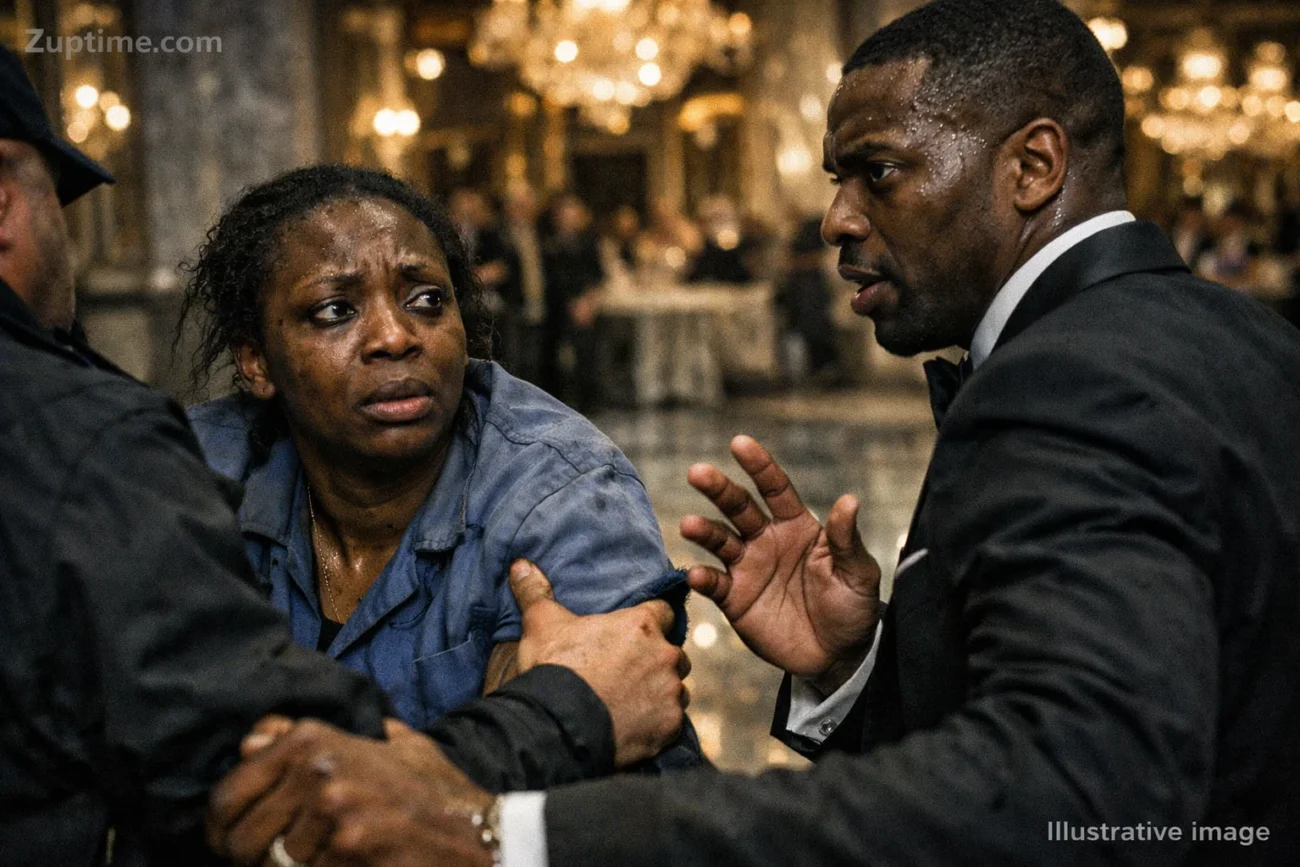
Aminata arrived only because a patient from the venue required medical assistance. She came through service corridors, uniform plain.
Security intercepted her.
That’s when she whispered the sentence that stopped the room.
“He once promised me… when he’s rich… he’d marry me.”
Jake turned.
He ended the wedding publicly.
“This ceremony was never about love,” he told the guests. “It was about comfort.”
He acknowledged the childhood promise — not as a romantic gesture, but as unfinished truth.
Aminata stepped forward.
“I didn’t come to be chosen,” she said clearly. “And I won’t be decided for.”
She left on her own terms.
That distinction mattered.
After the Applause Stopped
The fallout was swift. Headlines criticized him. Contracts paused. Social alliances fractured.
Jake didn’t retaliate. He restructured his foundation and stepped back from visibility.
Aminata continued working. Rent remained due. Her son still needed homework help.
They returned to the port bench.
Not as spectacle.
As adults negotiating reality.
Jake listened more than he spoke.
“I once thought becoming rich was the hard part,” he admitted.
“It wasn’t,” she said.
Months later, walking along the shore at sunset, he said:
“I don’t want to marry a memory. I want to build something with who you are now.”
She answered with conditions.
“No rescue story. No shadow. No performance.”
“Agreed,” he said.
They waited.
They built quietly.
When they finally married, it wasn’t in a marble hall.
It was near the docks at sunset, with a few people who understood the full story.
Not redemption.
Responsibility.
The boy made a promise about wealth.
The man learned that love costs more than money.
Conclusion
Memory is easy to carry when it asks nothing of you.
Commitment is different. It requires presence, accountability, and the willingness to lose status for integrity.
Jake didn’t keep his promise because he became rich.
He kept it because he chose to stand still when it cost him.
And Aminata didn’t accept him because of history.
She accepted him because he earned the present.
Editorial Note: This story is a work of fiction created for narrative purposes. Characters, events, and dialogue are part of a literary construction. Any resemblance to real individuals or situations is purely coincidental.