Many people dismissed her as misguided. She was a poor Black nanny who barely earned enough to feed herself, yet she chose a path few understood. She walked into an orphanage and adopted three little boys no one else was willing to take in. Critics claimed she was making a mistake and destroying her future. But twenty-five years later, those same boys—now wealthy and accomplished—returned to her life and did something that moved their mother to tears.
The story begins in Birmingham, England, inside a modest red-brick house worn down by years of wind and rain. The street was mostly quiet, save for the distant sound of children playing football and a dog barking behind a fence. Inside, Mary Johnson, a Black woman in her early thirties, was finishing her daily chores. Her strength was evident, though fatigue lingered in her posture.
Mary had spent much of her adult life working as a nanny for various families, caring for other people’s children while she herself struggled to rise above poverty. She had no partner and no children, although she quietly yearned for a family of her own. Her past had been difficult. Raised in Alabama in the southern United States, she had left home at nineteen to seek work in England.
Before she boarded the ship to leave, her mother had said to her, “Mary, you carry a gift for loving people. Do not waste it. Use it where God guides you.” Those words stayed with her throughout her life.
Before continuing with this account, viewers were invited to share where they were watching from. Those who enjoyed stories like this were encouraged to subscribe, like the video, share it with others, and leave a comment about the day’s story.
Returning to Mary’s journey: it was in Birmingham that her life took an unexpected turn. One rainy afternoon, while walking home from a cleaning job, her thin coat soaked through by the drizzle, she pushed forward with her usual resolve. The grey sky mirrored the weight she often carried, yet her steps remained steady.
As she passed a small brick building on a narrow side street, she heard children laughing. The sound made her stop. Rain dripped from her umbrella as she listened. The laughter was warm, yet carried an unmistakable hollowness—as though the children were trying to find joy despite their circumstances.
Above the doorway was a sign: “Street Mary’s Orphanage.” Mary had always loved children. Though she had none of her own, she often imagined feeling a small hand in hers or hearing the word “mama” spoken to her. That familiar longing pulled at her heart. Acting on impulse, she opened the door and stepped inside.
The scent of disinfectant mingled with porridge filled the air. Children scattered across the playroom, their laughter echoing against faded wallpaper. What struck her most, however, was not the noise—it was the quiet corner where three boys sat alone. Thin, unkempt, and aching with sadness.
James, five years old, clutched a broken toy truck as if it were precious. Daniel, seven, sat silently with his gaze fixed on the floor, withdrawn to the point of invisibility. Michael, only four, had large brown eyes that looked far older than his age. The caretaker, noticing Mary’s concern, shared their stories.
James’s parents had succumbed to addiction. Daniel’s father was in prison, and his mother had disappeared. Michael had lost both parents in a car accident, and no relatives had come for him. These were the children who were passed over during adoption visits. They were the ones no one chose.
Mary felt her chest tighten. Looking at them, she felt as though a divine voice whispered, “These are yours.”
When she asked about adoption, the director hesitated. “Miss Johnson, your financial situation is limited. You are single. Adopting one child would be difficult. Three would be impossible.”
Mary straightened her back. “Impossible for you, perhaps. Not for me. They need someone, and I have nothing but love to offer them.”
What followed were months of struggle: endless forms, intrusive interviews, and constant judgment. Neighbors gossiped and mocked the idea of a poor Black woman raising three abandoned boys. Yet Mary persisted. Through exhaustion, tears, and prayer, she refused to step back.
One frosty December morning, she signed the adoption papers. James, Daniel, and Michael officially became her sons. That night, in the cramped kitchen of her small two-bedroom home, she cooked a pot of chicken stew. James devoured his food with a grin, Michael leaned against her as though he had always belonged there, and Daniel whispered a single word so faint she almost missed it: “Mama.”
Mary felt tears rise. From that moment on, she was truly their mother.
Life was far from easy. Mary worked mornings cleaning offices, evenings cooking in a café, and late nights sewing clothes for extra income. The boys wore secondhand shoes. Winters were harsh, and blankets were shared. Many nights Mary sacrificed her own meals so the boys could eat. She never complained.
She always gathered them close and said, “We may not have much, but we have each other. And that is worth more than gold.”
Years brought both difficulties and joys. James was prone to fights and often returned home bruised. Daniel carried deep emotional wounds and rarely spoke. Michael, gentle but frail, suffered severe asthma that frequently landed them in hospitals.
Mary shouldered their burdens with quiet resilience. When James limped home after a fight, she held him on her lap despite his size and whispered, “Do not let this world define you. You are not forgotten. You are my son, and you were made for greatness.”
When Daniel asked why she loved them despite the trouble they caused, she answered, “Because God loved me when I was nothing. And now I love you the same. Nothing will ever change that.”
The boys remembered everything. There were moments of light, too. One Christmas, Mary could not afford presents, so she carved a wooden truck for James, knitted a scarf for Daniel, and gave Michael a gently used storybook she had cleaned carefully. Their joy was overwhelming.
One snowy night, when Michael struggled to breathe, she prayed aloud as she held him until dawn, refusing to sleep until his breathing eased.
Time moved on. Scholarships and determination took the boys to college. James studied engineering, Daniel pursued law, and Michael entered business. Mary remained in her humble Birmingham home, her hands worn from decades of labor. Her only wish was to see her boys succeed.
Finally, her sons’ careers flourished. James became a renowned engineer in London. Daniel built a successful legal career in New York. Michael created a chain of coffee shops and became a multimillionaire. They never forgot the sacrifices that shaped their lives.
For months, they planned a surprise worthy of the woman who saved them. One warm afternoon, Mary sat on her porch, drinking tea, when three luxury cars pulled up. Out stepped her sons, grown men in tailored suits, confident and accomplished.
Her hand trembled around her cane as she stood. “Boys,” she whispered.
“Mama,” James said, embracing her.
Daniel kissed her cheek. “We missed you.”
Michael held her hand. “Today is your day.”
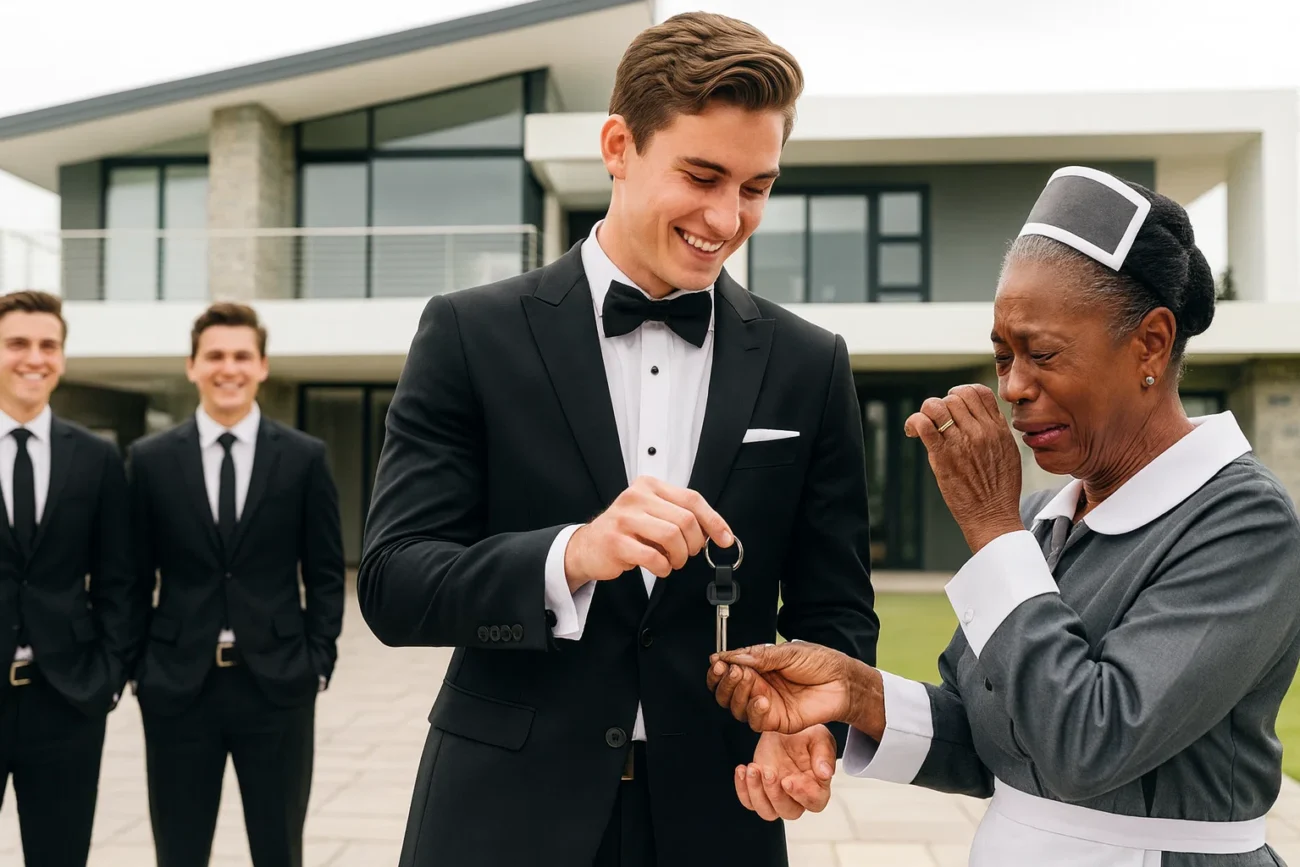
Mary blinked, puzzled. James placed a set of keys in her palm. Across the street gleamed a new silver car. “It’s yours,” Daniel explained. “No more walking in the rain. No more long bus rides.”
Mary gasped, overwhelmed. But the surprises continued. Michael placed another set of keys in her hand.
“That is the key to your new home, only five minutes away. Fully furnished. And you will not live alone—we have arranged for cooking, cleaning, and personal care. It is your time to rest.”
Mary shook her head, tears falling. “This is too much.”
Daniel steadied her. “It is not enough. You gave everything for us.”
Finally, Michael presented a folder. “Mama, you always dreamed of owning a café—a place where kindness and warmth could fill the room. So we opened one for you near your new home. It’s called Mary’s Place. Staff will run it, but it belongs to you.”
Mary wept openly, embracing each of her sons. “I do not deserve this.”
James whispered, “You deserve the world.”
Neighbors gathered outside, some crying as they witnessed the moment. The woman who once had nothing now stood surrounded by three successful men who called her mother and honored her sacrifices.
As Mary rode to her new home, she reflected on every struggle, every hungry night, every prayer whispered in the dark. None of it had been in vain. Love, she realized, was the greatest investment. What is given freely returns multiplied.
Soon, customers entered Mary’s Place café and felt the warmth of her spirit in every corner. On the wall hung a photograph of Mary and her sons, smiling. Beneath it were the words:
“Love creates family. Family creates miracles.”
⸻
Creative-Fiction Note
This story is inspired by themes, characters, and events shaped for narrative purposes. Names, backgrounds, and details have been adapted or altered to preserve privacy and enhance storytelling. Any resemblance to real individuals or actual events is coincidental. The author and editors do not guarantee factual accuracy and are not responsible for interpretations made by readers. The story is provided as is, and the views expressed belong solely to the characters within the narrative.