
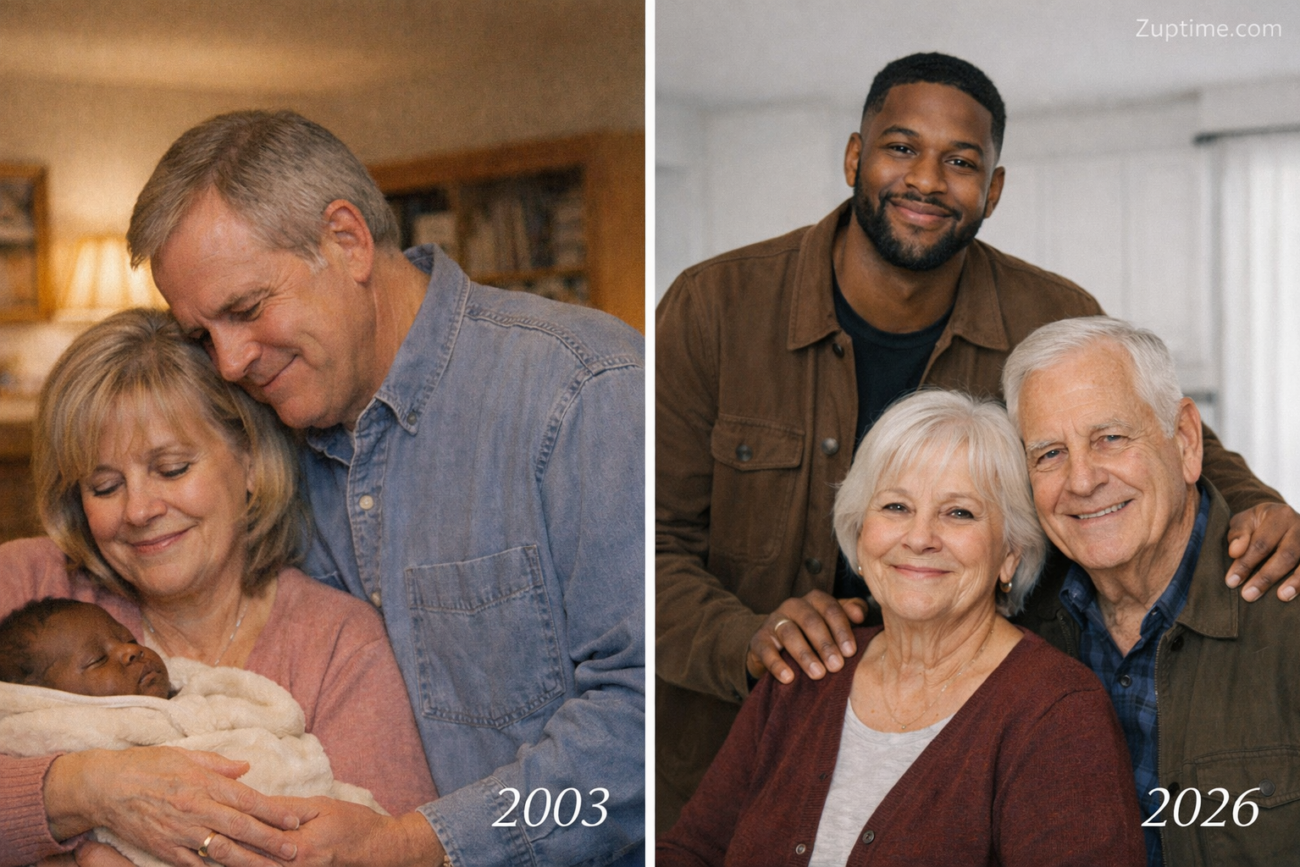
Most people my age are looking for retirement homes, not diapers. At 56, my life was supposed to be quiet—a slow fade into old age with Harold, flavored by the bitter taste of canned soup and the silence of a house that never knew the sound of small feet. We had spent decades telling ourselves “later,” until “later” became “never” in a cold doctor’s office. We didn’t break down; we just adjusted. We bought a small house, paid our bills, and let the neighbors think we just didn’t want kids. It was a clean, quiet lie that kept the pain tucked away in the floorboards.
Then came the winter that changed the temperature of our souls forever.
A Basket in the Icy Dark
It was a brutal morning. The kind of cold that makes the house groan. I woke up to a sound I thought was the wind—a thin, jagged crying that cut right through the hum of the heater. When I opened the front door, the icy air slapped me across the face, but the sight on the doormat froze me faster. A basket. Inside, a baby boy, his skin a terrifying shade of red, wrapped in a blanket so thin it felt like wet tissue paper.
There was no note. No name. Just wide, alert eyes that seemed to be asking if the world was always this cold. Harold and I didn’t think about our age, our aching backs, or our bank account. We just grabbed him. We spent the next months fighting a mountain of paperwork and the whispers of neighbors who thought we were “grandparents playing house.” But every time that tiny fist curled around my finger, the exhaustion of the 2 a.m. feedings disappeared. We named him Julian. He was our son, not by blood, but by choice.
The Lawyer, the Box, and the “Old Money” Ghost
Julian grew up knowing the truth. We told him he was chosen, that he was found in the frost and brought into the warmth. He became a man of few words but deep loyalty—the kind of kid who’d defend the underdog and call us every Sunday from college. We thought the mystery was buried.
Then, when Julian turned 23, the mystery walked up our driveway in a tidy coat, carrying a box.
Marianne, a lawyer, sat in our living room and spilled a story that felt like a gut-punch. Julian’s biological parents weren’t desperate or poor. They were “old money”—the kind of family that cares more about a polished image than a human life. When Julian was born with potential medical risks, they didn’t see a son; they saw a “problem” that might tarnish their perfection. So, they discarded him like a piece of faulty luggage on our porch and went back to their big house.
The Price of a Name
The lawyer opened the folders to reveal a fortune. His biological parents had died in a car crash, leaving everything to their “only child.” Millions of dollars, properties, a name that carried weight in high society. “Look at what your son is hiding from you,” she said. My stomach turned. Julian had known for years. He had been carrying the weight of their rejection and their guilt in silence, protecting us from the mess of his past.
The confrontation at the kitchen table that night was the most honest moment of my life. Julian sat there, rubbing his face, looking miserable. He had handled the DNA tests and the legal calls alone because he didn’t want their “mess” in our house.
“Do you want the money?” I asked him, my heart in my throat. I told him we wouldn’t blame him. Millions of dollars could change his life. He could pay off his loans, travel, never worry again.
Family is Who Opens the Door
Julian looked at us—at my wrinkled hands and Harold’s tired eyes. “They put me out there in the freezing cold,” he said, his voice thick with a 23-year-old hurt. “You dragged me inside. That’s the difference. They don’t get to be my parents just because they left me a check. I already won. I got parents who actually wanted me.”
He walked away from the fortune. He chose the small house, the Sundays with us, and the identity he built with his own hands rather than a name bought with blood and abandonment. I used to think I failed as a woman because my body couldn’t create life. But standing there, watching my son wash the dinner dishes, I realized I became a mother the second I refused to leave him in the cold. And 23 years later, he chose us right back.