
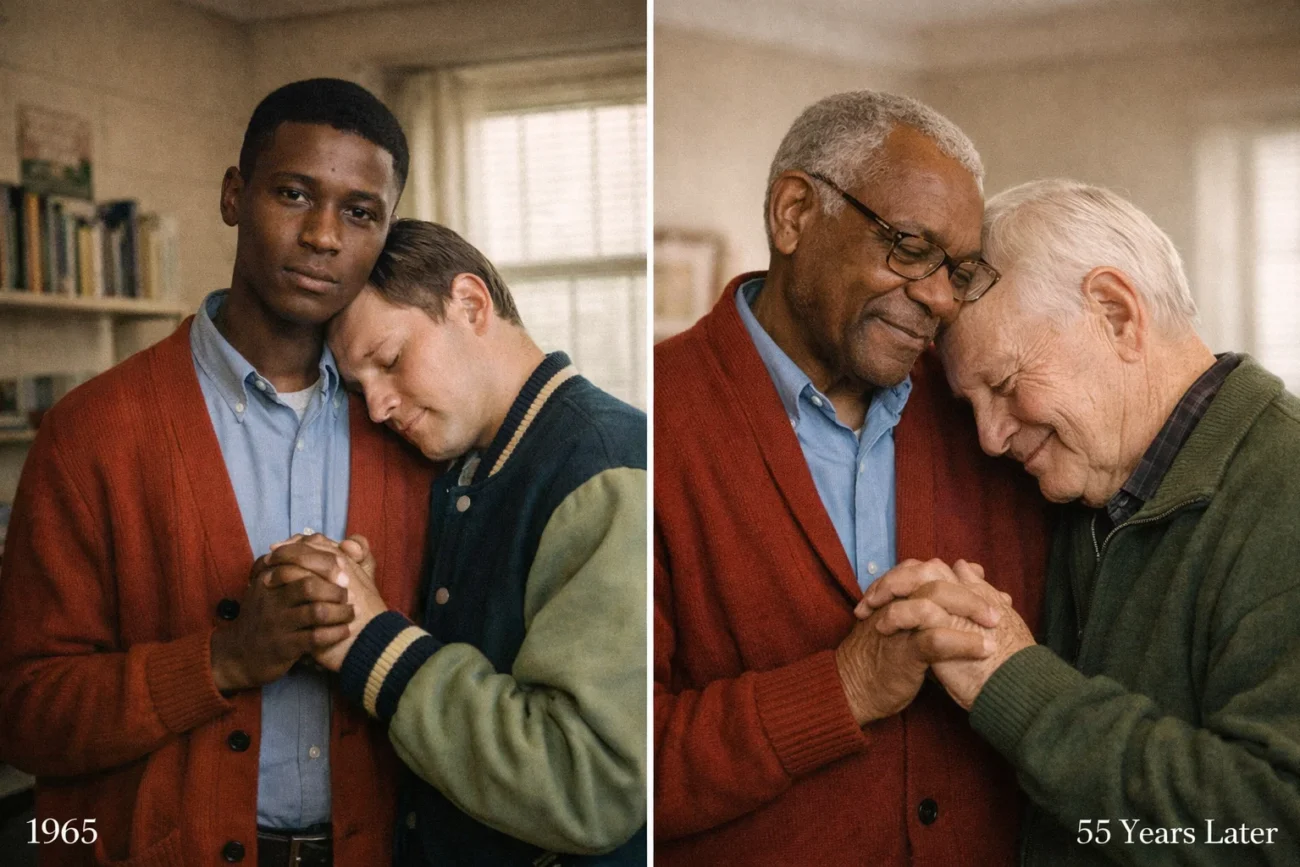
The year 1965 in North Carolina was defined by invisible lines.
These lines dictated where a person could sit, eat, and breathe.
It was the height of the Civil Rights Movement—an era where the humid air was thick with both the hope of change and the violent friction of a segregated society.
The Quiet Defiance of the Algebra Room
The meeting was never intended to be a statement of rebellion.
It began as a simple struggle with mathematics.
The narrator, then a young college student, found herself lost in the complexities of algebra until she encountered James.
In a room where racial boundaries were strictly observed, James was a calm, singular presence.
He wasn’t just a student; he was a teacher.
James approached the sessions with a patient, steady hand, helping his peers navigate equations that seemed unsolvable.
In the spaces between solving for x and y, they discovered a shared language of music and aspirations.
Sanctuary at the Water’s Edge
As their connection deepened, the campus lounge felt increasingly restrictive.
They began trading skills that society didn’t want them to share.
She taught him guitar chords.
He taught her the reality of being a Black man in a world designed to limit his movements.
To escape the prying eyes of the town, they found a sanctuary at a lake on the outskirts.
By the water, the rigid expectations of the 1960s South seemed to dissolve.
The Weight of the First Warning
The transition from a private friendship to a public scandal happened with a single whisper.
A mutual acquaintance spotted them and delivered a low, hesitant warning: “People talk.”
For the narrator, the comment felt vague.
For James, it was a cold reminder of the stakes.
He understood that “people talking” was the precursor to loss: of employment, of reputation, and of physical safety.
Their meetings became hurried, shadowed by the constant need to check over their shoulders.
The Intervention and the 50-Year Void
The bubble burst when the narrator’s father discovered a simple, affectionate note James had written.
In 1965, an innocent gesture was treated as a “social emergency.”
Infuriated, her father drove three hours to the campus, signaling the end of her autonomy and James’s peace.
The fallout was immediate: James was fired from his position as a tutor.
The silence that followed lasted for more than 50 years.
They moved into the separate lanes the world paved for them: degrees, marriages, and the inevitable fading of youth.
The Reunion: “Took You Long Enough”
It wasn’t until 55 years later that a college reunion brought the narrator back to the campus.
Walking through the grounds, the years of absence felt like a heavy fog.
She didn’t expect to find a ghost, but sitting on a bench they had once shared was James.
Though time had added wrinkles, the subtle spark in his eyes remained unchanged.
His first words were delivered with a mix of humor and relief: “Took you long enough.”
Reflections on Resilience
Their conversation was a visceral deconstruction of the lives they had led apart.
It was a testament to survival.
The years apart hadn’t diminished their connection; they had refined it.
James had lived a life of cautious pride, while the narrator had learned that the most important things in life are often those you are told you cannot have.
After a half-century of silence, they chose to stay.