
In certain parts of Chicago, you either grow up fast or you don’t grow up at all. Amari grew up with a lawnmower in his hands and a hole in his stomach. By the age of twelve, he was the man of the house, hustling for loose change to make sure his mother and two younger brothers had more than just water for dinner.
The most brutal part wasn’t the work—it was the view. Amari spent his summers mowing the lush, green grass of the city’s wealthiest estates. One of those estates belonged to his father, Marcus. Amari would push that heavy mower under the scorching sun, watching through the floor-to-ceiling windows as Marcus lived a life of silk ties and cold drinks. Marcus knew exactly who Amari was. He just didn’t care. He never offered a seat, a glass of water, or even a single scoop of ice cream on a 100-degree day.
The only shadow of mercy came from Julianne, Marcus’s wife. She saw the “invisible” boy. When Marcus wasn’t looking, she would slip out to the porch and hide a ten-dollar bill inside a folded napkin, whispering for Amari to put it in his pocket quickly. That “secret” money was the only reason Amari’s brothers had shoes that fit.
Football started as a way to hit back at a world that ignored him. In high school, Amari was a force of nature. He wasn’t playing for scouts; he was playing for survival. He spent his nights unloading crates at a warehouse and his mornings at practice. He arrived at college with nothing but a duffel bag and a chip on his shoulder the size of the Sears Tower.
He didn’t “break out” overnight. He spent two years on the practice squad, taking the hits that no one else wanted, sending every cent of his meal allowance back to his mother in Chicago. By his senior year, he was an All-American. When he was drafted into the NFL, the world saw a millionaire. Amari just saw a way to make sure his mother never had to cry over a light bill again.
At 27, Amari is at the top of his game. But the past has a way of circling back. Marcus, the man who once had everything, watched his empire crumble in a spectacular bankruptcy. The cars were gone, the mansion was seized, and the pride was all that was left—until that ran out too.
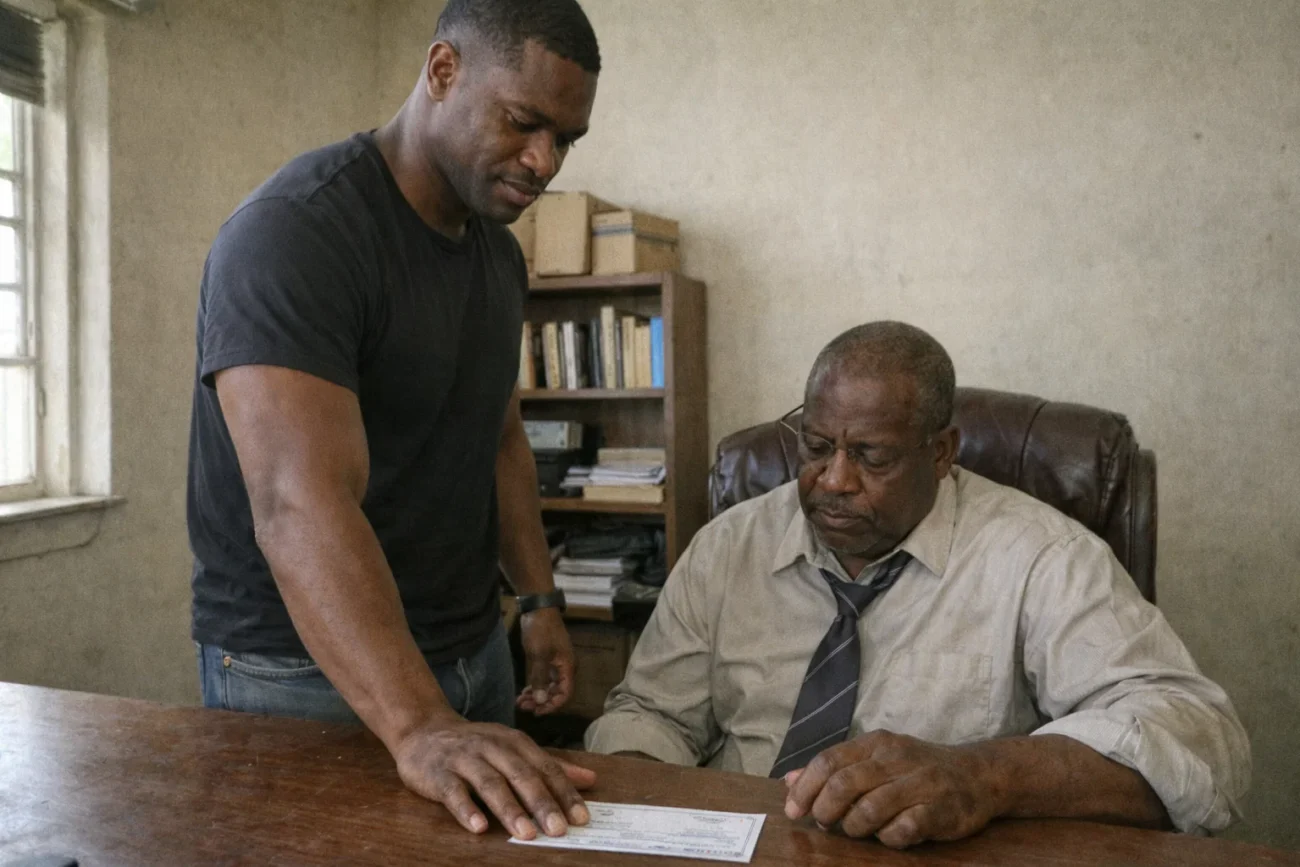
They met in a sterile, quiet room. Marcus looked small, his expensive suit now sagging off his frame. He asked for help, but he couldn’t bring himself to ask for forgiveness. Amari didn’t hesitate. He pulled out a pen and signed a check for an amount that would change Marcus’s life.
He slid the paper across the table. “This isn’t for you,” Amari said, his voice as sharp as a stadium whistle. “This is for Julianne’s napkins.”
He left without a handshake. He gave his father the money, but he kept his peace. Marcus got his check, but Amari walked away knowing that some explanations are never coming—and at 27, he was finally okay with that.
Note: This is a narrative exploration of social confrontation and the architecture of human silence. It serves as an illustrative case study on the psychology of debt, pride, and the visceral reality of earned success.