
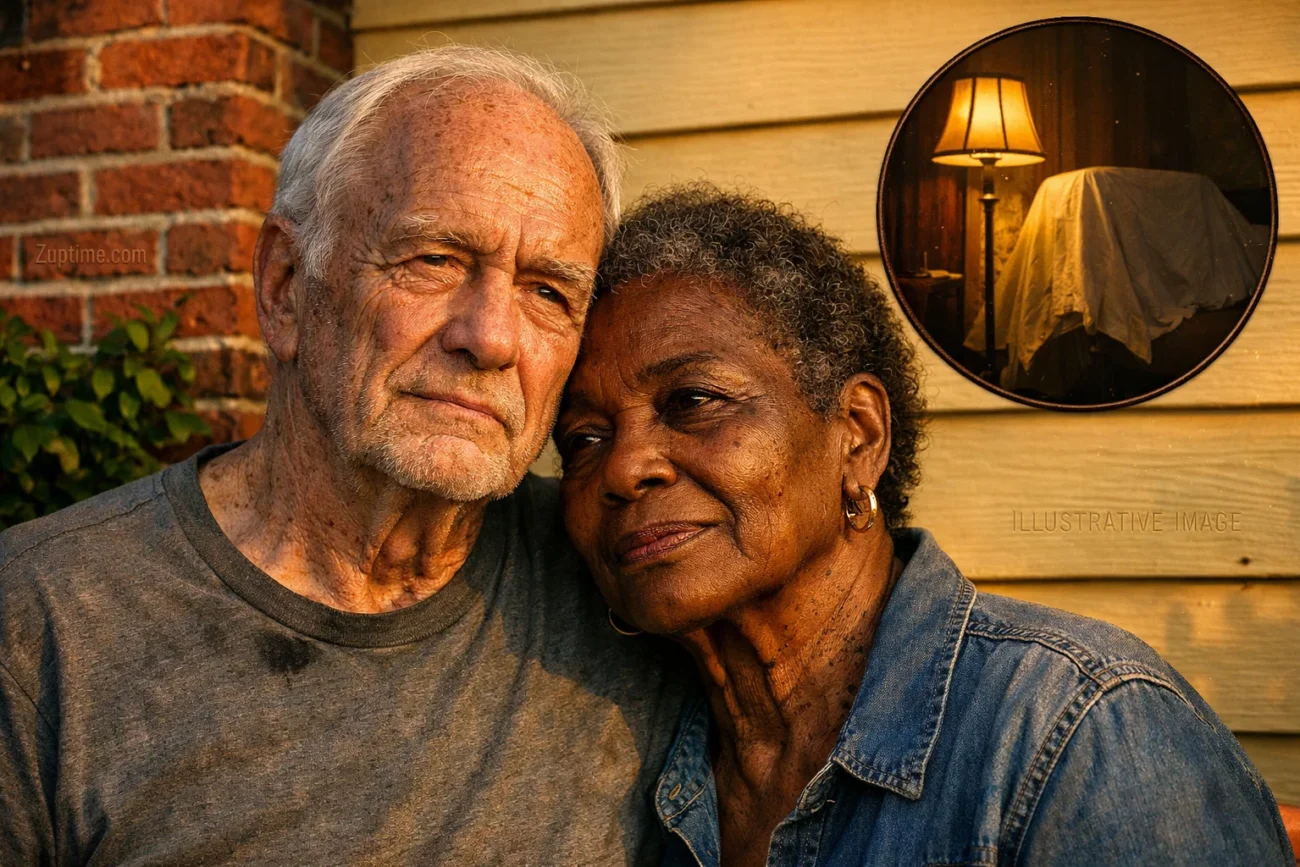
My name is Gerald, but most people call me Gerry. I’m 76 years old, retired Navy, and not exactly the kind of man who shares personal stories online. My grandkids laugh at me just for having a Facebook account. But something happened recently that turned my world upside down, and I can’t keep it to myself anymore.
My wife, Martha, and I have been married for 52 years. We built a life together in an old Victorian house in Vermont back in 1972. We raised three children there. Now we have seven grandchildren who fill the place with noise every time they visit. I truly believed that after more than five decades together, there was nothing left for me to learn about the woman I married.
I was wrong.
There has always been one part of our house that I never saw. The attic. The door at the top of the stairs has been locked with a heavy brass padlock for as long as I can remember. Anytime I asked about it, Martha would shrug it off.
“Just old junk from my parents’ place,” she’d say. “Nothing worth looking at.”
I trusted her. We all deserve some privacy. Still, after 52 years of walking past that locked door, curiosity had quietly taken root inside me.
Two weeks ago, Martha slipped in the kitchen while baking a pie for our grandson. She fractured her hip and had to undergo surgery. At 75, recovery isn’t easy. She was sent to a rehab facility, and for the first time in decades, I was alone in that creaky old house.
The evenings felt long. Too quiet.
That’s when I started hearing it.
A scratching sound from above. Slow. Deliberate. Always in the evening. At first, I told myself it was squirrels. But it didn’t sound like animals. It sounded almost… intentional.
One night, I grabbed my flashlight and Martha’s spare key ring from the kitchen drawer. I tried every key. None opened the attic door. That bothered me. Martha kept keys to everything. Except the attic.
So I did something I never thought I would. I went to the garage, grabbed a screwdriver, and forced the lock off.
When I opened the door, a heavy musty smell hit me. Old paper. Dust. Something metallic underneath it.
The attic looked ordinary at first. Boxes, old furniture under sheets. But in the far corner sat an old oak trunk with greenish brass corners. It was locked, too.
The next day, I casually asked Martha about it during my visit.
“What’s in that trunk up there?” I said.
I will never forget the look on her face. The color drained from it instantly. Her hands shook so badly she dropped her glass.
“You didn’t open it… did you?” she whispered.
That wasn’t a normal reaction.
That night, I went back up with bolt cutters.
Inside the trunk were hundreds of letters. Carefully tied and organized by date. The earliest ones were from 1966 — the year Martha and I got married.
They were all addressed to her.
And all signed by a man named Daniel.
One line stopped my heart cold. Every letter ended with:
“I’ll come for you and our son when the time is right.”
Our son?
I kept reading. The letters talked about a boy named James.
James is my firstborn.
The man I raised. The boy I taught to ride a bike. The young man I walked down the aisle.
The next day, I confronted Martha.
Between tears, she told me everything.
Before she met me, she was engaged to Daniel. He was drafted to Vietnam. Shortly after he left, she found out she was pregnant. He wrote to her constantly from overseas. Then his plane went down over Cambodia. He was declared missing in action. Presumed dead.
Two months later, she met me. We married quickly.
I had always believed James was born slightly premature.
He wasn’t.
Daniel was his biological father.
I thought that was the whole truth. A young woman alone, grieving, believing her fiancé was dead. I could almost understand that.
But I went back and read the later letters.
Daniel hadn’t died. He had been captured and held as a prisoner of war. He was released in 1972.
In a letter from 1974, he wrote that he had found Martha. That he had seen her happy with her husband and family. That he would not disrupt her life. But he would watch over “our son James” from a distance.
He had lived in our town.
For decades.
I found an address in one of the later letters and drove there. The house was boarded up. A neighbor told me Daniel had passed away just three days earlier.
Three days.
Around the same time I started hearing those noises.
When I told Martha, she confessed something else. Daniel had visited her three weeks before her accident. He was sick. He didn’t have much time. He wanted to see her one last time. He had brought something for James.
Back in the attic, hidden beneath the letters, I found it.
A Purple Heart medal.
A leather diary.
A photograph of a young Daniel in uniform standing beside a young Martha holding baby James.
The resemblance between Daniel and my son was undeniable.
When I brought the box to James, his face changed immediately.
He told me he had known the truth since he was sixteen. Daniel had approached him after a baseball game and explained everything. But he made James promise never to tell us. He didn’t want to break our family apart.
James looked at me and said, “You may not be my biological father, but you are my dad. You raised me. You loved me. That’s what matters.”
I didn’t know whether to feel betrayed or grateful. Martha had carried this secret for more than fifty years. James had carried it for forty.
Now, at 76, I’m left thinking about Daniel — a man who loved a woman he couldn’t have and watched a son he couldn’t claim.
Families aren’t built on blood alone. They’re built on love, sacrifice, and sometimes painful truths.
I don’t know if breaking that lock was the right thing to do.
But I know this: the man my son became has more to do with the years we spent together than with the DNA he carries.
And that has to mean something.
This story is inspired by real-life emotions and situations but has been fictionalized for creative purposes. Names, characters, and certain details have been adapted to protect privacy. Any resemblance to actual persons or events is coincidental. The narrative is presented as a personal reflection and does not claim to represent verified historical fact.