
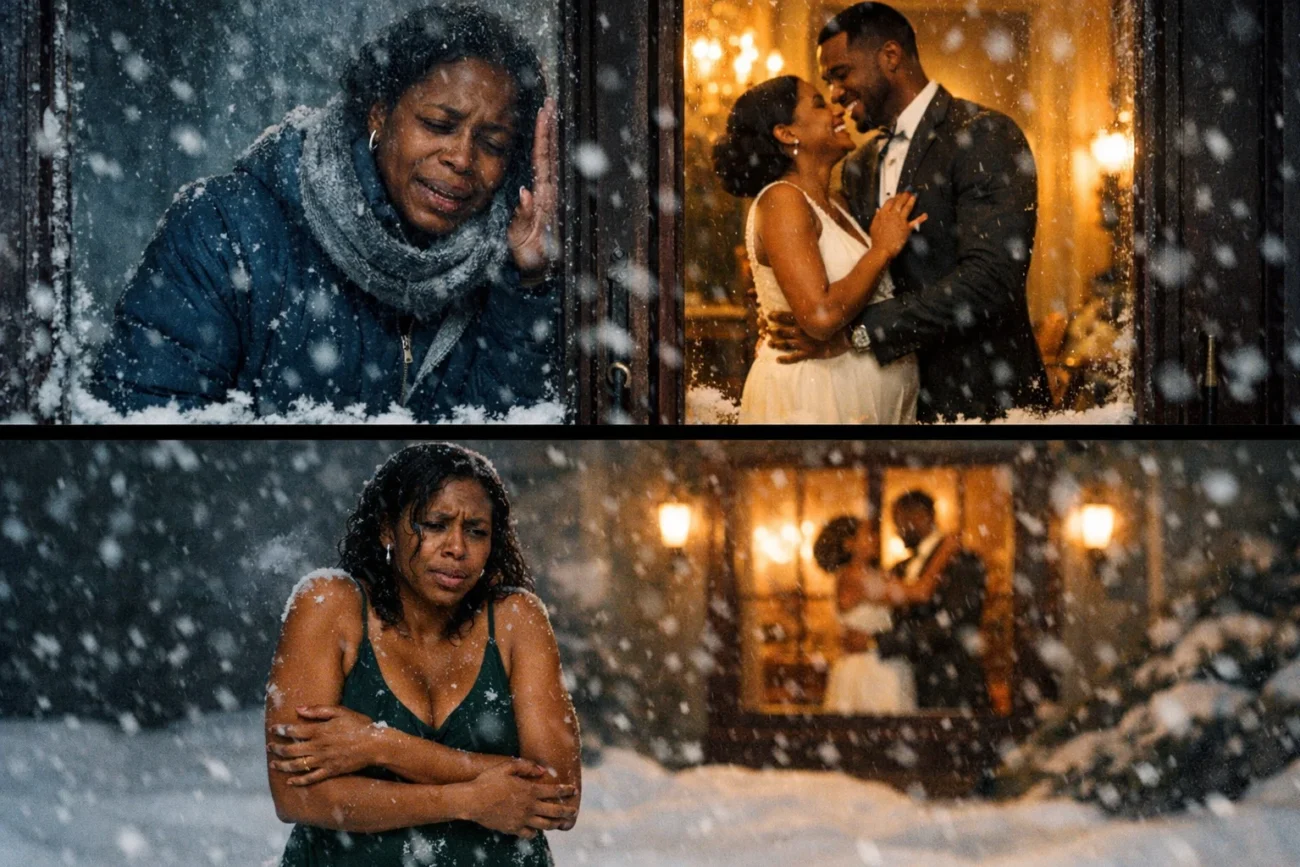
The cold felt deliberate.
Not the kind you check on a phone and prepare for, but a brutal, accusing cold that burned skin and stole breath. Snow tore across the driveway of the Sterling estate, erasing the world inch by inch. The wind howled like it had been invited.
Amanda Sterling stood gripping the iron gate, her bare fingers stiff with numbness. Her cocktail dress was soaked at the hem, clinging to her legs, useless against the storm. Beneath the thin fabric, her seven-month pregnant belly rose and fell steadily — warm, alive, defiant.
Behind her, the mansion glowed.
Light spilled from the windows, soft and golden. Inside, silhouettes moved. Glasses lifted. Laughter bloomed. Amanda didn’t hear it, but she knew the sound well. She had spent seven years learning how to belong to rooms like that — and how easily they decided she didn’t.
The door had locked before she reached it.
She remembered the sound clearly. Sharp. Final.
Security had escorted her out politely, professionally. No coat. No boots. No bag. Just the dress she wore to what she thought was a reconciliation dinner… and the divorce papers she’d signed at the table, her signature still wet with disbelief.
Amanda caught her reflection in the iron bars. Pale skin. Blue lips. Hair once curled now flattened by snow.
Movement flickered in the window again.
Thomas.
Her husband. Her ex-husband, technically — forty minutes too late to matter.
He stood relaxed, glass in hand, leaning in to kiss a woman’s cheek.
Rachel.
Amanda recognized her instantly. Confidence wore Rachel easily, like something she’d been born into. White dress. Loose hair. A laugh made for attention. The kind of woman history rewrites itself around.
Amanda placed both hands on her belly.
“I’m leaving,” she whispered. Not to the house. Not to Thomas. To the child.
Her phone still worked. He hadn’t thought to take it.
She ordered a car.
The icon crept toward her on the screen while snow thickened and the world shrank to breath, cold, and the quiet strength inside her.
When the car arrived, the driver stared.
“You’re pregnant,” he said softly.
“Yes. Please take me to the Waldorf Festori.”
“That hotel is expensive.”
“I know.”
Warm air hit her face as she slid inside. She didn’t cry. She didn’t shake. She stared out the window as the gate disappeared behind them.
At the hotel, staff moved quickly. A robe appeared. A suite. Silence.
Amanda showered. Changed. Sat on the bed and opened her laptop.
At 11:47 p.m., she began making calls.
Not emotional ones. Strategic ones.
Amanda had learned early that power didn’t shout. It whispered — through contracts, clauses, ownership structures that didn’t announce themselves.
By sixteen, she had inherited an empire from her uncle Gerald, a man who believed invisibility was the safest form of wealth. He taught her to let people underestimate her. To let them feel taller. To let them relax.
Thomas had never asked questions.
He liked her “simple.”
He liked explaining things to her.
He liked believing she needed him.
Amanda let him.
By morning, she stopped letting him.
While Thomas married Rachel at dawn — careless, theatrical — Amanda reviewed leases. Termination clauses. Credit structures. Dependencies. Every beam holding Thomas’s life upright.
She didn’t attack.
She withdrew oxygen.
By the end of the week, his privileges were “under review.” His credit was “restructured.” His clients quietly left. His foundations cracked.
Then the truth surfaced.
Rachel was under federal investigation.
Thomas hadn’t married love.
He married exposure.
The collapse was slow. Legal. Silent.
By the time Thomas realized Amanda had owned the building his firm operated from — and dozens like it — it was already over.
He tried calling.
She never answered.
Amanda gave birth on a quiet winter morning.
She named her daughter Grace.
Not because she felt merciful — but because she understood restraint.
Months later, Amanda passed a man on a street corner holding a cardboard sign.
Thomas.
They locked eyes.
No anger. No triumph.
Only recognition.
She handed him a card for a legal aid clinic.
“Why?” he whispered.
“Because I’m not you,” Amanda replied.
She walked away.
Years later, Thomas would say the hardest part of losing everything wasn’t money — it was realizing he had treated a human being like furniture.
Amanda raised Grace with gentleness and clarity, teaching her that dignity isn’t something people earn — it’s something you choose to give.
Power still moved quietly around her.
But now, it had purpose.
⸻
Author’s Note
This story is a work of fiction, inspired by common themes of power, invisibility, and resilience. Names, characters, locations, and events have been fictionalized. Any resemblance to real persons or events is coincidental.