
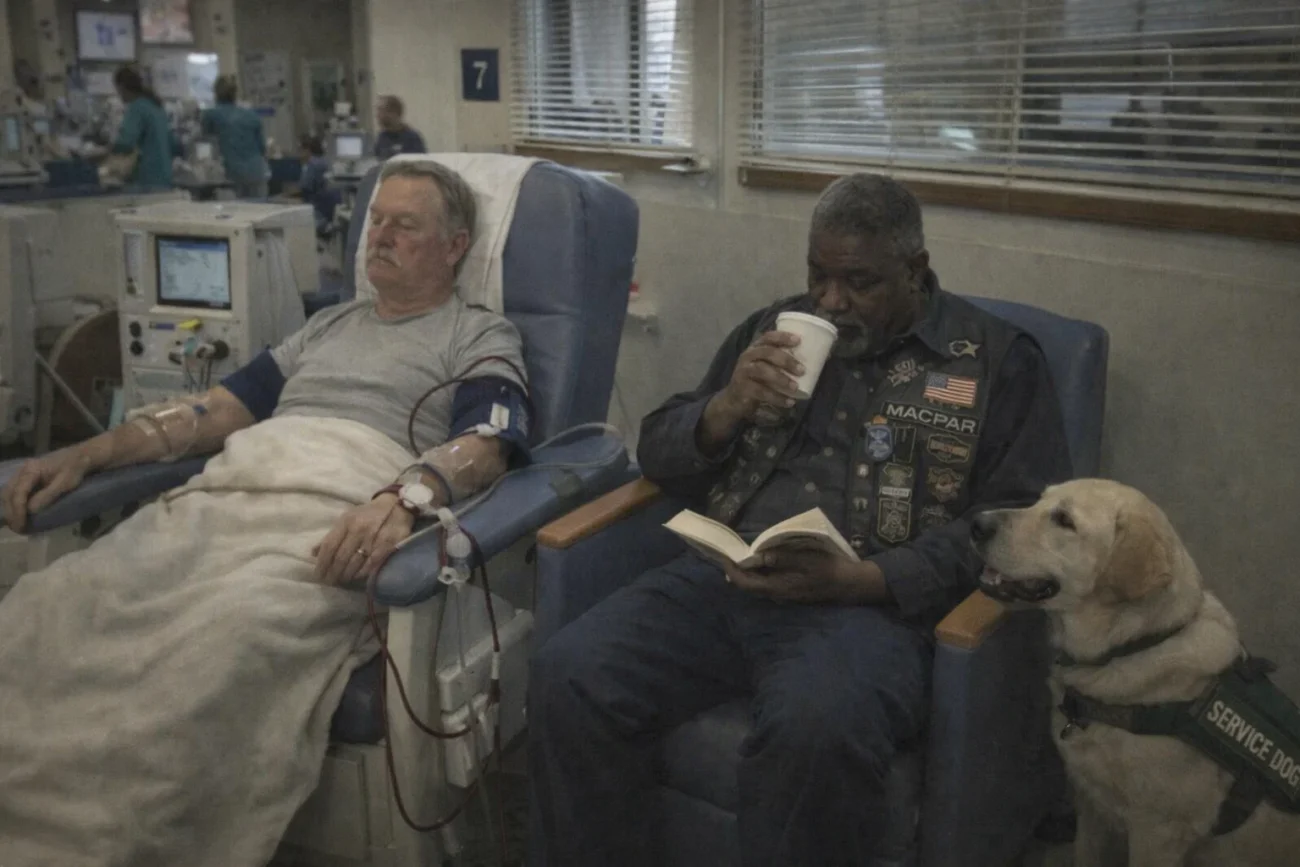
I have no family support and no car. Yet for four years, one man has driven me to dialysis three times a week without ever missing a single appointment.
His name is Marcus. He is 58 years old. He drinks his coffee black, prefers historical fiction, and works night shifts as a hospital custodian so he can be present during my morning treatments.
He has never failed to show up.
Not on holidays.
Not during storms.
Not even when the dialysis center was barely operating in the middle of a blizzard.
Marcus was always there.
My relatives stopped coming after the second month.
My daughter visited twice. Then her children had activities. Then the distance became an excuse. Eventually, she stopped calling altogether.
My son came once, stayed less than half an hour, spent most of it on his phone, and left before my session ended. I have not seen him since.
My former wife sent flowers on my birthday. They wilted before I returned home from the hospital.
Marcus never stopped coming.
At first, I thought there had been a misunderstanding. I assumed he was waiting for someone else. When I realized he was there for me, I believed he must be confused.
After three weeks, I finally asked him why.
“I’m here to keep you company,” he said.
“I don’t even know you,” I replied.
“Not yet,” he answered.
That was four years ago.
Today, I know his coffee order, his favorite authors, the names of his two adult children. I know he is a widower and a veteran. I know he volunteers in three different places because staying busy helps him live with his grief.
What I never understood was why he chose me.
The dialysis center has around thirty regular patients. Some receive visitors. Most sit alone, watching television or sleeping through the four-hour sessions.
Marcus could have sat with anyone. He chose me.
He sometimes brought breakfast that fit my kidney diet. He researched what I could eat without ever asking. He brought books and read aloud when I was too exhausted to focus. He introduced me to gin rummy, and over hundreds of games, he has built a comfortable lead.
When I had a severe reaction during treatment last year and my blood pressure dropped dangerously low, Marcus held my hand while the nurses worked. My emergency contact did not answer the phone. Marcus was there.
The staff assumed he was my brother. I stopped correcting them.
Last week marked four years since I started dialysis. Four years of machines, needles, and watching my blood flow through plastic tubes. Four years of wondering if I would ever qualify for a transplant.
Marcus brought a card. He is not sentimental, but he brought one anyway.
Inside, he wrote:
“Four years of fighting. I’m honored to witness it.”
I asked him why he continued to come.
“You don’t have to,” I said. “I’ll manage.”
He looked at me for a long time before answering.
“When my wife was on dialysis, I sat with her through every session. For two years. She died waiting for a kidney that never came.”
He explained that after her death, he could not stay away from the clinic. The staff eventually asked him to volunteer with patients who had no one.
“So you chose me?” I asked.
“I did. The first day I saw you, you were reading the same book she was reading when she died. Same edition. Same bookmark. I finished it for her.”
I looked down at the book in my hands. I had bought it at a thrift store.
“I thought it was a sign,” Marcus said.
A week later, something happened that made me realize his presence was about far more than grief or coincidence.
It was a Tuesday morning like any other. Marcus was already waiting when they called me back to Chair 7. His jacket marked the visitor seat.
Midway through treatment, a woman approached my chair and introduced herself as Dr. Sarah Kellerman from the transplant center.
She told me a kidney had become available.
It was a match.
And it was intended specifically for me.
I was stunned. I was not high on the transplant list.
“This is a directed donation,” she explained. “The donor requested you personally.”
I had no idea who would do that for me.
Marcus stood beside me as they disconnected me early and prepared to transfer me to the hospital. I asked him to come with me. He agreed.
That evening, he visited me in my hospital room, telling the staff he was my brother. They allowed him inside.
I asked him why the timing felt so strange.
That was when he told me the truth.
Eight years earlier, Marcus had caused a car accident after glancing at his phone while driving home from work. He crossed into another lane and struck an oncoming vehicle.
The driver survived but suffered severe internal injuries. Her kidneys failed, and acute damage became chronic illness.
The woman he hit was my wife, Jennifer.
Marcus told me he had accepted full responsibility, lost his license, paid fines, and completed community service. He attended her funeral. He saw me there.
Later, he learned that I too would need dialysis.
He began showing up because he could not undo what he had done, but he could make sure I did not face it alone.
Then he told me the final truth.
He was my donor.
For two years, he had undergone testing and waited for approval. He asked the transplant center to keep his identity confidential until I agreed.
“I took your wife’s kidneys,” he said. “Now I want to give you mine.”
The surgery took place the next morning.
Both operations were successful.
When I woke up, the new kidney was already functioning.
Marcus recovered in a separate room. On the third day, we were allowed to see each other briefly.
Six months have passed since the transplant. My kidney function is normal. I no longer need dialysis. I have my energy back. I have my life back.
Marcus still shows up. Not three times a week anymore, but he calls. We meet for coffee. We play cards.
My daughter visited recently for the first time in four years. I introduced Marcus as a friend. I did not tell her the rest.
Perhaps someday I will.
Marcus still visits Jennifer’s grave. I went with him last week.
“I’m taking care of him,” he said quietly.
I told her he was taking care of me too.
Marcus insists he no longer does this out of guilt.
“I do it because you’re my friend,” he says.
And that is the truth.
A stranger showed up when no one else would. And he never stopped.