The Flight That Changed Everything
There are moments when time seems to slow, and a single decision exposes the truth about character, power, and empathy. One such moment unfolded aboard Flight 847, scheduled to depart for New York late in the afternoon.
Shortly after the seatbelt sign illuminated, tension surfaced in the first-class cabin. What began as a minor misunderstanding escalated rapidly into an incident that would remain unforgettable—not because of the confrontation itself, but because of how it ultimately concluded.
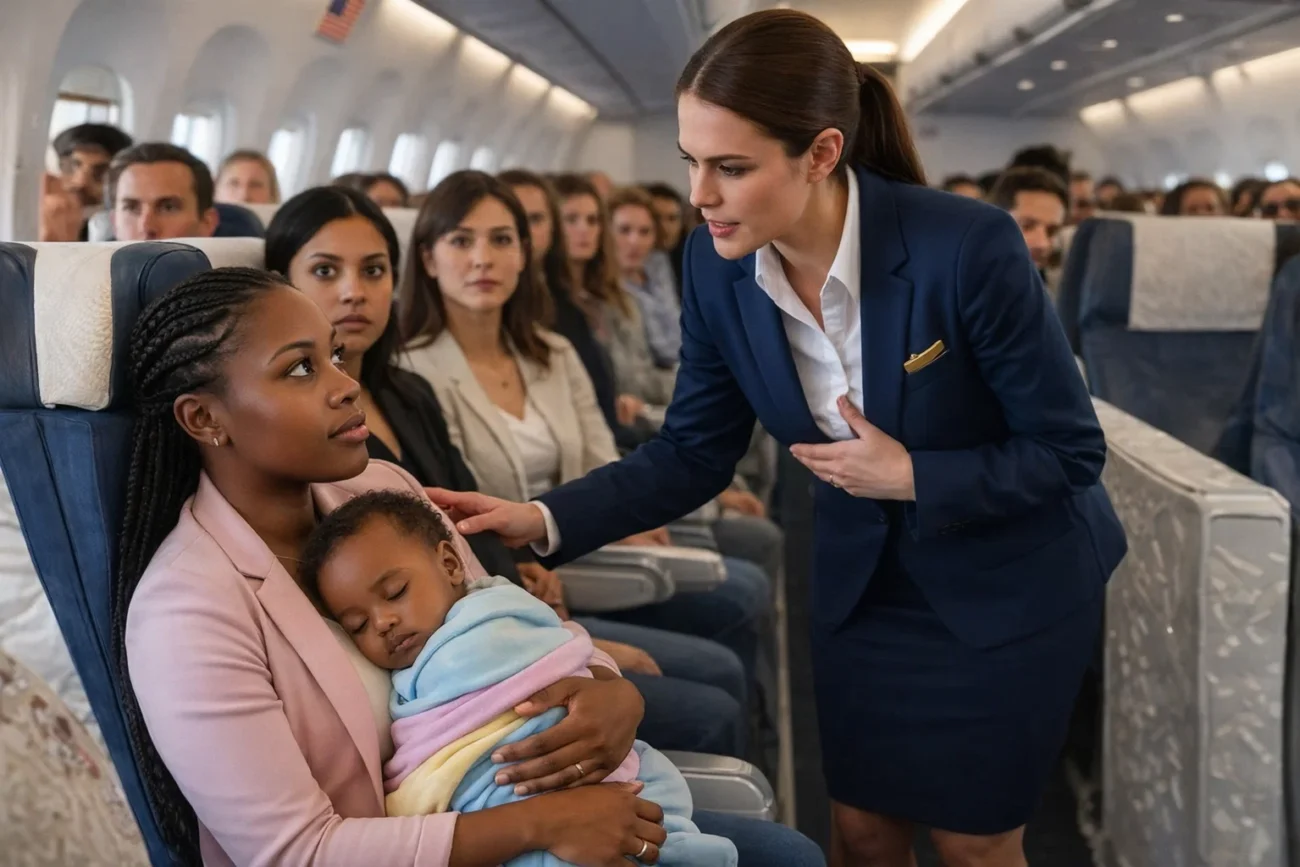
Later, passengers would say they sensed the strain before a word was spoken. A young mother sat quietly, gently rocking her baby in an effort to soothe her. When the child cried softly, a few passengers glanced over, but most simply smiled and returned to their screens.
Soon after, a flight attendant approached. She raised her voice and used harsh language, convinced that the mother was violating procedures or delaying departure. In her haste to assert control, she overlooked the most essential element of her role: compassion.
⸻
A Mother Who Remained Steady
The woman, identified as Kesha, remained composed. She had followed all instructions. Her boarding pass clearly assigned her to seat 2A in first class, where she was seated. Holding her baby, Zoe, she spoke gently, trying to calm her.
As the attendant’s tone grew sharper, more passengers began to take notice. Some nodded in agreement with the crew, believing they were simply enforcing policy. Others discreetly lifted their phones and began recording.
Kesha did not raise her voice. “I apologize if there was any delay,” she said calmly. “My baby hasn’t been feeling well. We’re just trying to settle before departure.”
Despite her polite explanation, the situation escalated. The attendant accused her of noncompliance and threatened removal from the aircraft. Murmurs spread through the cabin as passengers hesitated, uncertain whom to support.
Without responding further, Kesha reached into her bag to prepare formula for her child. Nearby passengers noticed a platinum-colored card beside her phone. When a call came in from the airline’s executive office, she did not answer.
The attendant noticed and frowned. “Please follow instructions, ma’am. We have procedures to maintain.”
⸻
When Assumptions Replace Verification
The captain entered the cabin to assess the disturbance. Trusting the account provided by his crew without further inquiry, he issued an ultimatum: comply immediately or be removed from the flight.
Kesha remained calm. “I understand,” she replied, “but you may want to verify my passenger status before proceeding.”
The attendant dismissed her comment. “We know what we’re doing.”
The captain signaled for security to board. Kesha looked down at her baby and smiled softly. “Almost time, sweetheart,” she whispered.
She then answered her phone and activated speaker mode. “Hi, honey,” she said quietly. “I’m having a problem with your airline.”
The cabin fell silent.
⸻
A Voice That Altered the Situation
The voice on the line was steady, authoritative, and unmistakably confident. It belonged to Marcus Thompson, the CEO of Skylink Airways.
“What flight is this?” he asked immediately.
“Flight 847, first class,” Kesha replied calmly.
Gasps rippled through the cabin. Several passengers lowered their phones as the reality of what they were recording became clear.
Marcus’s tone hardened. “Ms. Mitchell, Captain Williams, step away from my wife immediately.”
The captain froze. The attendant turned pale. The only sound was the soft breathing of the baby.
Phones continued recording as the livestream audience grew rapidly.
“I will handle this personally,” Marcus said evenly. “I want both of you removed from this aircraft right now.”
The captain attempted to explain. “Sir, we were following procedure—”
“Disrespect is never procedure,” Marcus interrupted firmly.
⸻
The Lesson Heard Around the Country
As the live feed continued, viewers watched as Kesha displayed her identification: an executive family pass bearing her name and title. The atmosphere was stunned and motionless.
The attendant spoke quietly. “I didn’t realize… she didn’t look—”
“Like someone who belongs here?” Kesha replied calmly, meeting her gaze.
No one responded. The moment required no further explanation.
Within minutes, Marcus appeared live via secure transmission, accompanied by corporate officials and federal investigators. His expression was composed, his words precise.
“My wife was a paying passenger on this flight and was treated without respect,” he said. “This is not about who she is. It is about how people are treated. Every passenger deserves fairness and dignity.”
The statement was broadcast immediately, dominating headlines nationwide.
⸻
A Company Confronts Itself
By the time the aircraft returned to the gate, the story had already spread globally. Skylink’s board convened an emergency session within hours. Marcus addressed employees worldwide, delivering a message that would permanently alter company culture.
“Our greatest failure today was not mechanical or environmental,” he said. “It was a failure of empathy. That ends now.”
Immediate changes were announced:
• A Family Care and Respect Policy prioritizing support for parents and caregivers
• A strict prohibition against verbal aggression or intimidation toward passengers
• The Thompson Standard, a comprehensive training initiative emphasizing professionalism, empathy, and accountability
What began as a public embarrassment evolved into a benchmark for responsibility across the aviation industry.
⸻
From Crisis to Industry Reform
In the weeks that followed, airlines nationwide adopted similar policies. Training manuals were rewritten. Pre-flight briefings echoed a consistent message:
“Verify. Assist. Respect.”
Captains were instructed to lead with courtesy, and flight attendants were trained to resolve conflicts through understanding rather than authority.
Though Kesha and Marcus avoided publicity, their experience resonated widely. Business publications, news outlets, and ethics panels began referencing the Thompson Standard as a model of modern leadership.
Government agencies responded as well. Within months, the Department of Transportation enacted new passenger protection regulations focused on fairness, verification, and respectful communication.
⸻
A Cultural Shift
Within Skylink, the transformation was tangible. Conversations about control gave way to discussions about care. “Passenger compliance” was replaced with “passenger understanding.”
A corporate observer later remarked, “That day taught me that humility is more powerful than authority.”
The attendant involved later sent Kesha a handwritten apology, admitting she recognized strength in Kesha’s composure and hoped to emulate it under pressure.
The college student who recorded the incident produced a short documentary titled Dignity in the Sky. It spread rapidly, praised for its honesty and call for change.
⸻
Six Months Later
Half a year passed. Skylink worked to rebuild trust, and public perception gradually improved. Customer reviews increasingly cited kindness and transparency.
One afternoon, Kesha boarded another Skylink flight. This time, she traveled anonymously, without revealing her status. Zoe, now older, laughed softly in her arms.
The crew greeted her warmly and assisted her without hesitation.
As the plane taxied, the seatbelt sign chimed gently. Kesha smiled at her daughter. “See?” she whispered. “Sometimes the sky remembers.”
⸻
A Lasting Message
What began as a report about Flight 847 became something far greater. Travelers shared its lesson across generations: respect costs nothing, yet means everything.
The Thompson Standard concludes every airline safety manual with a simple directive:
“Treat every person with respect. You may not know who they are, but you always know what is right.”
A confrontation became a movement—one rooted in kindness, fairness, and the courage to act with integrity, anywhere and at any time.