
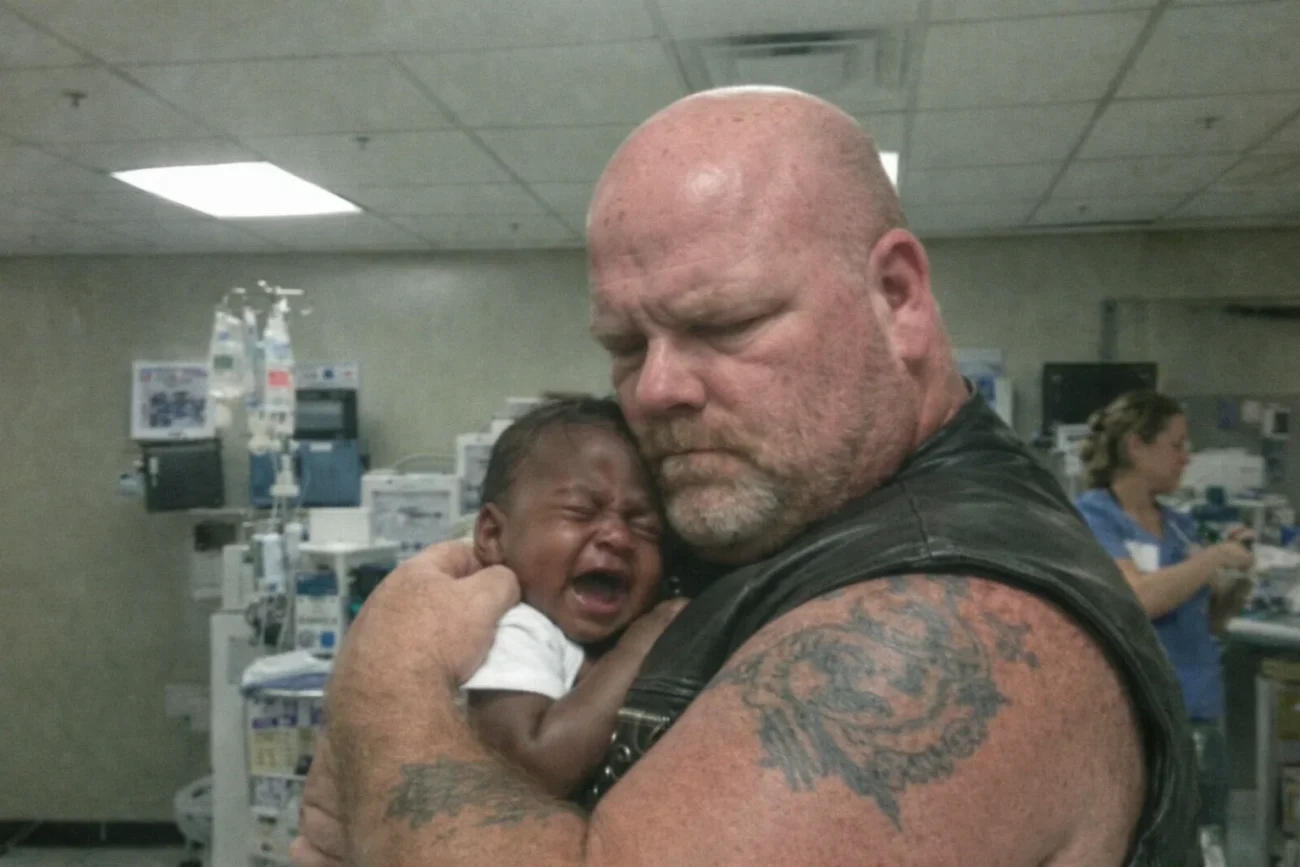
The fluorescent lights of the emergency room hummed with a sterile, cold tension that mirrored the panic in my chest. My three-month-old daughter, Emma, had been screaming for hours, her fever spiking to a dangerous 102 degrees while Sarah and I felt our world collapsing from sheer exhaustion. I was on the edge, my judgment clouded by three months of sleepless nights and the raw, piercing sound of colic that felt like it was drilling into my skull. When a large man in a weathered leather vest stepped into that crowded waiting room, his heavy boots echoing against the linoleum, I didn’t see a father; I saw a threat.
A Night of Raw Panic and Frozen Judgment
Sarah was shaking, her eyes red from holding back tears, as Emma’s cries drowned out the low murmur of the hospital. People were staring, their judgment felt in every sideways glance, making me feel like a failure as a father. When the man approached us, his presence large and imposing, I stepped in front of my family, my hands balled into fists, ready to call security. I was blinded by fear and every stereotype I’d ever absorbed about bikers. He stepped back calmly, his voice a low rumble that didn’t match the “dangerous” look I had projected onto him.
As Emma’s fever continued to spike and her screams hit a pitch that felt like a physical blow, the man, Jake, offered something we had lost: calmness. With Sarah’s desperate nod, I handed our child to a stranger. Jake held her against his broad chest and began a steady, low hum—a deep vibration that seemed to cut through her panic. Within minutes, for the first time in what felt like a lifetime, there was silence. Jake explained that babies are like sponges for tension; she wasn’t just crying because of the fever, she was reacting to the fear radiating off us.
The Truth Behind the Leather Vest
While we waited for the doctor, Jake revealed why he was there: his closest friend had been hit by a car and was in surgery. Even in his own moment of crisis, he saw two drowning parents and chose to reach out. By the time Emma was discharged with a simple virus and a dropping fever, Jake was gone, but the lesson he left stayed etched in my mind. We eventually tracked him down through a local group and found him at a warehouse, not looking for trouble, but wrapping toys for foster children with his club.
The “dangerous” bikers I feared turned out to be teachers, veterans, and social workers—people who defined strength by how much they could protect, not how much they could intimidate. Jake told me that my initial fear was understandable, but it was my choice to eventually trust him that mattered. Today, Emma is three years old and calls him “Uncle Jake,” growing up with a godfather who taught her father that a leather vest can carry more kindness than a thousand suits.