
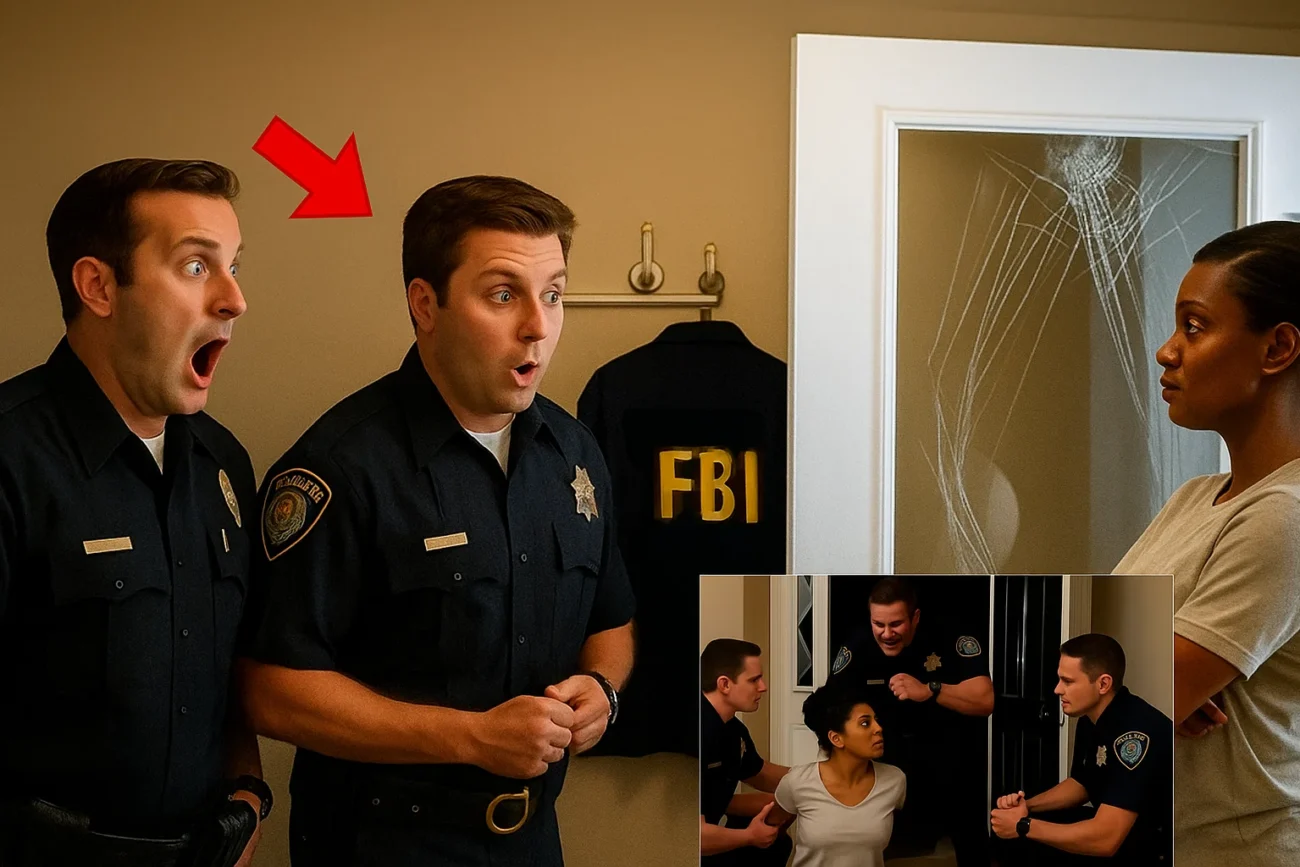
The entry began unexpectedly. At two in the morning, three officers arrived at a residence they believed to be connected to an investigation. When they entered the home, the setting was quiet except for the sound of their steps moving across the floor. Their flashlights illuminated the space in sharp beams as they evaluated each room with procedural precision.
The woman who lived there awoke abruptly, disoriented by the sudden lights. Wearing a tank top and shorts, she sat upright while the officers instructed her to keep her hands visible. As her eyes adjusted, she observed the scene calmly: furniture disturbed, drawers open, papers displaced. During their inspection, the lead detective’s light paused on an item hanging on the bedroom wall—a dark blue jacket bearing the unmistakable gold letters: FBI.
For several seconds, the room fell into a tense quiet as the officers exchanged subtle reactions. Despite the discovery, they proceeded with their search, believing they were acting according to the information they had received. To them, this was an ongoing operation. To her, it was the beginning of something she had anticipated.
Her response was measured. She watched them work, noting identifying details of each officer and quietly tracking the time. When one officer inspected her belongings, she memorized his actions. She displayed no signs of panic, only a deliberate calm that contrasted sharply with the charged atmosphere.
When the detective examined her purse, he appeared to uncover a bag containing a white powder. He announced the discovery, but the woman offered only a slight, knowing smile. Nearby, her federal credentials folder sat plainly in view, unnoticed. On her nightstand, her encrypted phone remained connected to its charger, containing many years of professional investigative material. Beneath her bed sheet rested something else they had overlooked.
The detective was unaware of her identity, but she understood clearly what was happening—and why. None of this, from her perspective, was random. It was the moment she had been prepared for.
Hidden in her bedroom lamp, a digital recorder had captured every step of the officers’ entry and every moment that followed. Each verbal exchange and each procedural misstep had been documented in real time.
The sergeant continued searching through her closet. His nervousness was visible. The woman, meanwhile, mentally reviewed procedures involving constitutional rights, search protocols, and case law. She understood precisely how far the officers had exceeded their authority.
Sitting upright, she spoke evenly. “I need to see your warrant.”
One officer replied that their entry stemmed from a noise complaint. She clarified that the extent of the search required legal authorization. Her tone was professional, her knowledge exact.
The captain then stated they had received reports of drug activity. She immediately requested the basis for the alleged probable cause. When they cited an anonymous tip, she explained calmly why such a tip did not justify a warrantless search.
Her references to constitutional rights, court precedents, and established legal rulings unsettled them. When she repeated that the search was unlawful, the officers questioned her background.
When she asked for badge numbers, she reminded them that any citizen can request identification during an official search. Reluctantly, the officers complied. She repeated each number slowly to commit them to memory and then confirmed that body cameras were recording—an essential part of documentation.
As the detective claimed they found drugs in her home and moved to arrest her, she spoke clearly toward the cameras:
“This arrest is based on planted evidence. I did not consent to this search.”
The officers instructed her to cooperate, and she complied physically while continuing to state her rights, including her request for legal counsel, supervisory review, and examination of body camera footage—all of which aligned with federal protocol.
On the way out of her home, she mentally cataloged each procedural violation, each departure from required practice, and each detail that would later support a broader case. When asked how she knew so much about police procedure, she did not answer. Her credentials folder still lay on her dresser, unexamined, but her silence was revealing.
At the patrol car, the officers exchanged uneasy glances. She exhibited none of the uncertainty they expected from a typical suspect. As they transported her to the station, she listened quietly, analyzing their conversations and behavior. They wondered aloud if she knew anything about an investigation—an implication she did not respond to.
Arriving at the station, they began the booking process. As her personal effects were handled, the booking sergeant discovered her federal identification—confirming she worked for a government agency. When her information was entered into the system, it triggered a federal alert identifying her as a law enforcement officer assigned to the Public Corruption Unit.
The discovery shifted the atmosphere entirely. Federal protocol required immediate attention. Calls were made. Procedures changed. Her identity was no longer in question.
Meanwhile, Officer Sarah Johnson, reviewing body camera footage, noticed discrepancies. She observed the moment of entry, the woman’s professional responses, and the sequence that led to the discovery of the alleged evidence. Johnson recognized signs of misconduct—the same concerns she had suspected quietly but never witnessed so clearly.
Running the woman’s name through the federal database confirmed everything:
Special Agent Diana Marshall.
A seasoned investigator.
The agent who had been assigned to evaluate corruption within the local department itself.
Johnson contacted the FBI, reporting that an undercover federal agent had been brought into custody under questionable circumstances. The agency responded with urgency, instructing her to preserve the footage.
Meanwhile, the detective pressed the suspect—now known to be Agent Marshall—during questioning. She asserted that the evidence had been planted and cited extensive legal knowledge that deepened the detective’s concerns. When she referenced Operation Clean House, a classified federal investigation into systematic corruption, he realized the extent of the situation.
Captain Wilson attempted damage control, but the investigation had already surpassed internal authority. Federal teams mobilized, warrants were approved, and the station’s communications and digital systems were placed under surveillance as evidence of ongoing misconduct emerged.
When federal agents arrived, they assumed control of the entire facility. One by one, officers were detained, systems were secured, and evidence was collected. Rodriguez, the federal director overseeing the operation, introduced Agent Marshall formally as the lead investigator.
For years, she had gathered evidence of wrongful arrests, improper searches, and systemic violations. Her documentation recorded dozens of instances involving planted evidence and unlawful procedures. The officers involved now faced federal charges.
Months later, in federal court, the resulting trial concluded with multiple guilty verdicts for violations of civil rights, evidence tampering, and other charges. Sentences ranged from several years to decades, depending on involvement.
After the case concluded, Agent Marshall addressed reporters. She affirmed that her work had required patience and precision and emphasized the importance of accountability within all institutions.
Officer Johnson, who had chosen to report the misconduct, later joined a federal task force—her cooperation having played a crucial role in confirming the investigation.
As Diana Marshall left the courthouse, her next assignment awaited. She accepted it without hesitation, recognizing that complex cases often required years of careful investigation. Her commitment to due process and constitutional protections defined her work.
Justice, she believed, progressed case by case—through discipline, consistency, and dedication to the truth.
Note: This text is a work of narrative fiction. All characters, events, and institutions are either entirely fictional or used in a fictionalized manner. Any resemblance to real persons, living or dead, or actual events is purely coincidental. This material is intended for storytelling and entertainment purposes only.