
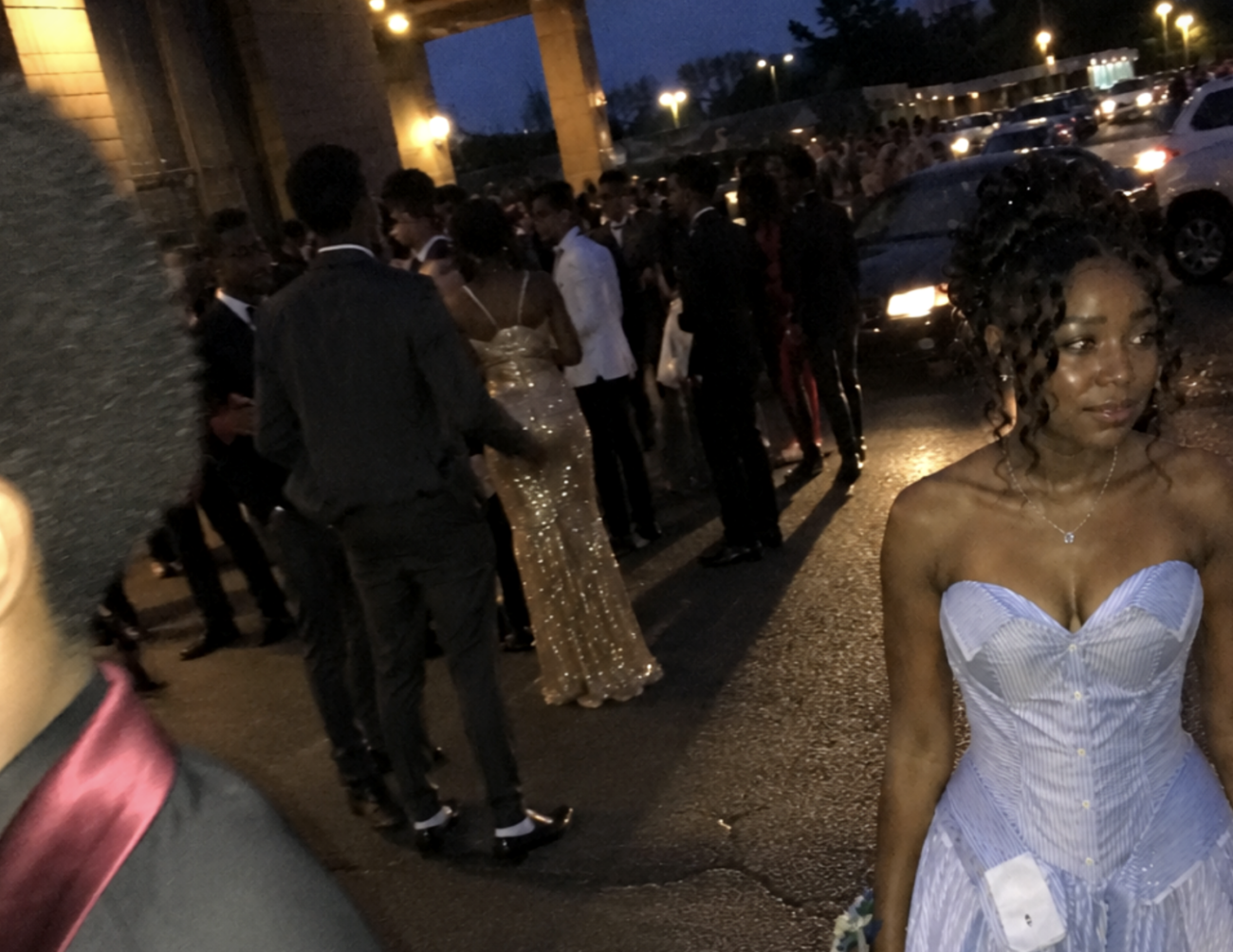
They Called It “The Janitor’s Dress” Until the Principal Took the Microphone
My father spent most of his life cleaning the hallways of the same school I attended. Students laughed at him for years, and because kids can be cruel, they laughed at me too. When he died from cancer just months before prom, I made my dress from his old work shirts so a part of him could still walk in beside me. People started laughing the moment I entered the ballroom. They stopped when our principal stood up and told the room who my father really was.
For as long as I can remember, it was just me and my dad.
My mother died the day I was born, so Dad raised me alone from the very beginning. He packed lunches before early shifts, burned pancakes almost every Sunday, and once spent an entire weekend learning how to braid hair from YouTube because he was tired of sending me to school with uneven ponytails.
His name was Frank.
At school, everyone knew him as the janitor.
And kids made sure I never forgot it.
“She’s the custodian’s daughter.”
“Her dad cleans our bathrooms.”
“You can smell bleach when she walks by.”
At first, I used to come home crying.
Dad always noticed, even when I tried to hide it.
He’d slide a plate of food in front of me at the kitchen table and say, “You know something about people who make themselves feel important by humiliating others?”
“What?” I’d ask quietly.
“They usually don’t have much else going for them.”
And somehow, hearing it from him always made the day feel smaller.
Dad believed honest work mattered. He believed dignity had nothing to do with job titles. As I got older, I started believing it too.
By sophomore year, I made a private promise to myself: one day, I would make him proud enough that none of those comments would matter anymore.
Then cancer entered our lives.
Dad kept working long after the doctors told him to slow down. Some afternoons, I’d find him leaning against a supply closet trying to catch his breath before finishing another hallway.
The second he noticed me looking worried, he’d straighten up and smile.
“Don’t look at me like that, kiddo. I’m tougher than I look.”
But he wasn’t.
And we both knew it.
One thing he repeated constantly during those last months was prom.
“I just want to see you all dressed up,” he’d say while sitting at the kitchen table after work. “I want to take embarrassing pictures and pretend I’m not crying.”
“You’ll be there,” I always told him.
I believed it every time I said it.
But a few months before prom, Dad lost his battle with cancer.
I found out while standing in the hallway between second and third period.
I remember staring at the freshly mopped floor and thinking how strange it was that the shine on the tiles looked exactly the way Dad liked them to look after waxing them.
Then everything after that became blurry.
The week after the funeral, I moved in with my aunt Linda. Her house smelled like lavender detergent and old books. Nothing there felt familiar.
Prom season arrived anyway.
Girls compared designer dresses in class and posted screenshots of gowns that cost more than my father earned in a month. Everyone talked about limousines, shoes, makeup appointments, and after-parties.
I felt disconnected from all of it.
Prom had never been about the dance for me.
It was supposed to be about Dad seeing me walk out the front door and pretending not to cry while taking too many pictures.
Without him, I didn’t even know if I wanted to go anymore.
A week later, I opened the cardboard box containing his belongings from the hospital.
His watch.
His wallet.
A cracked pair of reading glasses.
And beneath everything else, neatly folded the way he folded all his clothes, his work shirts.
Blue.
Gray.
Faded green.
I sat there holding one for a long time before the idea came to me suddenly and completely.
If Dad couldn’t come to prom with me, then maybe I could still carry part of him there.
When I told Aunt Linda what I wanted to do, she didn’t laugh once.
“I barely know how to sew,” I admitted.
“Good,” she said. “That means you’ll learn.”
That weekend, we spread Dad’s shirts across the kitchen table beside an old sewing kit and started working.
It was harder than I expected.
I ruined fabric more than once. I stitched sections backward. One night I had to pull apart nearly half the dress because I’d sewn an entire side unevenly.
Through all of it, my aunt stayed patient.
Some evenings, I cried quietly while sewing.
Other nights, I talked out loud to Dad like he was still sitting nearby listening to me ramble after school.
Every piece of fabric carried a memory.
The blue shirt from my first day of high school when Dad stood outside taking blurry photos because his hands shook from nerves.
The faded green one from the day he taught me to ride a bike and nearly injured himself running behind me.
The gray shirt he wore when he hugged me after the worst day of junior year without asking a single question.
By the time the dress was finished, it felt less like clothing and more like a scrapbook stitched together from pieces of my life with him.
The night before prom, I finally tried it on.
I stood in front of my aunt’s hallway mirror in complete silence.
It wasn’t glamorous.
It wasn’t designer.
But every color in the dress had once belonged to my father.
For the first time since the hospital called, I didn’t feel completely alone.
Aunt Linda stood in the doorway staring at me with tears in her eyes.
“Your dad would’ve lost his mind seeing this,” she whispered. “He would’ve been so proud of you.”
Prom night arrived faster than I expected.
The ballroom glowed with string lights and loud music while students crowded near the entrance taking photos.
The whispering started almost immediately after I walked in.
“Is that made from janitor uniforms?”
“She seriously wore that?”
A girl near the front laughed loudly enough for half the room to hear.
“That’s the custodian dress.”
Several people laughed with her.
The sound spread quickly.
For one terrible moment, I felt fourteen again, standing in a hallway while classmates mocked my father’s job.
My face burned.
I wanted to leave.
Instead, I forced myself to speak.
“I made this from my dad’s shirts,” I said. “He passed away a few months ago. This was my way of bringing him here with me.”
A few students looked uncomfortable.
Others rolled their eyes.
“Okay, but that’s still weird,” someone muttered.
I sat near the edge of the dance floor trying to breathe evenly while the humiliation crawled up my throat.
Then suddenly, the music stopped.
The DJ lowered his headphones and stepped aside.
Every head in the room turned toward the center of the ballroom where Principal Bennett stood holding a microphone.
“I need everyone’s attention for a moment,” he said.
The room slowly quieted.
He looked directly at me before continuing.
“For twelve years, Frank took care of this school.”
Nobody moved.
“He stayed late fixing lockers students accidentally broke because he didn’t want them getting charged for repairs. He quietly repaired backpacks and returned them before anyone noticed. More than once, he paid for student lunches out of his own pocket and never told anybody.”
The room had gone completely silent.
Principal Bennett continued speaking.
“A lot of people in this room benefited from Frank’s kindness without ever realizing it. Tonight, his daughter honored him in a way I think every person here should respect.”
Then he looked around the ballroom.
“If Frank ever helped you in some way while you attended this school, I’d like you to stand.”
For a second, nobody moved.
Then one teacher stood.
A football player near the back rose slowly to his feet.
Then another student stood.
And another.
Within moments, dozens of people across the ballroom were standing silently around me.
Teachers.
Students.
Parents.
Staff members.
People my father had quietly helped for years without wanting recognition.
The girl who mocked my dress stared down at the floor without speaking.
I stood there surrounded by people rising one after another because of the man everyone once reduced to “the janitor.”
And that was the moment I finally stopped trying not to cry.
Someone began clapping softly.
Then more people joined in.
The applause spread through the ballroom louder than the laughter ever had.
Principal Bennett handed me the microphone.
I only managed a few sentences.
“My dad spent his whole life making other people’s days easier,” I said through tears. “Everything good about me came from him. I just wanted him here tonight.”
That was all I could get out.
After the dance, my aunt drove me to the cemetery.
The grass was damp from evening rain, and the sky had started turning gold at the edges as the sun disappeared.
I knelt beside Dad’s headstone and rested my hand against the cool marble.
“I did it, Dad,” I whispered. “You still got to walk me in.”
And for the first time since losing him, I truly believed he had.
This story is a work of fiction created for storytelling and entertainment purposes.