
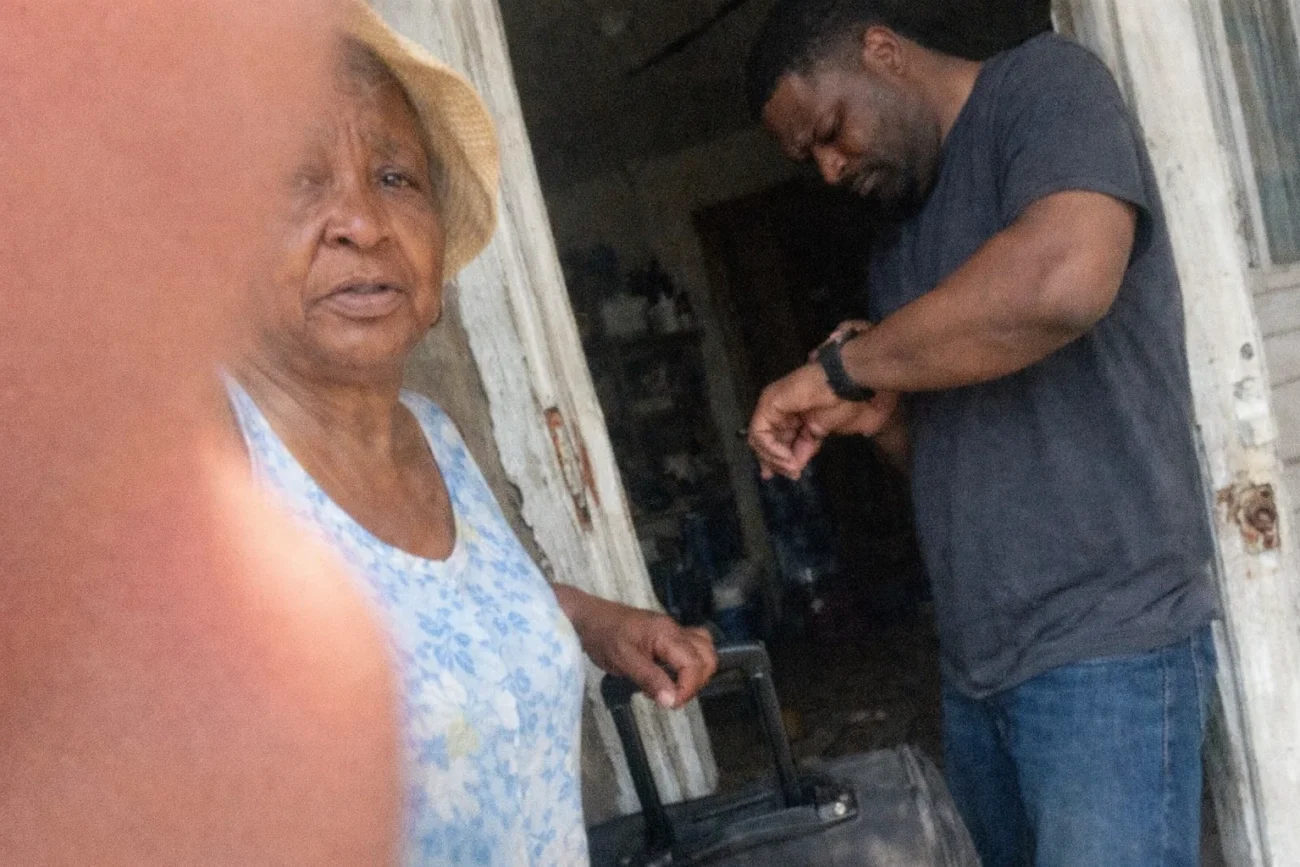
I flew across the country with a suitcase full of gifts and a blue dress I bought just for that day, thinking I was finally walking back into my son’s life—not as a voice on the phone, not as a “we’ll plan something soon,” but as someone who belonged in his home.
Fifteen minutes later, I was sitting alone in a cheap motel, realizing how easy it had been for him to leave me outside.
My name is Margaret. I’m a mother before anything else. And that day, I learned how quietly a place in someone’s life can disappear.
Nick had been saying it for years.
“Come anytime, Mom.”
“We’ll make it work.”
“The kids ask about you.”
Words that sound warm but never land anywhere.
But a month before, something shifted.
“Pick a weekend,” he said. “Seriously.”
So I did.
I booked the flight early. I called twice to confirm. I packed carefully—little things that matter. A stuffed rabbit for Emma. Puzzle books for the boys. Toy cars. I even bought that blue dress. Not fancy. Just… enough to look like I belonged in his world.
I wanted to walk in and not feel like a guest.
The Uber driver smiled at me.
“Big family visit?”
“I hope so,” I said.
Nick told me to come at four. I got there at 3:45. The ride was faster than expected.
I stood on the porch, smoothing my dress, checking my reflection in my phone. You do small things like that when you’re trying to feel steady.
Then the door opened.
He didn’t hug me.
He looked past me first. Toward the street.
“Mom… it’s 3:45.”
I laughed, thinking I missed the joke.
“I know. I got here early.”
No smile.
“Linda’s still setting up,” he said. “The house isn’t ready. Can you wait outside? Just fifteen minutes.”
Outside.
I could hear music. Kids running. Laughter. Life happening—just not including me.
“Nick, I just came from the airport.”
“I know. We just want it to be ready.”
That tone. Efficient. Polite. Distant.
“Please, Mom. Fifteen minutes.”
And then he closed the door.
Not slammed. Just… closed.
I stood there staring at it.
At first, I told myself it was nothing.
Five minutes.
Ten.
Fifteen.
No one came back.
I sat on my suitcase. My legs hurt. The music got louder. A child laughed inside—high and bright—and it cut through me in a way I didn’t expect.
And then it hit me.
I wasn’t early.
I wasn’t unexpected.
I just wasn’t important enough to interrupt whatever mattered more.
That realization is quiet. It doesn’t scream. It settles in your chest like weight.
I picked up my suitcase and walked away.
No one opened the door.
No one called after me.
At the corner, I called a cab.
“Where to?” the driver asked.
“Somewhere cheap,” I said.
The motel room smelled like old carpet and tired air. I sat on the bed in that blue dress, gifts still in the bag, and felt something inside me go still.
Not dramatic. Not loud.
Just… done.
I didn’t turn my phone on that night.
Not when I washed my face.
Not when I lay down fully dressed.
Not when I woke up at 3 a.m. with my heart racing for no reason I could name.
In the morning, I turned it on.
Twenty-seven missed calls.
Messages stacked on messages.
“Mom, where are you?”
“Please answer.”
“Mom…”
And then one:
“Mom, please answer. It was for you.”
That one landed.
I read the rest.
A banner. The kids hiding. A surprise. Emma saw me leave and started crying.
“I wasn’t sending you away,” he wrote. “I just wanted it to be perfect.”
Perfect.
I stared at that word longer than I should have.
Then the phone rang.
Nick.
I almost didn’t answer.
Almost.
But hope… it doesn’t die cleanly. It lingers where it shouldn’t.
I picked up.
Said nothing.
“Mom?”
His voice sounded smaller.
“I messed up,” he said. “I thought fifteen minutes wouldn’t matter.”
I pressed my fingers against my lips to stop whatever was rising.
In the background, a child asked, “Is Grandma coming back?”
That broke something open.
“She thinks we didn’t want her,” he said quietly.
“She’s right,” I answered.
Silence.
Then: “No. That’s what I did wrong. I treated you like something to manage.”
There it was. Finally said out loud.
“I didn’t come to be managed,” I said. “I came to be wanted.”
The truth doesn’t shout. It lands.
And you either step toward it… or away.
He didn’t argue.
“I know,” he said. “And I hate that I made you feel otherwise.”
Then a small voice came on the line.
“Grandma?”
I closed my eyes.
“Hi, sweetheart.”
“I made you a sign,” she said. “Are you still coming?”
Children don’t negotiate love. They just ask for it.
I took a breath that didn’t quite steady.
“Put your dad back on.”
When he came back, I didn’t soften it.
“I’m not coming back for one nice evening and then silence again. I want real effort. Real presence. Not ‘sometime soon.’”
“You’re right,” he said.
“And I’m never waiting outside that door again.”
“Never,” he said. And this time, it sounded like something he meant.
An hour later, there was a knock.
I opened the door.
He stood there, hair damp from rain, holding a piece of paper. Emma peeked from behind him.
He handed it to me.
A crayon drawing. A house. A huge sun. Three kids. Two adults.
And one woman in a blue dress in the middle.
At the top, crooked letters:
WELCOME GRANDMA
That undid me.
Not the words.
The effort.
The space I was given in that picture.
Emma wrapped her arms around me.
“You came back,” she whispered.
“I did.”
On the drive back, we didn’t fill the silence with excuses.
At a red light, he said, “I don’t expect this to be fixed today.”
“Good,” I said. “Because it isn’t.”
That was the first honest thing between us in years.
When we pulled up, the door opened before I reached it.
Linda stood there, eyes red, holding a handmade banner.
The kids behind her.
The banner read:
HOME IS FULL NOW
I stood there, looking at it, feeling something shift—not erased, not healed, but… acknowledged.
Inside, the house wasn’t perfect.
Streamers crooked. Tape showing. One flower falling off the wall.
Real.
Human.
Mine, maybe… again.
I cried. Not politely. Not quietly.
“I’m here now,” I said. “But you almost taught me not to come back.”
No one defended themselves.
That mattered.
Later, after cake and noise and too many pictures, when the house finally went quiet, Nick made tea.
“How much sugar?” he asked.
“Two.”
He winced. “I should know that.”
“Yes,” I said. “You should.”
He nodded.
“I can’t undo yesterday,” he said. “But I can show up differently.”
“Then do it,” I said. “Again and again.”
Because that’s the part people forget.
Love isn’t proven in big gestures.
It’s proven in repetition.
The next morning, Emma climbed into my lap.
“You stayed,” she said. “Does that mean pancakes?”
“It does,” I told her.
As I walked to the kitchen, I passed the front door.
I paused.
Nick noticed.
He walked over, opened it wide, and stepped aside.
No words. Just the gesture.
“Come in, Mom.”
This time… I did.