
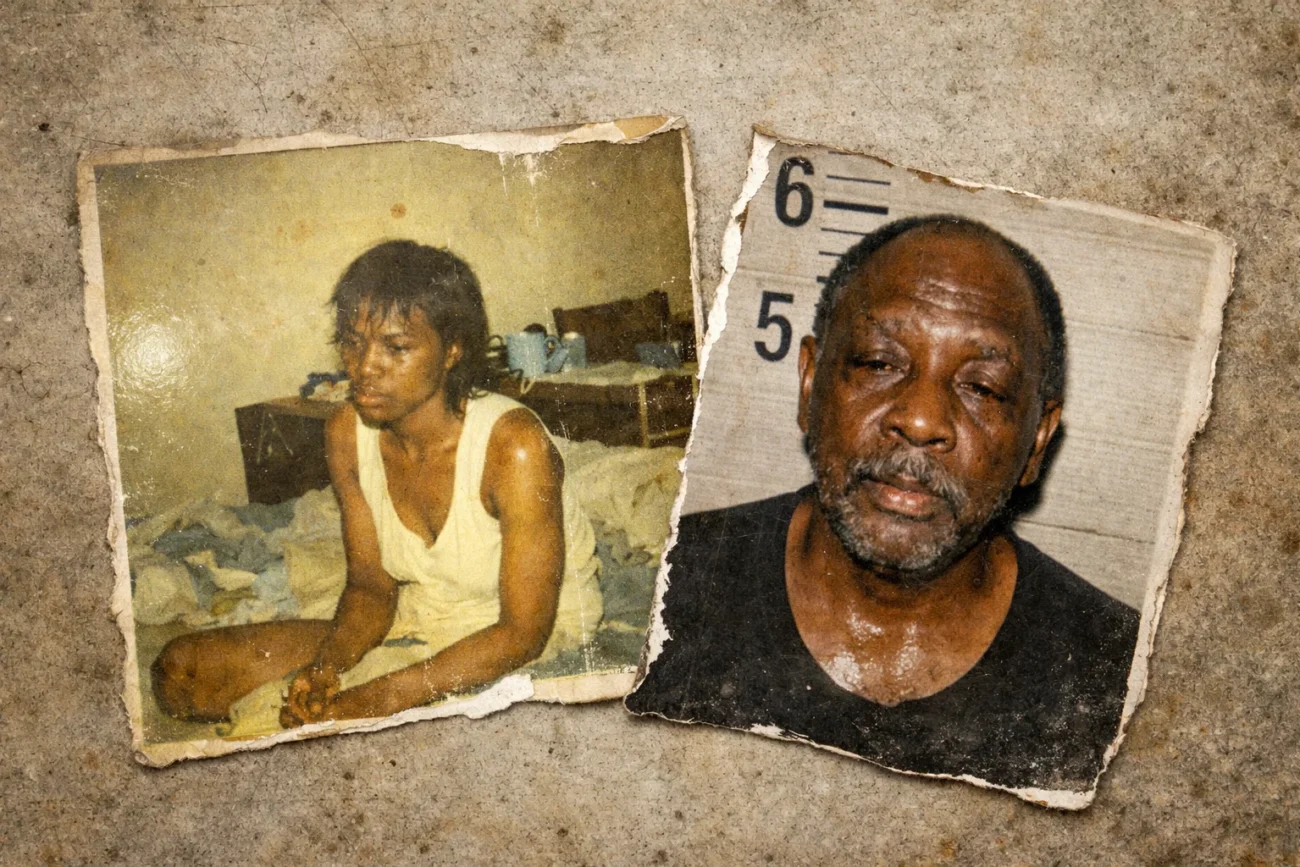
I was too young to remember my mother’s face the night she disappeared.
I was only a baby when someone left me on a doorstep in the middle of the night and walked away.
For most of my life, that mystery lived inside me like a second heartbeat.
I grew up with questions no one could answer.
What happened to my mother?
Why was I abandoned on a porch hours before sunrise?
And why did nobody ever seem able to prove what everyone quietly suspected?
For years, I held on to a small, stubborn hope that she had somehow survived. That one day she would come back, explain everything, and make the broken story of my life make sense.
She never did.
And when the truth finally came out, it was worse than anything I had imagined.
It started on a quiet November night in 1986.
Vanessa Hughes was twenty-two years old and trying to rebuild her life. She had recently moved into her own apartment in Charlotte, North Carolina. She had found steady work as a secretary. She had a young son. She was not living a glamorous life, but it was hers, and she was trying to hold it together.
Then she vanished.
When she failed to show up for work, concern turned into alarm. Police were called. Detectives went to her apartment expecting the usual signs of violence—forced entry, overturned furniture, blood, broken objects, anything that would explain why a young mother had disappeared without warning.
Instead, they found silence.
Her glasses were still on the nightstand.
Her clothes were hanging in the closet.
Cash was untouched.
Nothing in the apartment suggested a struggle. No blood. No damage. No frantic signs of a fight.
But not everything was there.
Her purse was missing. So were her identification documents. A paycheck for $160 that she had never cashed had vanished too.
And one detail stood out more than any other: the sheets and pillowcases had been removed from the bed.
It was the kind of scene that made no sense at first and only became more disturbing the longer people looked at it.
Then police learned what had happened across town that same night.
Vanessa’s seventeen-month-old son, Andre, had been left outside another house at around 2:30 in the morning.
Someone rang the bell and disappeared.
The woman inside, Cynthia Rollins, was frightened by the late-night knock and refused to answer the door. Hours later, when she finally stepped outside, she found a car seat on the porch.
Inside was a baby.
Cold, but alive.
That baby was me.
From that moment, detectives focused on the man at the center of Vanessa’s life: Derek Rollins, my biological father.
He and Vanessa had been fighting over child support. The dispute had become serious. Money was involved, pressure was rising, and the relationship between them had turned bitter.
Police believed he had motive.
But motive is not proof.
When they questioned Derek, he calmly told them he had spent the entire night at a bar called the Rusty Anchor, playing pool with friends.
Three men backed him up.
They said he never left.
With no body, no witnesses, no confession, and no physical evidence, the case slowly died in front of them.
Police searched everywhere. Parks. Empty lots. Water. Hospitals. Shelters. They watched bank activity. They checked whether Vanessa had used her identification, cashed her paycheck, or tried to start over somewhere else.
Nothing.
The paycheck was never deposited.
No trace of her appeared anywhere.
Eventually, the case slid into the cold archive where impossible cases go to wait.
Vanessa Hughes was declared legally dead.
And the truth remained buried for almost three decades.
Then, in 2014, something ordinary changed everything.
I was twenty-nine years old by then. I had grown up with the knowledge that my mother had disappeared and that nobody had ever solved it. Cynthia—the woman who found me on her porch and raised me—had eventually told me the truth about my past. She never hid from me that my mother had vanished or that my father had long been suspected.
But suspicion had never become justice.
One afternoon, while cleaning out Cynthia’s garage, I found an old leather bomber jacket that had belonged to Derek. It had been sitting in storage for years, forgotten like everything else people stop looking at after enough time passes.
I liked old clothes. I tried it on.
When I slipped my phone into the inner pocket, it disappeared into the lining.
That was strange enough to make me stop.
I felt around inside the jacket and found a tear in the seam. There was a hidden gap between the lining and the leather shell, a place where something could slip through and get trapped.
I cut the seam open carefully.
My phone dropped out.
Then something else fell with it.
An old plastic bag, yellowed with age.
Inside were two things that should never have been there.
My mother’s driver’s license.
And her uncashed paycheck from November 1986.
I just stared at them.
For a moment, I could not even think.
Those were the very items police believed my mother had taken with her when she supposedly disappeared on her own.
But she hadn’t taken them anywhere.
They had been hidden in my father’s jacket the whole time.
That was the moment everything changed.
I took the evidence straight to the police.
Within hours, the case reopened.
A homicide detective named Marcus Thorne began pulling the old file apart and rebuilding it from the ground up. The discovery in the jacket destroyed the theory that Vanessa had left voluntarily. If Derek had her license and paycheck, then the story he had lived behind for decades was cracking wide open.
But the items alone were not enough.
They proved he had handled things that should have been with Vanessa. They did not yet prove murder.
So Thorne went back to the beginning.
He reexamined Derek’s alibi.
He tracked down the old friends who had vouched for him in 1986.
Time had done what police pressure once couldn’t.
One of those men finally admitted the truth.
Derek had not been at the bar all night.
He had arrived around ten, stayed for a while, then left around 11:30 p.m. He did not come back until about three in the morning. When he returned, he was sweating, tense, and desperate. He asked his friends to lie for him if anyone came asking questions. He told them he had been with a married woman and didn’t want trouble.
They believed they were covering for an affair.
In reality, they had covered for something far worse.
That gave investigators a time window.
Three and a half hours.
Enough time to go to Vanessa’s apartment, kill her, remove her body, dispose of evidence, and return before dawn.
Thorne kept digging.
In 1986, Derek had worked nights at Carolina Waste, a facility with industrial equipment, including a high-temperature incinerator capable of destroying almost anything. Archived logs showed that on the very night Vanessa disappeared, Derek had signed out keys to the incinerator shortly after midnight, claiming he needed to inspect the exhaust system.
A few days later, maintenance workers had recorded a jam in the machinery.
What caused it?
Dense cotton fabric.
The description matched bed linens.
The same bed linens missing from Vanessa’s apartment.
Piece by piece, the shape of the truth emerged.
Police brought Cynthia in again. This time, they had enough to confront her with. Faced with the evidence, and after years of carrying her own fear, she finally told them what she had buried inside herself for decades.
On the morning after Vanessa disappeared, Derek had called her from a pay phone.
He told her to bring the baby inside from the porch.
He told her not to ask questions.
And then he said something she never forgot:
He had solved the support problem permanently.
Vanessa would never bother them again.
That statement changed the case from suspicion into something much darker and much more complete.
Investigators reconstructed the likely sequence.
Derek went to the bar first to create witnesses.
He left late at night and drove to Vanessa’s apartment.
He had a duplicate key.
She was probably asleep.
He killed her quickly, before she could fully wake or fight back.
He stripped the bed, wrapped her body in the bedding, and carried both her body and my car seat out to his truck. He took her purse, her documents, and the paycheck to help stage the scene as though she had left on her own. At some point, the license and paycheck slipped into the torn jacket lining without him realizing it.
Then he drove to the waste facility.
He signed out the incinerator keys.
He destroyed her body there.
The bedding partially jammed the machinery, which is why the maintenance report later mentioned cotton fabric.
And after that, he drove me to Cynthia’s house, left me on the porch, rang the bell, and vanished back into the night.
By the time he returned to the bar, he had erased the body, planted the lie, and walked back into the room where his friends unknowingly sealed his alibi.
It was monstrous.
But it was methodical.
That was what made it even harder to absorb.
When police arrested Derek in 2014, he showed almost no emotion.
At trial, the prosecution built its case around the small things that had survived him: the license, the paycheck, the witnesses, the work logs, the maintenance records, Cynthia’s statement, the legal records showing the child support pressure he had been under.
There was still no body.
The defense leaned heavily on that.
But by then, the case no longer depended on one dramatic piece of evidence. It rested on a chain of facts that all pointed in the same direction.
He had motive.
He had time.
He had access.
He had lied.
And he had possessed the missing items from the woman who never came home.
The jury found him guilty of first-degree murder.
He was sentenced to life in prison without parole.
I sat in that courtroom and listened to the sentence being read to the man whose blood I carried in my body.
There is no easy word for what I felt.
Relief, maybe.
Grief, certainly.
Anger.
Emptiness.
A strange kind of silence inside myself.
I had spent my whole life wondering whether my mother had left me or whether something terrible had happened to her.
Now I knew.
She had not abandoned me.
She had been taken from me.
And the truth had been sitting unnoticed in an old jacket for nearly thirty years.
That part still haunts me.
Not just that he killed her.
But that justice was trapped for decades inside something as ordinary as clothing.
A torn seam.
A hidden pocket.
A forgotten box in a garage.
That was all it took to keep the truth buried.
And all it took to bring it back.
In the end, my mother did not come back to tell me what happened.
But she did leave something behind.
Not by choice.
Not as a message.
But enough.
Enough for the lie to collapse.
Enough for the silence to end.
Enough for her son to finally know.
And after twenty-eight years, that had to be enough.
This story is based on real-life situations and has been adapted for storytelling. Names and certain details have been changed.