
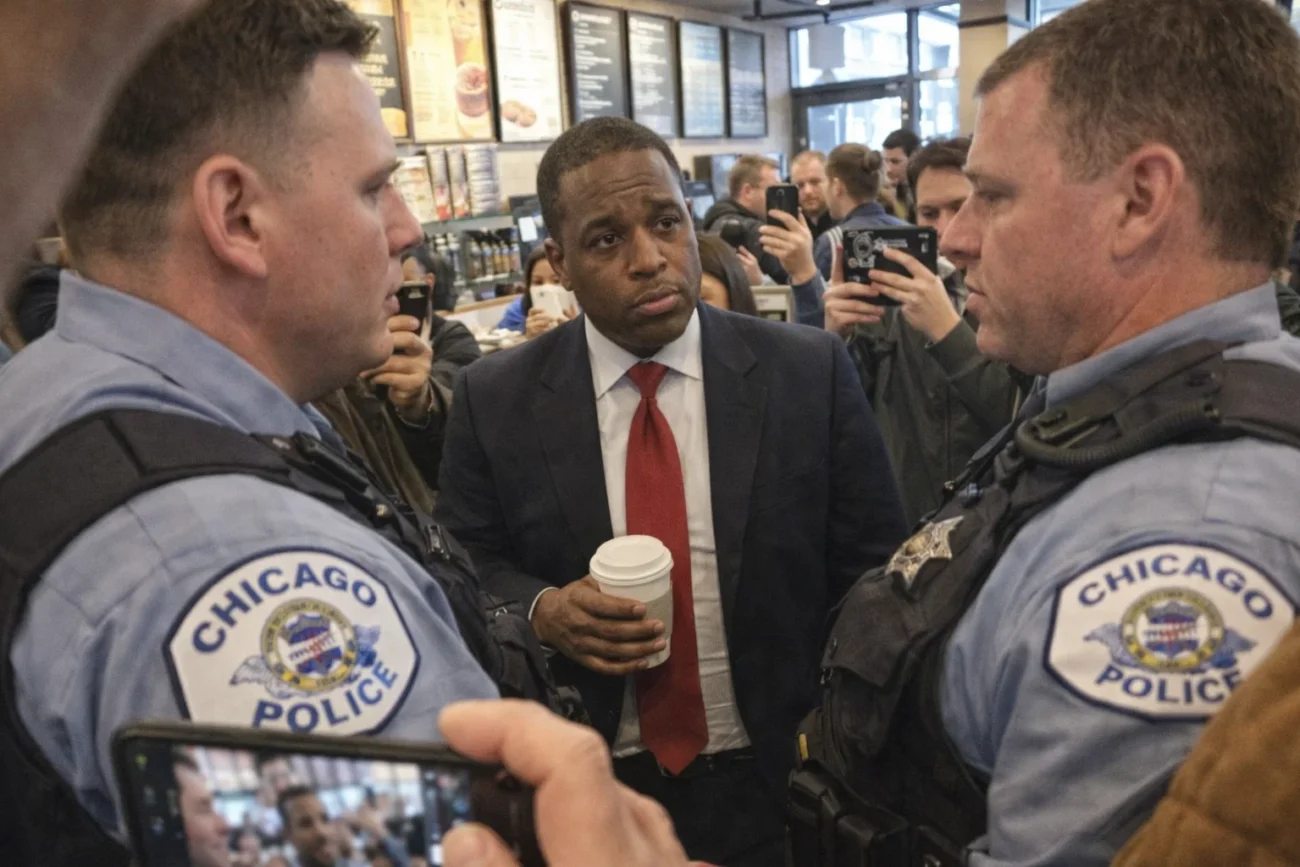
On an ordinary Wednesday morning in October, the line at Martin’s Coffee House in downtown Chicago looked exactly the way it did every weekday.
People stood shoulder to shoulder, waiting for caffeine before work. A few checked emails on their phones. Someone fumbled with a credit card at the register while another customer balanced a laptop bag and a paper cup.
Frank Sinatra played softly through the speakers overhead. The glass door near the entrance carried a small American flag magnet beside the shop’s opening hours, its corner peeling slightly.
It was the kind of routine morning that disappears into memory almost immediately.
Then two Chicago police officers walked in.
And within minutes, the normal rhythm of the room collapsed into something no one there expected.
Security footage later reviewed by investigators shows the moment clearly. Near the front of the line stood a man in his mid-50s wearing a dark overcoat over a suit. He had been in line for several minutes, quietly scanning the menu board like someone deciding between options he had probably ordered many times before.
He wasn’t speaking to anyone.
He wasn’t pacing or acting unusually.
He was simply waiting to buy coffee.
The officers passed several other customers and approached him directly.
One of them asked for identification.
Witnesses later said the man appeared confused but calm. He asked why he had been singled out when no one else in the shop had been questioned.
The officer repeated the request.
The man asked whether he was being detained or suspected of committing a crime.
What followed unfolded quickly.
The officers told him he was obstructing an investigation. When he continued asking what the basis for the stop was, the situation escalated. Customers watched as voices rose and tension spread across the room.
Phones appeared in several hands.
Within minutes, the man who had entered the shop simply to buy coffee was placed in handcuffs.
Only later did the officers realize who they had detained.
The man standing quietly in line that morning was Marcus Thompson, a United States District Judge for the Northern District of Illinois.
For fifteen years, Thompson had served on the federal bench, presiding over thousands of cases in one of the most influential trial courts in the country. His written opinions had been cited by appellate courts numerous times, particularly in matters involving constitutional protections and criminal procedure.
On the bench, Thompson was known for his precise explanations of the Fourth Amendment — the constitutional provision governing searches, seizures, and police stops.
Inside Martin’s Coffee House that morning, however, the legal principles he had spent a career interpreting became intensely personal.
Marcus Thompson grew up on Chicago’s West Side, the son of a mechanic and a nurse who insisted education was the only reliable path forward. After earning a full scholarship to Northwestern University, he went on to Harvard Law School, where he served on the Law Review.
His early career included eight years as a federal prosecutor, where he built a reputation for meticulous preparation and a strong trial record. Later he joined a major law firm before being appointed to the state circuit court bench.
At forty-one, he received a federal judicial appointment — a lifetime position that placed him among the most powerful legal decision-makers in the American system.
Over the years he presided over cases involving organized crime, political corruption, and complex constitutional challenges. He had sentenced violent offenders to life in prison and written detailed opinions on due process, equal protection, and the limits of police authority.
Yet none of that authority followed him into a coffee shop.
Video from the incident spread quickly online once witnesses began sharing recordings from their phones. Civil rights attorneys soon filed suit against the City of Chicago and the police department, arguing that the stop lacked any lawful basis.
The central legal question was straightforward: what reasonable suspicion justified the officers demanding identification from Thompson in the first place?
Security footage showed him doing nothing unusual before officers approached him.
He had simply been waiting in line.
During litigation, attorneys argued that the arrest demonstrated a broader misunderstanding among officers about the legal standard required to detain someone or demand identification.
The case eventually ended in a settlement.
The City of Chicago agreed to pay $7.5 million to resolve the lawsuit.
But the financial cost was only part of the outcome.
As part of the settlement agreement, the city committed to significant changes in police training. Departments across Illinois began reviewing procedures related to investigative stops, identification requests, and the definition of “obstruction” during police encounters.
Training materials were updated to emphasize the constitutional limits governing police authority in public spaces.
In the years since, the incident has been used in legal seminars and police training programs as a case study illustrating how quickly routine interactions can escalate when the boundaries of reasonable suspicion are misunderstood.
For many observers, the most striking aspect of the case was its irony.
A federal judge who had spent decades interpreting the Constitution suddenly found himself subject to the very questions his courtroom had often addressed.
For eleven minutes inside a Chicago coffee shop, Marcus Thompson stood on the other side of the legal system he had helped shape.
And those eleven minutes forced a city — and its police department — to reconsider how the law is applied in the most ordinary places.
Even places as simple as a morning coffee line.
Note: This article is presented as a narrative reconstruction for storytelling purposes. Certain details may be dramatized.