
I married Thomas when I was nineteen.
Back then we had almost nothing — a small apartment, a few pieces of second-hand furniture, and dreams that were much bigger than our bank account. But we were steady. No drama, no big gestures. Just two young people slowly building a life together.
Year after year we added the usual milestones: a better house, savings for retirement, quiet routines that made life feel safe.
I used to think I had an honest marriage.
Thirty-nine years later, I stood in the rain and watched them lower Thomas into the ground.
“A heart attack,” the doctors said. Quick.
“At least he didn’t suffer,” people whispered at the funeral.
I nodded politely, the way you do when people try to comfort you with words that don’t really help.
Grief after four decades of marriage isn’t loud. It’s quiet. It sits across from you at the kitchen table and reminds you that the chair on the other side will never be filled again.
Thomas wasn’t a man of secrets.
At least, that’s what I believed.
There was only one strange thing in our entire marriage.
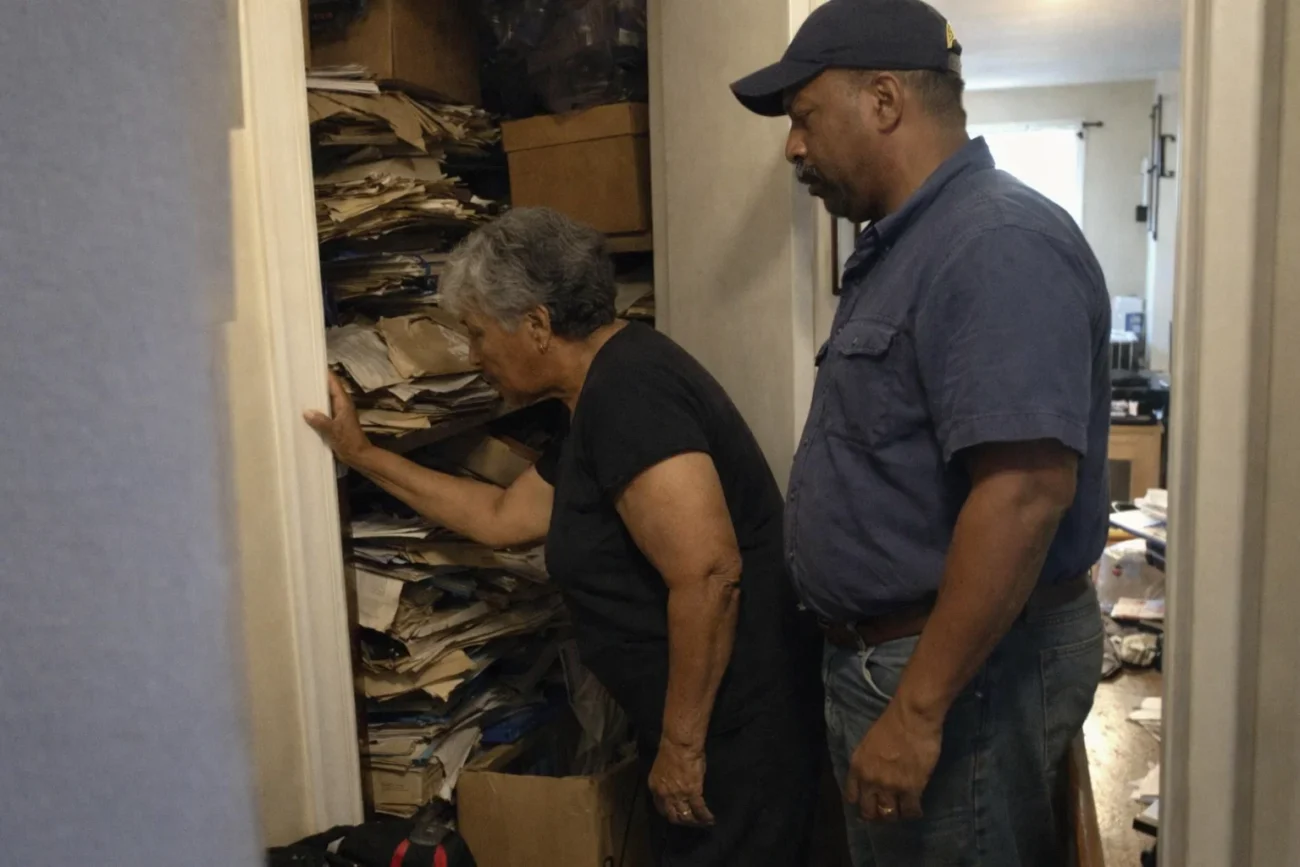
A closet at the end of the hallway.
Locked.
Always.
In nearly forty years I had never seen what was inside.
Whenever I asked about it, Thomas would smile gently and say, “Just old paperwork, Margaret. Nothing interesting.”
And I believed him.
After that many years of marriage, you stop questioning small mysteries. Trust becomes a habit.
But once Thomas was gone, that locked door began to feel heavier every time I walked past it.
After the funeral I sorted through his clothes, folded his shirts, and packed away things that still smelled faintly like him.
And every time I crossed the hallway, my eyes landed on that door.
At first I told myself it would be wrong to open it. Whatever was inside had belonged to him.
But curiosity has a way of growing when grief leaves too much quiet in a house.
On the tenth day after the funeral, I called a locksmith.
When the young man arrived, I stood at the end of the hallway with my hands clasped together while he worked on the lock.
The metallic click echoed down the hall.
The door slowly creaked open.
Inside were shelves stacked with dusty boxes and folders. Nothing dramatic. Just years of paper and forgotten things.
Except for one object sitting on the top shelf.
A small metal strongbox.
“Want me to open that too?” the locksmith asked.
I nodded.
While he worked on the lock, I pulled one of the cardboard boxes toward me. Inside were bundles of old letters tied together with twine.
I opened the first one.
Tom, the check came yesterday. Thank you. I didn’t know how I was going to cover the cleats and league fees this month. He still thinks the money comes from an old friend of his father’s.
My hands grew cold.
I opened another letter.
Tom, we need to talk about how long we’re going to keep the truth from him. He’s getting older. He deserves to know who you really are to him.
For a moment I couldn’t breathe.
Thirty-nine years of marriage… and suddenly it looked like my husband had been secretly supporting another child.
“I was nineteen when I married you,” I whispered to the empty hallway. “When did you even find the time?”
I kept reading.
Then one envelope caught my attention.
The return address was from a state correctional facility.
I tore it open.
Tommy, you shouldn’t be writing to me. Mom and Dad changed your name and moved you away for a reason. They wanted to protect you from what I did.
I blinked.
Tommy…?
Thomas had always told me he was an only child.
I grabbed another letter.
I’m glad you reached out. It gives me a chance to say I’m sorry. If I could go back, I would have been a better big brother to you.
Big brother.
The pieces slowly began to fall into place.
Another letter explained the rest.
The man writing from prison — Steve — was Thomas’s older brother.
Years earlier he had caused a terrible car accident that killed another driver. After the trial, the family changed their last name and moved away, trying to escape the scandal.
Thomas had grown up carrying that secret.
Steve later had a child — a boy named Daniel — and from prison he begged Thomas to help the child have a better life than he had.
So Thomas did.
Quietly.
For decades he sent money, paid school fees, and supported his nephew… without ever telling anyone.
Not even me.
A loud metallic snap pulled me out of my thoughts.
The locksmith had opened the strongbox.
Inside were old newspaper clippings, a worn baseball glove, and a few scuffed baseballs.
One clipping showed a young man in a baseball uniform, smiling at the camera.
“Hey,” the locksmith said, looking closer. “My dad used to talk about this guy. Said he had the best arm in the county until that accident happened. After the trial the whole family disappeared.”
I stared at the photo.
The boy standing beside the pitcher — the little kid with the proud smile — was Thomas.
After the locksmith left, I sat on the hallway floor for hours reading every letter.
My husband hadn’t been hiding another life.
He had been protecting his family.
The next two days I kept thinking about the letters — especially the ones from the woman named Marilyn.
Finally I copied the address from one of the envelopes and drove there.
It was a small house with a basketball hoop over the garage.
A man in his thirties opened the door.
He had Thomas’s eyes.
“Can I help you?” he asked.
“My name is Margaret,” I said carefully. “I was married to Thomas.”
The man froze.
“My Uncle Tom?”
“You knew about him?”
He nodded slowly.
“Mom told me the truth when I turned eighteen. She said he didn’t want recognition. He just wanted to make sure I had opportunities.”
I handed him the box with the glove, the baseballs, and the newspaper clippings.
“These belonged to your father,” I said softly. “Thomas kept them all these years because he never wanted your dad to be forgotten.”
The man ran his fingers over the worn leather glove.
“Thank you,” he whispered.
When I returned home that evening, the hallway felt different.
The closet door was still open.
For nearly four decades I had walked past it without asking questions, believing that trust meant leaving certain doors closed.
Now I understood something else.
Sometimes people keep secrets not out of betrayal — but out of loyalty.
Thomas had carried the weight of his family’s past alone because he believed it was his responsibility.
I wish he had trusted me enough to share that burden while he was alive.
But at least now the truth was no longer hidden behind a locked door.
And neither was the family he quietly protected for all those years.
Note: This story is a fictional narrative created for storytelling purposes.